
Community Colleges - Hidden Gems of US Education
 Talk to Expert
Interested in learning everything about community colleges in the USA? Here is a set of questions and answers by the Dean of International Education—Colleges of Contra Costa, which will shed light on the whys and hows of a community college. So check it out now!

While millions thrive on studying in the USA, admission to community colleges is still under a shadow. Those interested in knowing everything about community colleges in the USA can read these questions and answers and understand how community colleges are an equally good option for studying.
Questions Pertaining to Community Colleges in USA
Here are some of the key questions and answers given by Dr. Hales, the Dean of International Education for the Colleges of Contra Costa. These questions will help Indian students consider undergraduate admissions to US universities and start their education at a community college in the USA.
Q1. How do you define a U.S. Community College?
Ans. A U.S. Community College is a type of higher education institution known for being accessible, affordable and high in quality. These colleges offer 2-year programs that often mirror the first two years of a 4-years university, which means the curriculum at community colleges is the same as the vast majority of 4-year colleges and universities; making them an excellent stepping stone in higher education.
As Jill Biden once said:
“One of the things that make community colleges so special is that they do not pick and choose their students - they work with all students.”
Q2. What kind of students are best fit for a community college?
Ans. Community colleges are a great fit for a wide range of students, especially those who:
- Plan to transfer to a university: Many students start at a community college to complete general education courses before transferring to a 4-year university for a bachelor’s degree.
- Want an affordable education: Tuition is much lower than at universities, making it a smart choice for students looking to save money.
- Are unsure about their career path: Students who aren’t sure what they want to study can explore different subjects without committing to a full 4-year program right away.
- Didn’t make it to the university: Students who for any reason didn’t get admission at a university or struggled at high school, this could be their second chance at higher education.
- Want hands-on job training: Student can focus on practical skills in field like healthcare, IT, business and skilled trades. They also get an option to work On-campus as well as Off campus through internship & OPT (post completion of associate degree)
Q3. What is the main difference between going to a community college versus a 4-year institution?
Ans. The main difference between attending a community college and a 4-year institution are as follows:
- Degree length & Purpose:
Community colleges typically offer two main pathways:
- Academic Track (for students planning to transfer to a 4-year university)
- Vocational Track (for those entering the workforce directly with practical skills)
At many community colleges—including CCCC—all students are currently following the academic path with the goal of eventually earning a bachelor’s degree.
Importantly, students don’t need to complete a degree at the community college to transfer. After finishing general education courses (usually within 2 years), they can move on to a university to complete the remaining major-specific coursework.
4-year University: Offers bachelor's degrees (which takes 4 years) and often includes specialized courses, research opportunities and extracurricular activities.
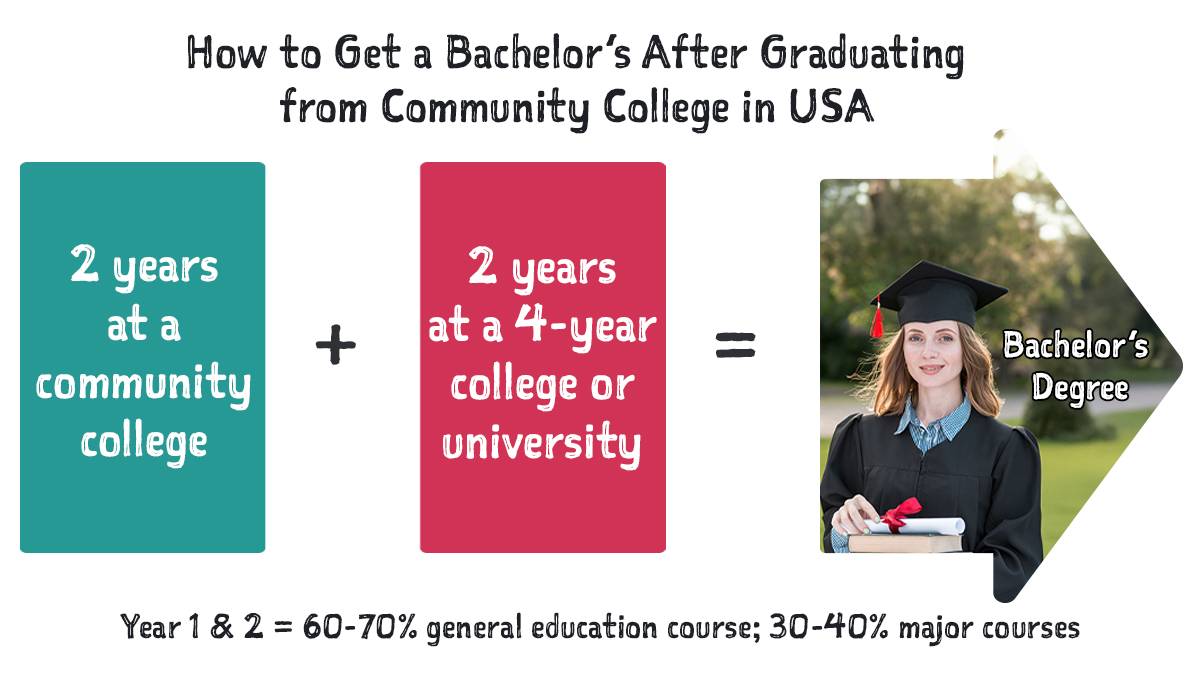
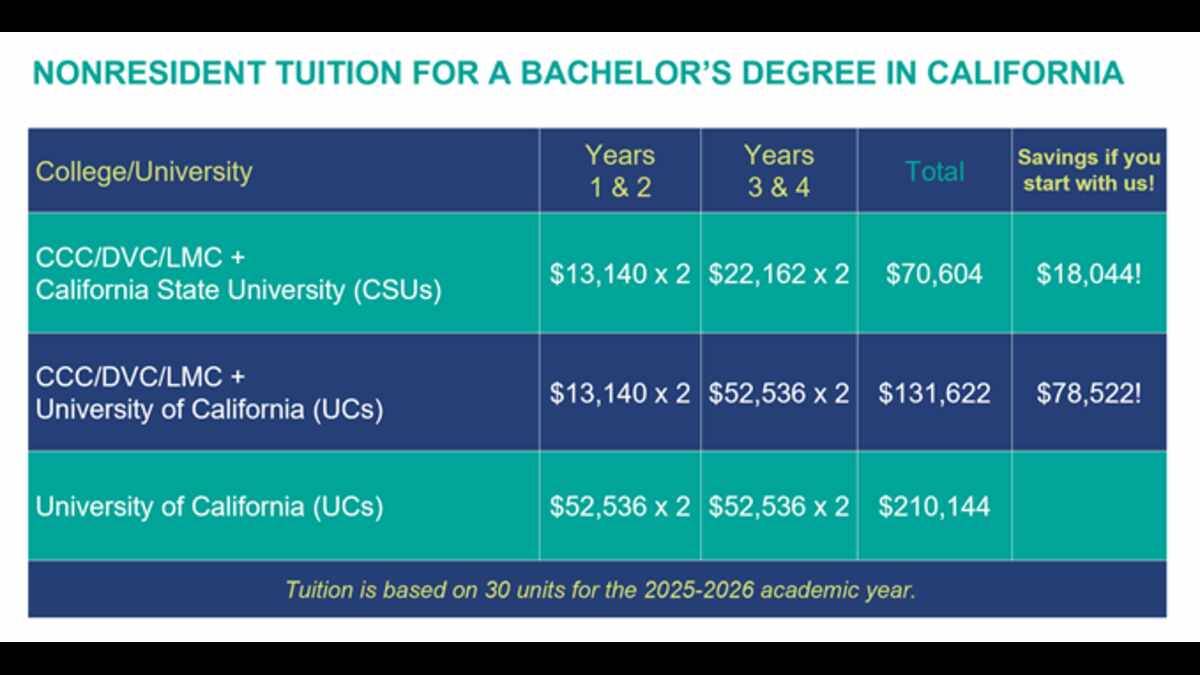
- Cost Comparison: Community college is significantly more affordable—especially for non-residents—compared to 4-year universities.
For example, non-resident tuition at California community colleges is much lower than at institutions like California State University (CSU) or the University of California (UC) system.
4-Year Universities
These institutions award bachelor’s degrees over four years and often provide:
- In-depth specialized coursework
- Research opportunities
- A wide range of extracurriculars
- Admissions & Flexibility:
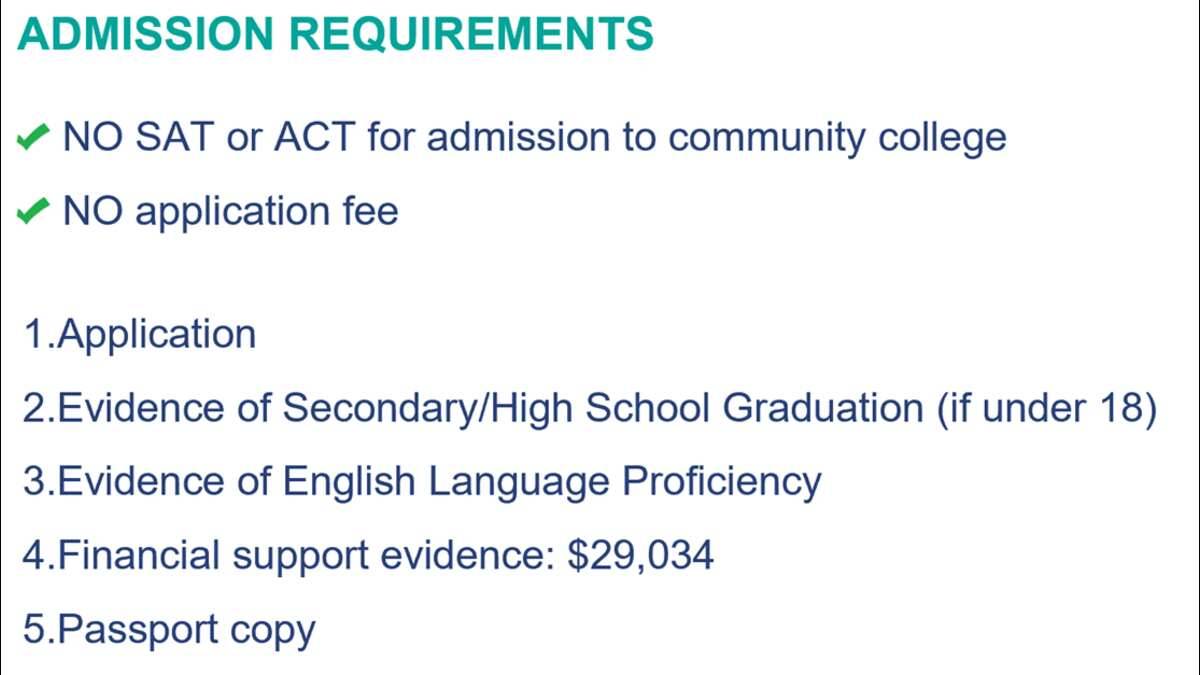
Community College: Anyone with a high school diploma or GED can enroll. More flexible class schedules including online classes.
University: More selective admissions, requiring good grades, test scores, SOP/Essays & LOR. Fixed class schedules, usually during the day.
- Campus Life: Typically, there are no dorms; homestay and apartment options are available. Below is an example of a house close to Diablo Valley College in Pleasant Hill, which costs $1000-1500/month and can be shared by two students. The universities in USA offers a more traditional experience with dorms and campus activities.
- Class Size & Teaching Style:
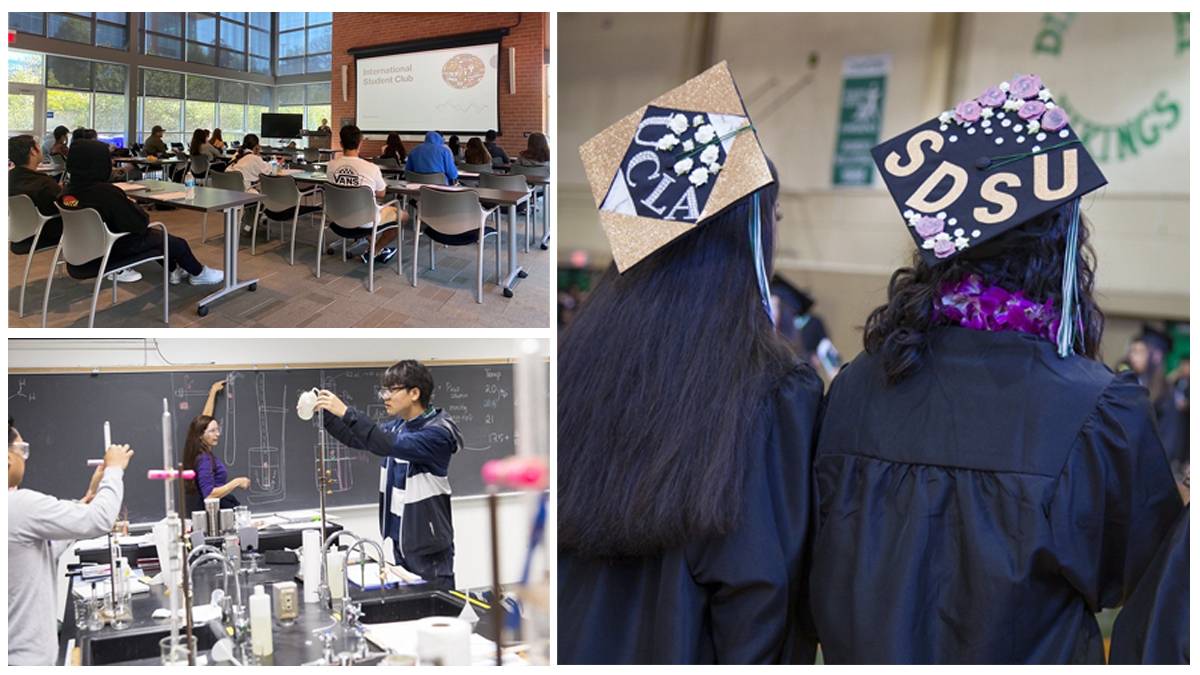
Community College: Community colleges typically offer smaller class sizes, which allows for more personalized attention from instructors. For instance, at the Colleges of Contra Costa, most classes range from 24 to 30 students. This creates a supportive environment where students can easily interact with their professors and peers.
University: In contrast, universities—especially in the first two years—often have large lecture halls, particularly for general education courses. It’s not uncommon for some classes to have over 100 students, making it harder to get individualized attention unless students actively seek it.
Visual Comparison:
- A community college classroom shows a more intimate setting, promoting direct interaction.
- A university lecture hall emphasizes scale, with lectures delivered to a large audience.
Q4. What support services does community college offer to international students?
The following support services are available to international students attending community colleges in USA:
- Academic Support
- Tutoring Centers – Free help with subjects like math, writing, and science.
- Library & Research Assistance – Access to books, databases, and librarians for research support.
- Academic Advising – Guidance on choosing courses, picking a major, and planning for university transfer.
- Career & Job Services
- Career Counseling – Help with exploring career options and job pathways.
- Resume & Interview Workshops – Training for job applications and interview preparation.
- Internships & Job Placement – Connections with local employers for internships and full-time jobs.
Check out:
- Financial Assistance
- Scholarships & Grants – Help finding and applying for financial aid. Check out Scholarships in USA
- Work-Study Programs – On-campus jobs to help students earn money while studying.
- Emergency Financial Aid – Support for students facing unexpected financial hardships.
- Transfer Assistance
- University Transfer Counseling – Help with applying to four-year schools.
- Articulation Agreements & The Admisison Guarantee Programs – Partnerships with universities to make transferring credits easier.
Check out: How to Transfer from One US University to Another?
- Personal Support
- Mental Health & Counseling Services – Free or low-cost therapy and emotional support.
- Disability Services – Accommodations for students with disabilities (e.g., extra time on tests, assistive technology).
- Student Life & Engagement
- Clubs & Organizations – Student groups for hobbies, culture, and leadership.
- Fitness & Wellness Centers – Gyms and wellness programs.
- Diversity & Inclusion Programs – Support for first-generation students, international students, and minority groups.
These services make community colleges more accessible and supportive, helping students overcome challenges and succeed in their education and careers.
Q5. What unique career placement opportunities exist for international students after completing a program here? The following placement opportunites are available for international students after completing programs at colleges of Contra Costs:
- Optional Practical Training (OPT)
What it is: An OPT is a temporary work authorization that allows F-1 visa students to work in their field of study for up to 12 months after completing their Associate degree or Certificate of Achievement.
Key Benefits of OPT in USA:
- Gain hands-on experience in the U.S.
- Build a network with U.S. employers.
- Some students use OPT as a stepping stone to a four-year university or an H-1B work visa later.
- Curricular Practical Training (CPT)
What it is: A CPT is a work-based training program that allows F-1 students to take internships, co-ops, or part-time jobs while still studying at a community college.
Key Benefits of CPT in USA:
- Get practical experience before graduation.
- Some internships turn into full-time job offers.
- Transfer to a Four-Year University (for Future Job Opportunities)
- Many community colleges have transfer agreements with universities. International students who complete a bachelor’s degree can then apply for OPT again.
- This also increases chances of getting sponsored for an H-1B work visa later.
About Author: Dr. Steven Hales:

Dr Hales is the Dean of International Education for the Colleges of Contra Costa. He has been working in international education for over 20 years across three continents, including more than 15 years in international higher education administration at universities and community colleges in the U.S.

Commonly asked questions
The average GMAT cutoff for MBA in USA ranges anywhere between 545 to 755. The applicants can aim for B-schools in USA accordingly.
Not all US universities have strict SAT cutoffs for admissions. Colleges will not usually explicitly mention them per se. Rather most of them in their school reports mentioning SAT score range of the admitted students in the previous year. So this can be referred to for reference when applying for admissions in the USA.
Massachusetts Institute of Technology offers diverse master's programs in areas like Aeronautics and Astronautics, Chemical Engineering, Data, Economics, and Design of Policy, Media Arts and Sciences, and more. Most of the master programme applications opens in September and closes between December and January of every year. Students can check the application deadline for the popular Masters programme below:
Program | Application Opens | Application Deadline |
|---|---|---|
Aeronautics and Astronautics | Sep 1, 2026 | Dec 1, 2026 |
Architecture | Oct 1, 2026 | Jan 7, 2026 |
Chemical Engineering | Sep 15, 2026 | Dec 1, 2026 |
Civil and Environmental Engineering | Sep 15, 2026 | Dec 15, 2026 |
Data, Economics, and Design of Policy | Nov 1, 2026 | Jan 15, 2026 |
Earth, Atmospheric, and Planetary Sciences | Sep 1, 2026 | Dec 15, 2026 |
Materials Science and Engineering | Sep 1, 2026 | Dec 1, 2026 |
Mechanical Engineering | Sep 15, 2026 | Dec 15, 2026 |
Media Arts and Sciences | Sep 15, 2026 | December 15 |
Nuclear Science and Engineering/Political Science | September 15 | Dec 15, 2026 |
Explore popular universities
 Statement of Purpose
 Letter of Recommendation
 Student Visa Application
 Admission Essay Writing
 Student Curriculum Vitae