


The PTE Academic assesses the Speaking, Writing, Reading and Listening skills to ensure that they are capable of studying in an international environment and prove their English language proficiency. The PTE exam 2026 syllabus is primarily made up of three sections, the Speaking & Writing Section, the Reading Section and the Listening Section. This article sheds light on the latest PTE Exam syllabus 2026.
Pearson PTE launched the following updates in the PTE Academic exam last year:
- Introduction of two new question types (task types) in Part 1 - Speaking & Writing of the PTE exam, i.e:
- Task 7 - Summarize Group Discussion
- Task 8 - Respond to a Situation
- Renaming of a few question types in Part 2 - Reading and Part 3 - Listening of the PTE exam.

- PTE Exam Syllabus 2026
- PTE Academic - Speaking & Writing Syllabus
- PTE Academic - Reading Syllabus
- PTE Academic Exam - Listening Syllabus
- Is there any change in syllabus of the PTE Exam 2026?
- Integrated Scoring based on Different Tasks in PTE
- PTE Syllabus 2026 FAQs


PTE Exam Syllabus 2026
To perform well in the PTE Academic exam, it's important to learn its syllabus. Here is the PTE exam syllabus for you-
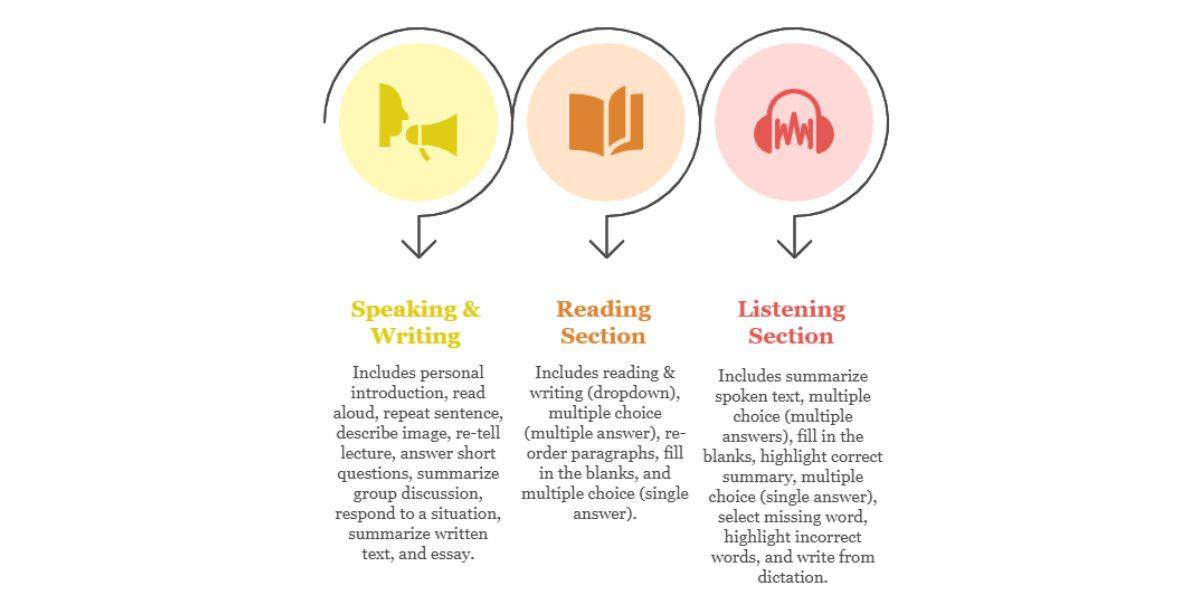

Commonly asked questions
The PTE exam syllabus is focused on the four key parameters of assessing the English language proficiency, i.e. Speaking, Writing, Reading and Listening. The PTE exam syllabus is-
- Speaking & Writing
- Personal Introduction- Involves a brief introduction of you.
- Read Aloud- Read short passages given on the screen and get tested for pronunciation, fluency and intonation.
- Repeat Sentence- Repeat the sentence that you listened to in the recording.
- Describe Image- You will be presented with an image on the screen, and that image may include a graph, data, or anything. You will then have to describe the image in detail in the given amount of time.
- Re-tell Lecture- Listen/watch a lecture and then re-tell it in your own words.
- Answer Short Question- Answer a question that you listened to on the recording with a single or multiple words.
- Summarise Group Discussion (New)- This task requires you to listen to a recorded discussion between 3 people and then summarise the whole of the discussion in your own words.
- Respond to a Situation- Listen to and read the description of a situation and then answer a question based on this.
- Summarise Written Text- On reading a given passage, you will be required to write a summary of it in 1 sentence.
- Essay- Write an essay of 200-300 words on a topic within the given amount of time.
- Reading
- Reading & Writing - (Dropdown): On the screen, you will be presented with a text containing several gaps. Select the right word for the gap from the dropdown list.
- Multiple Choice, Multiple Answers- After listening to a recording, answer a multiple-choi
A lot of times, candidates are left wondering about a good PTE score. PTE Academic test takers should be aware that every university would have a required PTE score and candidates are expected to achieve the same or a higher value to be eligible for admission to the university. A good PTE score could be a score that would make the candidate eligible for most universities accepting PTE scores. Having a good PTE score not only increases your chances of admission to the university but also makes you a frontrunner for any scholarships the university may provide.
There is no passing marks for the PTE exam. According to the Pearson PLC Group, PTE test takers should aim to score a minimum of CEFR B2 level, which equals to a PTE Academic score range of 59-75. With that level of English proficiency, the students become eligible to apply for most of the universities abroad.
These scores imply that the student can follow academic-level instructions and participate in academic education both coursework and student life. This level of English is also considered eligible for professional registration, employment and applying for Australian skilled migration visas.

PTE Academic - Speaking & Writing Syllabus
Syllabus for PTE Speaking and Writing Section: As the name implies, this section tests the candidates on the basis of their two major skills of communication, which are spoken and written skills. The Speaking & Writing of the PTE section is approximately 76 - 84 minutes long in the PTE exam and the section contains seven different question types. The Speaking & Writing section is the longest section of the PTE test. The candidate will be tested on their speaking and writing skills, using English they might hear in an academic environment.
This section comprises seven small sections that test you on your promptness over speaking and writing, the written test that you would get to read for the first time ever. The complete section is given on a time duration of 76 to 84 minutes and the time allotted to each segment is as follows:
| PTE Course 2026: Speaking & Writing Section | |||
|---|---|---|---|
| Segment | Number of Questions | Time to answer (approx) | Skills Assessed |
| Personal Introduction | 1 | 55 seconds: 25 seconds for prompt, 30 seconds to record | |
| Read Aloud | 6 - 7 | 30-40 seconds to prepare for reading out the text of 60 words. Time to answer the question varies according to the length of the prompt. |
Speaking |
| Repeat Sentence | 10 - 12 | 15 seconds: 3-9 seconds for prompt, 15 seconds to record | Listening and speaking |
| Describe Image | 5 - 6 | 25 seconds are granted to study the image as well as prepare your response on the same and 40 seconds are given to record your answer | Speaking |
| Re-Tell Lecture | 2 - 3 | 90 seconds for prompt length, 10 seconds to prepare and 40 seconds to answer | Listening and speaking |
| Answer Short Question | 5 - 6 | 20 seconds: 3-9 seconds for prompt, 10 seconds to answer | Listening |
| Summarise Group Discussion | 2 - 3 | 5 min per question - Up to 3 min of prompt length and 2 min for answering | Listening and Speaking |
| Respond to a Situation | 2 - 3 | 50 seconds- 10 sec for preparing your response and 40 sec for answering | Speaking |
| Summarize Written Text | 2 | 10 minutes to answer to text prompt of 300 words | Reading and writing |
| Essay Writing | 1 | 20 minutes to answer to text prompt of 2-3 sentences | Writing |
Related Reads
| PTE prep tips: Reading Section | |
| PTE Academic Writing Section Tips and Tricks | PTE Speaking Section - Tips and Tricks |
Commonly asked questions
The Part 1 of the PTE exam comprises of 10 different question types (including the Personal Introduction which is not scored). The number of questions asked on the PTE exam for each question type varies, except the "Personal Introduction", for which there is only 1 questio/prompt. The total number of questions that will be asked on Part 1 of the PTE exam post the declaration of the major update is not sure yet as the conducting body, Pearson PTE, is yet make an announcement for the same.
Additionally, you do not get a score for personal introduction; however this is shared with your chosen universities abroad along with your score report.
In total, there used to be 28-36 questions in Part 1 - Speaking & Writing of the PTE exam. However, after the latest update in the PTE exam pattern, the questions in Part 1 will increase to 31 - 44.
A candidate can take the PTE exam 12 times within a period of 12 months. An extra number of attempt(s) can be granted only if your reason for requesting an extended number of attempts aligns with the Pearson PTE test's retake policy. However, candidates cannot sit for another PTE exam until the following conditions are met -
- They have received the results of their last PTE exam. Until you receive the result of your last PTE test, you will not be able to register for a new one on the official PTE website.
- They have not already booked another PTE exam date. If you have booked a PTE test date, you will not be able to book another one. This is done to ensure that all the PTE test seats are taken by test takers at all times.
One can book another PTE test at the next convenient date after they have received the results of the previous test. In the light of above points, candidates can take their next PTE exam within a gap of 4-5 days, and this is the only criteria set by the board. They only need to wait to receive their scores before they can book their next test. Candidates should note that PTE Test Scores are made available to test takers within 2 days.
PTE Academic - Reading Syllabus
Syllabus of PTE Reading Section: This section tests the candidates on the basis of their ability to understand the written instructions in the language. The section further divided into 5 segments is 23 to 30 minutes long. Check out the segment-wise pattern for the time distribution of this section:
| PTE 2026 Syllabus: Reading Section | |||
|---|---|---|---|
| Segment | Number of Questions | Task | Skills Assessed |
| Fill in the Blanks (Dropdown) |
5 - 6 | Read text of length of up to 300 words - with some missing words. Then, fill in the gaps with the right words from the dropdown | Reading |
| Multiple Choice, Multiple Answers | 2 - 3 | Read 350 words of text, then answer multiple choice question bsed on the content or tone of the text | Reading |
| Re-Order Paragraphs | 2 - 3 | You will see various text boxes on screen containing up to 150 words, arrange them in the right order | Reading |
| Fill in the Blanks (Drag and Drop) | 4 - 5 | Read 80 words of text and drag the words to fill the gaps | Reading |
| Reading and Writing: Fill in the Blanks | 2 - 3 | Read 300 words of text and drag the words to fill the gaps | Reading |
Commonly asked questions
There will be 22 different question types (excluding the personal introduction, which is not scored) in the PTE exam. Part 1 - Speaking and Writing consists of 10 different question types (including Personal Introduction, which is not a part of PTE results and scores). Part 2 - Reading contains 5 different types of questions and Part 3 - Listening contains 8 different question types.
There are 5 different types of questions in Part 2 of the PTE exam. And you will be asked 13-18 of such questions in part 2 - Reading of the PTE exam.
PTE Academic Exam - Listening Syllabus
Syllabus of PTE Listening Section: The listening section of the PTE Academic is stretched over 31 to 39 minutes of duration. This one is designed to determine the ability to understand spoken English by the candidate. Here, the student needs to ascertain that they carefully hear the audio file played and retain what they heard. This section is divided into 8 segments and the time given to each segment is as follows.
| PTE exam 2026 Syllabus: Listening Section | |||
|---|---|---|---|
| Segment | Number of Questions | Task | Skills Assessed |
| Summarize Spoken Text | 1 | 60-90 seconds to skim and proofread the text. 10 minutes for writing the 50-70 word summary | Listening and writing |
| Multiple Choice, Multiple Answer | 2 - 3 | 40-90 seconds to listen to audio and choose more than one response relevant to the question | Listening |
| Fill in the Blanks (Type in) | 2 - 3 | 30-60 seconds to listen to a recording and fill in the gaps in the transcript | Listening and writing |
| Highlight Correct Summary | 2 - 3 | 30-90 seconds to listen and choose the summary that best suits the recording | Listening and reading |
| Multiple Choice, Single Answer | 2 - 3 | 30-60 seconds to listen to the audio and choose one response relevant to the question | Listening |
| Select Missing Word | 1 - 2 | 20-70 seconds to listen to the audio and choose the missing word to complete the recording | Listening |
| Highlight Incorrect Words | 2 - 3 | 15-50 seconds to listen to a recording and identify the words that differ in the transcript and audio | Listening and reading |
| Write From Dictation | 3 - 4 | 3-5 seconds to listen and type out the sentence | Listening and writing |
Commonly asked questions
An AI-based automated scoring system assesses your performance in each section of the PTE exam. Scores are assigned on a 10 to 90 points scale - overall and for communicative skills reports (for Speaking, Writing, Reading and Listening).
There are 8 different types of questions in Part 3 of the PTE exam. And in total, you will be required to answer 12-20 questions in Part 3 - Listening of the PTE exam.
There are 8 different types of questions in Part 3 - Listening of the PTE exam. The type of questions asked are listed below:
- Summarize Spoken Text
- Multiple Choice, Multiple Answers
- Fill in the Blanks (Type in)
- Highlight Correct Summary
- Multiple Choice, Single Answer
- Select Missing Word
- Highlight Incorrect Words
- Write from Dictation
Is there any change in syllabus of the PTE Exam 2026?
For the 2026-27 academic year, there are significant updates to the PTE Academic syllabus and test format, focusing more on real-world communication and reducing the influence of memorised templates. The core structure remains divided into three sections: Speaking & Writing, Reading, and Listening. However, two new question types have been added to the Speaking & Writing part of the exam and some tasks from Part 2 and Part 3 have been renamed too. The two new task types added to the exam are -
- Summarize Group Discussion
- Respond to a Situation
Commonly asked questions
As of now there is no bar on the number of attempts allowed to take the PTE exam. Test takers can retake the exam as many times they want to improve their score. However, there are two conditions associated with the allowed retakes. These are-
- A new PTE exam slot must be booked only after the result of previous attempt is released.
- Only 12 attempts are allowed in a given 12 months window. If you happen to have exhausted all these 12 attempts for the concerned 12 months window and want another attempt in the same window, then you'll have to submit an application for the same.
After the latest update in PTE Exam Pattern, the Part 1 - Speaking & Writing of PTE now has 10 different question types. These new tasks are introduced as 7th and 8th tasks in Speaking and Writing section of the PTE exam.
The complete updated list of different question types in Part 1 - Speaking and Writing of the PTE exam is given below.
- Personal Introduction
- Read Aloud
- Repeat Sentence
- Describe Image
- Re-tell Lecture
- Answer Short Question
- Summarize Group Discussion (New)
- Respond to a Situation (New)
- Summarise Written Text
- Essay
Integrated Scoring based on Different Tasks in PTE
Unlike other standardised tests where sections are isolated, PTE operates on a highly cross-functional, integrated scoring architecture where one task simultaneously grades multiple communicative skills. In that sense, your listening score is not merely determined by the listening section. In fact, roughly 50% to 60% of your Listening score is heavily dependent on Speaking modules like Repeat Sentence, Retell Lecture, and Summarise Group Discussion.
Similarly, Writing scores are fundamentally driven by Write From Dictation (which heavily impacts Listening and Writing) and Reading & Writing: Fill in the Blanks (which splits points across Reading and Writing). So, because of this integrated scoring pattern, if your performance dips in any such question, then the scores for two communicative skills will be impacted.
PTE Syllabus 2026 FAQs
Check out the PTE Exam Syllabus FAQs below.
Yes. A 75 PTE score falls under the 'Very Good' category. A PTE 75 score is equivalent to IELTS 7.5 - 8.0 band score. However, candidates should note that the real determining factor is their preferred university PTE score requirements. If they are eligible to apply with their PTE scores, good or else they can always re-take the test.
The toughest section in the PTE Academic exam would depend on the candidates' expertise. Students are advised to have a holistic approach towards preparing for the PTE Academic exam, concentrating both on tough as well as easy sections.
A lot of times, candidates are left wondering about a good PTE score. PTE Academic test takers should be aware that every university would have a required PTE score and candidates are expected to achieve the same or a higher value to be eligible for admission to the university. A good PTE score could be a score that would make the candidate eligible for most universities accepting PTE scores. Having a good PTE score not only increases your chances of admission to the university but also makes you a frontrunner for any scholarships the university may provide.
No, you are not allowed to take anything in the PTE Academic Exam Hall. This is because test centres provide you with everything necessary from computer equipment to notepad.
No. The candidate should understand that the test has been created to understand proficiency in English. Anyone who prepares for it with practice may not find it tough on main day.
PTE Academic scores are typically made available within two working days (48hrs). After the completion of your PTE Academic exam, you will receive PTE Academic scores for each of the skill sections in a band range of 10 – 90. Along with that, you will also get an overall PTE score.
After you share your scores with the universities abroad, it will take around 48 hours for the universities to be able to see those scores. Note that the universities will only be able to see the scores that you have shared and no previous scores will be shared with them.
The PTE Academic test is an English language proficiency test to understand the reading, writing, speaking, and listening capabilities of the test taker.
Candidates who are well versed with the PTE Academic syllabus and the exam pattern and have prepared well for the exam would not find the PTE Academic exam difficult.
PTE is a fully computer-based English proficiency test - separated into 3 different sections namely the Speaking & Writing (Part 1), Reading (Part 2) and Listening (Part 3). Below are details on PTE Exam Pattern in 2026:
PTE Exam Pattern | Details |
|---|---|
PTE Exam Duration (section-wise breakup) |
|
PTE Exam Complete Duration | ~2 Hours, tested in a single test sitting |
Mode | Computer-based exam (with headset) |
PTE Exam Venue | Taken at a test centre |
Question Layout | Assesses real-life English used in teaching and conversational setups |
Question Types | 22 question types |
Candidates are advised to appear for the PTE Academic exam after having prepared well for the exam. Candidates are advised to refer to online/offline study material available on the official PTE website and also go through our preparatory guide.
Predict your IELTS, TOEFL, and PTE in just 4 steps!
 Statement of Purpose
 Letter of Recommendation
 Student Visa Application
 Admission Essay Writing
 Student Curriculum Vitae
Comments
(204)
n
a year ago
P
2 years ago
P
2 years ago