
 / IELTS
IELTS Exam 2026: Registration, Exam Dates, Fees, Syllabus & Preparation Tips
International English Language Testing System ( IELTS )


The full form is International English Language Testing System. Every year, almost 4 million users take the test. The IELTS exam is a popular test to check how good your English is for study, work, or migration. More than 12,500 organizations like colleges and offices around the world accept this score. The test checks four main things: Listening, Reading, Writing, and Speaking. There are two types of IELTS test: IELTS Academic (for students) and IELTS General Training (for work or migration). Both are available on paper and computer mode.
Preparing for the IELTS test is the first big step for your global goals. It might look hard at first, but once you understand the IELTS exam pattern, it becomes much more easier to get the score you need for your dream country. The IELTS exam 2026 will be available throughout the year for the computer-delivered test and 48 times for the paper-based test. One can take the IELTS computer-based test on all seven days of the month, excluding national holidays and major festivals. The IELTS exam fees in India 2026 are INR 18,000 for both Academic and General Training tests.
- IELTS Exam Highlights
- IELTS 2026 Updates
- What is IELTS?
- IELTS Exam Pattern 2026
- IELTS Syllabus
- IELTS Eligibility for Indian Students
- IELTS Registration 2026
- IELTS Exam Fees in India 2026
- IELTS Exam Dates 2026
- IELTS Test Centres in India
- IELTS Results & Score
- IELTS Preparation
- IELTS Frequently Asked Questions (FAQs)


IELTS Exam Highlights
| Exam Name |
IELTS |
|---|---|
| IELTS full form |
International English Language Testing System |
| Official Website |
ieltsidpindia.com |
| Purpose |
Study, Work, PR/Migration abroad |
| Accepted by |
More than 12,500+ organisations |
| Year Started |
1980 |
| Test Format |
|
| Test Types |
|
| Test Mode | The IELTS Academic or General Training tests are available in both paper and computer modes.
|
| Available Dates | Available throughout the year |
| Owned and Conducted by |
British Council, IDP IELTS, and Cambridge University Press & Assessment |
| Result released |
Within 2 days (computer); 13 days (paper) |
| IELTS Exam Fees |
In India, the fee for both Academic and General Training is increased to INR 18,000 since March 1, 2025. |
| Score Range |
Each section is scored on a scale of Band 1 to Band 9, with an overall band score |
| IELTS score validity |
2 years or 24 months |
| IELTS Contact |
Head Office Global Gateway Towers, Tower B, 5th Floor, Sikanderpur Ghosi, Sector-26, M.G. Road, Gurugram -122002 Haryana, India Phone: 1800-102-4544 (Mon to Sat - 9:00 AM to 5:30 PM) Email: ielts.india@idp.com |


Commonly asked questions
Yes, 7.5 is a very good score! It means your English is excellent. Most top universities abroad ask for 7 plus band score. If you have this much band score, you are 100% safe for admission. It also makes your visa profile very strong.
There is no eligibility requirement for IELTS. You should be at least 16 years old. This is ideally recommended. The most important thing is your Original Passport. You cannot book or write the IELTS exam without a valid passport.
The IELTS exam is a test to prove your English level for study abroad or work. Countries like UK, Canada, and Australia need this proof for your student visa. Without this score, the embassy thinks you cannot manage there.
The IELTS test can be little hard for some people, mostly when they not prepare enough. Every part of the IELTS exam has its own challenge, like time problem in Reading and Writing tasks. But if you make a good study plan and practice with mock tests, it become much easier.
IELTS 2026 Updates
Candidates preparing for the test this year need to stay ahead of the latest IELTS 2026 updates regarding test logistics and scoring trends. There no official announcements of a IELTS new format from IDP or the British Council. Recent feedback from test-takers highlights crucial changes in how IELTS 2026 will be conducted. If you are just starting your preparation, you might want to review the basic changes IELTS exam syllabus.
IELTS 2026 Exam Updates & Trends
| Exam Section | Key Updates & Details |
|---|---|
| General Overview | Contrary to rumors, the official IELTS exam format remains unchanged by IDP/British Council. Major structural changes are not officially announced, so stick to standard preparation. |
| Test Logistics | Paper-based exam: You are now required to use pens only; pencils are no longer permitted for the writing section. Speaking Module: In 70–80% of centers, the interview is now a video call speaking test (conducted at the center) rather than face-to-face. |
| Writing Task 2 | The exam is favoring realistic, opinion-based essays (e.g., "To what extent do you agree"). Tip: Avoid using generic templates or memorized lines. Examiners are scoring natural, genuine ideas higher. |
| Writing Task 1 | Expect to see more mixed charts (e.g., a pie chart + bar chart). Strategy: Do not force comparisons. Describe each chart in a separate paragraph for better clarity. |
| Listening Section |
|
| Reading Section |
|
| Study Resources | The Cambridge IELTS Book 20 has been released. Treat it as a standard practice resource, not a rulebook for new changes. |
Commonly asked questions
No, the main rules are the same. The official bodies like IDP and British Council have not announced any big changes to the IELTS exam format. Stick to your normal study plan for now.
Yes it is very likely. 80% of IELTS test centers now use video call speaking tests instead of face to face interviews with a real examiner. It will be easier to give IELTS speaking test now.
Pencils are not allowed anymore. For the IELTS paper-based test you must write all your answers using a pen to ensure they are clear. Please practice your handwriting before test day.
No, do not use them. Examiners are stricter now and will cut marks if you use generic or memorized essay templates for your answers. You should write natural ideas to get a high score.
What is IELTS?
The IELTS exam is a very popular English test. Many students and working people give this test when they want to study in other countries, get job, or live in English-speaking countries. The IELTS test checks 4 skills – listening, reading, writing and speaking.
This exam is accepted by more than 12,500 universities, employers, immigration office and other bodies in the world. It is also called one of the most trusted English test to join top universities abroad.
The IELTS exam is run by British Council, IDP IELTS and Cambridge University Press & Assessment. Giving the IELTS test not only help in visa and admission, but also give more chance for scholarship, job and registration.
There are two types of IELTS:
IELTS Academic – for students who want to study in university abroad.
IELTS General Training – for people who want job, training or migration.
In India, the official body for IELTS exam is IDP IELTS. Students can choose paper test or computer test. Both are same in format and score, and both are accepted worldwide.
The IELTS exam dates 2026 are already out. In India and many countries, the exam happen almost 4 times every month. That means you have 48 chances in 2026 to give the test.
- Computer based test: Available almost every day of the week.
- Paper based test: Usually on Thursdays and Saturdays.
The IELTS exam fees 2026 are again INR 18000. There is no increase in IELTS exam fees this year as of now. You must check the official IDP website for exact price because it change sometimes.
Check the detailed video on IELTS overview:
IELTS Full Form
The full form of IELTS is International English Language Testing System.
Commonly asked questions
IELTS IDP has not set any 12th score requirements for taking the IELTS. You can take the IELTS irrespective of the marks you scored in the 12th standard. So, one can attempt the IELTS exam without worrying about their class 12th score.
In IELTS exam, if you get less marks in only one subject like Writing or Reading, you don't need to give the full IELTS test again. In this case you can take only that module of IELTS test. This saves your time and money. But you must book this within 60 days of your original test.
The difficulty is exactly same. The questions are same. But, if you have good typing speed, computer test feels easier for Writing task. Also, for Reading task, the screen is split so you can see passage and questions together, which many students find helpful.
The full form of IELTS is International English Language Testing System. It is a test to check how good your English skills in academic and general training contexts. This is mandatory requirement in foreign country if you want to study, work or live in a country where English is used.
IELTS Exam Pattern 2026
IELTS Exam Pattern 2026 is the most important thing to know before you start your preparation. The IELTS 2026 Exam Pattern consists of four different sections: Listening, Reading, Writing, and Speaking. These sections of IELTS test are designed to assess your English language capabilities accurately.
You need to understand the IELTS format clearly. While the Listening and Speaking tests are the same for everyone, the IELTS Exam Pattern 2026 for Reading and Writing differs depending on whether you are taking the Academic or General Training module.
Scoring well depends on knowing the rules. A significant update to the IELTS Exam Pattern is the introduction of the One Skill Retake, which allows test-takers to re-sit a single section to improve their overall band score without retaking the full test.
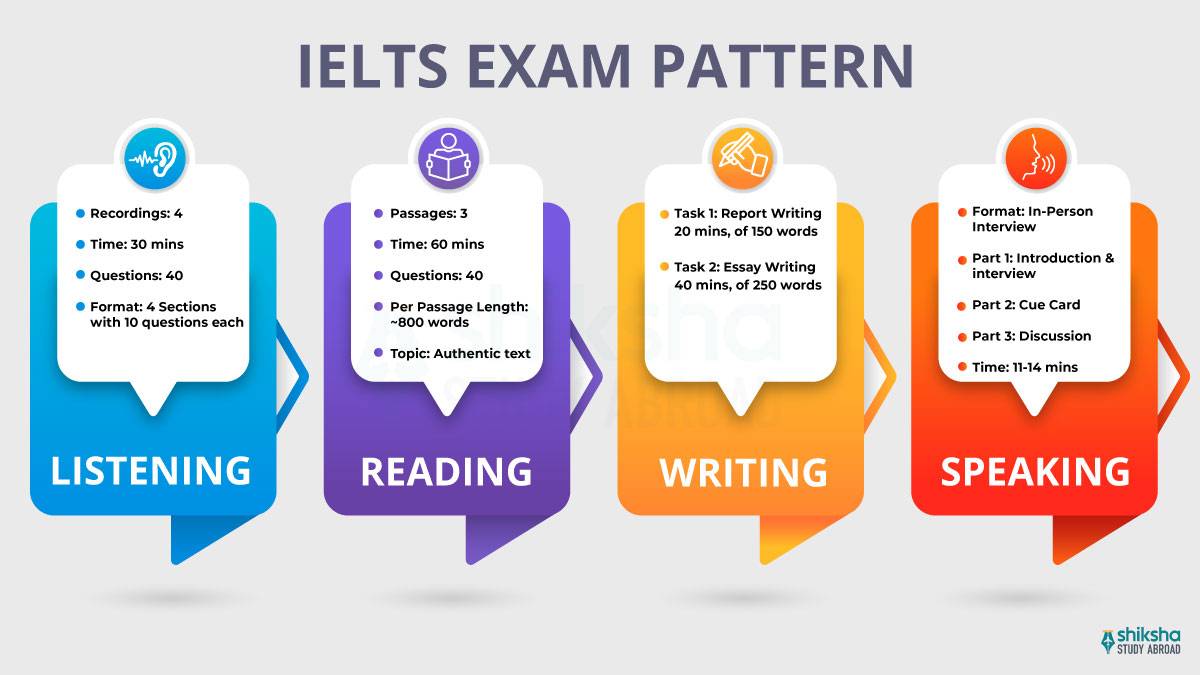
The IELTS syllabus is divided into four parts. The total time is about 2 hours and 45 minutes.
- IELTS Listening (30 mins): You listen to 4 recordings and answer 40 questions. Tip: In IELTS 2026, accents are more mixed, so listen to podcasts from different countries.
- Reading (60 mins): You read 3 long passages. For IELTS Academic, these are from books and journals. For General, they are from newspapers.
- Writing (60 mins): Two tasks. Task 1 is describing a graph (Academic) or writing a letter (General). Task 2 is an essay. IELTS writing tips say you must write more than 150 words for task 1 and 250 words for task 2.
- Speaking (11-14 mins): This is a face-to-face interview with a real person. It has 3 parts: introduction, cue card topic, and discussion.
The IELTS test pattern can be checked below with their duration and description.
| Section |
Duration |
Description |
|---|---|---|
| IELTS Listening |
30 mins |
4 sections, 40 questions |
| 60 mins |
3 passages, 40 questions |
|
| IELTS Writing |
60 mins |
A total of 2 tasks (Task 1: 150 words, Task 2: 250 words) |
| 11–14 mins |
3 parts: Introduction, Long Turn, Discussion |
Commonly asked questions
The total test time for IELTS exam is 2 hours and 45 minutes.
Here is the detailed mode of conduction for the IELTS examination . The examination is conducted both online and offline for the ease of students. They can choose whether they want to complete it online or offline. There is no difference in the questions, it is just the mode through which they prefer to answer.
For the computer based mode candidates are required to go to the examination centre, sit behind the computer screen and answer the questions. For the speaking section a trained IELTS examination trainer will ask them the questions. Results for the computer based test are available from 3 to 5 days after the examination.
For the pen and paper based examination, candidates will give the traditional method of question paper and answer booklet . The result for this mode of examination will take around 13 days.
The Listening is 30 minutes. Reading and Writing are exactly 60 minutes each without any break. The Speaking is very fast, it takes only 11 to 14 minutes to finish.
Here are some tips by experts to ace your IELTS examination:
Be familiar with the syllabus: IELTS test pattern can be a little new for candidates who don't know about it . It is advised for one to be familiar with the syllabus.
Take as many test as possible to make sure that you are aware of where you stand in the examination.
Practice time base test as much as possible as time management will play an important role in this examination.
Don't just be dependent on text book but learn from wherever you get like movies, English music, reading books and much more .
Conversate in English as much as possible to be fluent in the speaking section.
To know more about the examination refer to the official website.
IELTS Syllabus
The IELTS exam syllabus have 4 main parts. The TOEFL exam test your skills like Listening, Reading, Writing and Speaking. Whole IELTS test take almost 2 hour 45 minute to finish. In IELTS Academic test, it also have same 4 parts only. Your final IELTS score come after adding marks from every section together.
IELTS Syllabus – Details
| Section |
What it checks |
Tasks / Questions |
Time |
|---|---|---|---|
| Listening |
Checks how good you understand spoken English |
You hear 4 recordings (talks, conversations, lectures). Then answer 40 questions like multiple choice, sentence fill, note complete etc. |
30 minutes |
| Reading |
Checks your reading skill and how fast you understand |
You read 3 passages from books, journals, newspaper etc. Then answer 40 questions like skimming, scanning, true/false, matching |
60 minutes |
| Writing |
Checks your English writing |
IELTS Writing Task 1: Write about chart, graph, table or diagram in simple words. IELTS Writing Task 2: Write an essay to give your opinion or argue on topic |
60 minutes |
| Speaking |
Checks your spoken English in interview with examiner |
Part 1: Intro + personal questions Part 2: Cue card (talk on topic for 1–2 min) Part 3: Discussion questions |
11–14 minutes |
Commonly asked questions
In the IELTS Speaking test there is a face-to-face interview between the test taker and the examiner. The Speaking test includes 3 parts which are mentioned above. Here, candidates are assessed on the following parameters:
- Grammar
- Pronunciation
- Lexical resource
- Fluency
The Speaking test is recorded and marked based on the applicant's performance. Applicants should be careful how they attempt this section.
IELTS subject means the 4 component of the test. The IELTS test is divided into four sections: Listening, Reading, Writing, and Speaking.
The subject of IELTS Reading section on the Academic IELTS is based on common topics of interest. These topics are mostly academically sourced topics that make up the three passages on this section. The topics on which the IELTS Readin section are tested can be from different subjects of:
- Science & Engineering
- Social Science
- Technology
- Business
- Humanities
- Environment
- Education
- Psychology
- Economics
- Agriculture
The list is endless and the topics can vary at large for IELTS Academic - Reading section. Thus, applicants can prepare for the IELTS Reading section and can find material at: IELTS Reading: Practice Test with Answers
Yes. The Reading and Writing sections differ between the two formats of IELTS Academic and General, while Listening and Speaking are the same in both format.
IELTS Eligibility for Indian Students
The is no requirements related to IELTS eligibility. You only have to be at least 16 years old and have a valid passport. There is no fixed education requirement for the test. You can give the IELTS exam many times in a year, there is no limit for that. The minimum IELTS score you need for admission or immigration is decided by the country or the institution where you applying.
| Category |
Details |
|---|---|
| Age |
Minimum age is 16 years, and there is no maximum age limit. |
| Educational Qualification |
No minimum qualification needed. |
| Nationality |
Open to all nationalities |
| Required Document |
A valid passport is mandatory |
| Test Attempts |
No limit |
Commonly asked questions
A valid passport is mandatory for both IELTS registration and on the test day. Other documents, like an Aadhar card, driver's license, or PAN card, are not accepted.
IELTS IDP has not set any 12th score requirements for taking the IELTS. You can take the IELTS irrespective of the marks you scored in the 12th standard. So, one can attempt the IELTS exam without worrying about their class 12th score.
No, there is no upper age limit. Even older students can take it. Most say at least 16 years is good to understand topics. Candidates willing to study in English speaking countries should take the test.
Mostly Canada, UK, Australia and USA requires IELTS for admission purposes. Even European countries like Germany ask for IELTS if your course is in English medium. It is valid almost everywhere.

IELTS Registration 2026
The IELTS 2026 registration is simple but be careful with your passport details. To register for IELTS, go to the official IDP IELTS India website and choose your test type (Computer/Paper, Academic/General). Then you have to select your city/date, fill in personal details using your passport, upload a passport copy, and pay the fee online. Then you will receive instant confirmation via email. The simple process to book IELTS slot is mentioned below.
- Go to the official IDP website.
- Click on book IELTS exam.
- Select your test type (Academic or General).
- Select your city and date.
- Pay the IELTS exam fees online.
Important: Keep your passport handy. You must use the same passport on the exam day that you used for booking. If you change passport, you cannot give the exam.
Commonly asked questions
No. A valid passport is mandatory for IELTS registration and on the test day. So, one cannot register for IELTS without a passport.
Candiadates have to only submit a valid passport and your national ID card during the time of IELTS registration. In the case of absence of any of a national ID proof, one have to submit the documents required while applying for the passport.
Yes, you first go to website and create account. You must have your original Passport with you. Without passport number, you cannot book the date. Make sure name spelling is exactly same as passport.
If you go to IDP office to book IELTS slot in offline mode, soon after the payment of IELTS fees, they will give you a confirmation letter right away. If you send by courier, you will get SMS or email confirmation once IDP checks your documents.
IELTS Exam Fees in India 2026
Commonly asked questions
Yes, the IELTS exam fees in refundable but only if you cancel more than 5 weeks before your test date. Cancellation of IELTS exam dates after this period will not be refunded unless due to serious reasons with supporting documents.
Reducing the IELTS fees is not possible as IDP does not offer any concession or discounts in IELTS fees.
The IELTS fees are still the same, INR 18,000. Any official confirmation on the increase in IELTS exam fees 2026 will be updated here.
The rechecking fees for both IELTS computer-based and paper-based tests are INR 13,500.
IELTS Exam Dates 2026
Commonly asked questions
The IELTS exam is offered multiple times a month. The IELTS test dates vary by test center. The IELTS exam dates for computer are available on almsot every date on the basis of availabilty. While, the IELTS Paper-delivered test are available up to 4 times a month.
IELTS test dates are conducted throughout the year in India. The IELTS computer-based test is conducted on all days of the month excluding national holidays and major festivals. The IELTS paper-based test is conducted 4 times a month or 48 times a year on Thursdays and Saturdays. Candidates can check out the available IELTS test dates on our website or IDP IELTS India.
The IELTS computer-delivered test is conducted on all days of the week including weekends. However, national holidays and major festivals are days when no IELTS test is held. When we talk about the IELTS paper-delivered test. The IELTS on paper is held four times a month and 48 times a year. They are mainly held on Saturdays and Thursdays.
The next date of IELTS exam will vary with the month you are looking for. The updated IELTS exam dates with monthly calendar can be checked regularly on the IDP official website.
Predict your IELTS, TOEFL, and PTE in just 4 steps!
IELTS Test Centres in India
Commonly asked questions
The IELTS exam fess will remain INR 18,000 for any of the test centres near you.
Booking an IELTS exam centre is not very difficult. Applicants can either register for the chosen IELTS exam centre online or go to the nearest IDP kiosk and choose for one. 75+ IELTS exam centres are available across various Indian cities. Thus, applicants will be able to book their IELTS test centres easily based on the available exam centres in India. When applicants will be registering on IDP's website for IELTS exam, they can directly choose their exam centre and register for the exam. On the other hand, when registering offline, people at IDP can help applicants choose their exam centres.
Applicants can request for a change in IELTS exam centre or even IELTS exam dates atleast 5 weeks before the exam. Applicants can log on to the portal where they registered for the exam and look for the option to change or transfer IELTS exam dates or centre. This is only applicable 5 weeks before the chosen exam date and applicants do so only if they need it urgently. Once they are able to select the new preferred IELTS test centre, an additional fee will be charged to make the new changes.
Please note: It is not always possible to get the preferred IELTS exam centre when changing from the original option. Thus, applicants should be very careful while submitting their applications and preferred choices.
The answer for this question is very subjective. The best IELTS test centre will vary on the individual requirements. However, always opt for the IELTS test centres which is the nearest to your location.

IELTS Results & Score
Commonly asked questions
The four types of IELTS exams are: IELTS Academic, IELTS General Training, IELTS for UKVI and IELTS for UKVI Life Skills. One should confirm the university or institutions about the types of IELTS exam they accepts. On the basis of IELTS types requirements, candidates should register for IELTS exam.
If you give exam on computer, result comes very fast in 3 to 5 days. If you give on paper, you have to wait for 13 days. So if you are in hurry, take computer test.
You do not need to go to the center to see your marks. Check these steps to check result.
- Visit official website of IDP India.
- Login to your IELTS IDP account
- Enter your Passport Number, Date of Birth, and Candidate Number.
- Click "Submit" to see your Band Scores.
IELTS Preparation
Commonly asked questions
Although two weeks are less, however, with a solid strategy can help you get a decent IELTS score. Candidates should understand the IELTS test format and prepare a comprehensive study plan for the next two weeks covering all the topics. After covering all the topics in each of the sections give full-length practice tests.
Each exam has its own preparation technique, which also changes the treatment of exam day. Planning your exam day and preparing for strategies to crack the question paper is equally essential as studying for the exam is. Therefore, it is as important to be exam-day-ready as it is to be prepared with its syllabus. Check out the IELTS exam day tips before you go to the examination hall.
There is no pass or fail in IELTS. But students want a good IELTS band score to go to top universities. To do well in first try, you should know the test format and practice all parts – Listening, Reading, Writing and Speaking.
You need the Cambridge books for practice tests. You need a timer or watch to stop yourself in 60 minutes. Also watch some YouTube videos to understand how to solve tricky questions. Consistancy is key.
IELTS Frequently Asked Questions (FAQs)
Commonly asked questions
IELTS is accepted by immigration authorities in the UK, Australia, Canada, and New Zealand for migration and work visa applications.
You should try to register for IELTS at least 1 or 2 months early. Test dates get booked fast, especially during busy times. The advance booking of IELTS exam also gives you more time to prepare for IELTS properly.
If you study about 2 to 3 hours daily, it's enough. Give time to all 4 parts: Listening, Reading, Writing, Speaking. You can change subjects every day so it don't feel boring.
After learning the complete format familiarize yourself with all the topics that you need to cover while preparing for the test. You can get online practice tests and make sure to do it while following the time. Prepare for the Listening test by listening to the audio recordings. Similarly, prepare for the Reading and Writing sections accordingly. Make sure you do as much practice as possible in order to get a decent IELTS score.
 Statement of Purpose
 Letter of Recommendation
 Student Visa Application
 Admission Essay Writing
 Student Curriculum Vitae
Comments
(1336)