
Post Study Work Permit in Germany: Requirements, Fees, Process
 Talk to Expert
Germany draws international students with its free education, booming job market and 18-month post-study work visa. The post-study work permit in Germany lets you stay in the country and look for jobs for up to 18 months after the completion of your graduation.

Germany is one of the most popular study abroad destinations because it offers excellent post-study work opportunities for international students. After completing a bachelor’s, master’s, or PhD from a recognized German university, non-EU students can apply for a Post Study Work Permit in Germany, which allows them to stay in the country for up to 18 months to search for a job related to their qualification. During this period, graduates can work in any job in Germany to support themselves while exploring long-term career opportunities.
The Germany post study work visa is attractive for Indian students because it provides enough time to secure employment in high-demand sectors such as engineering, information technology, automotive, healthcare, finance, and business. Once you receive a suitable job offer, you can convert your permit into a German work visa or an EU Blue Card, which can later lead to permanent residency.
With affordable education, strong industry connections, and a robust economy, the post study work permit in Germany for international students makes Germany an ideal destination for students who want to build a successful global career after graduation.
- What is the Post-study Work Visa in Germany?
- Who can apply for a Post Study Work Visa in Germany?
- When to apply for your Post Study Work Visa?
- Time Period of Post-Study Work Visa in Germany
- How to Apply for Post Study Work Visa?
- How to Get PR for Germany?
- What is an EU Blue Card?
- What is a German Opportunity Card (Chancenkarte)?

What is the Post-study Work Visa in Germany?
International students who have successfully completed a full-time course in Germany are eligible to seek employment in the country under the post-study work visa in Germany guidelines. This is time over and above the duration of the study period granted in your German Study Visa. As part of a post-study work visa in Germany, students can apply for an extended 18-month Job Seeking Visa to find work related to their area of study. In these 18 months, the candidates can work as much as they like and take up any kind of employment to support themselves.
Key Benefits of the German Post-Study Work Visa
- 18-month job search period after graduation.
- Freedom to work in any role to support yourself during this time.
- Pathway to long-term work permits like the EU Blue Card.
- Gain valuable international work experience.
- Opportunity to convert to permanent residence (PR) if conditions are met.
Who can apply for a Post Study Work Visa in Germany?
Only those graduates can apply for a German post study work visa who:
- Have completed a full-time course at a university in Germany.
- Still hold a valid German Student Visa at the time of application.
- Can demonstrate sufficient funds available to them to support themselves during the whole period of post study work and also have secured a health insurance coverage.
- Applied for a post study work visa before the expiration of their student visa in Germany.
When to apply for your Post Study Work Visa?
Your German Student Visa expires on completion of your studies in Germany. However, students should ideally apply for their 18-month post-study work visa before the expiry of their student visa. The 18 months extended work period begins as soon as the candidates receive their final exam results, so they should start looking for employment during their final semester. Ideally, a month before your German study visa is due to expire is the best time to apply for your post-study work visa from the German authorities at the Foreign Nationals’ Registration Office.
Documents Required for Applying for a Post-Study Work Visa in Germany
-
Valid Passport: While it is not specified, it is important to have a passport that is valid for the intended period.
-
University Degree or 'Nachweis': 'Nachweis' is an official document provided by the university that clearly states that you have completed your course. This is usually the document submitted as the Degree may take longer. It is important to remember that the 'Nachweis' must have the official stamp of the University.
-
Health Insurance: You need valid health insurance for both applying for a Student Visa and for the entire duration of your stay. This also includes the tenure of the post-study work visa requests. Read more about the Health Insurance Requirements for International Students in Germany.
-
Proof of Funds: The country lets you stay on to search for a job but you have to prove that you can afford the stay. For this, you can provide a bank document with the required funds or proof of a grant, if provided to you. It is always advisable to check with the local authority about the exact amount of funds required to procure the Work Visa.
Predict your IELTS, TOEFL, and PTE in just 4 steps!
Time Period of Post-Study Work Visa in Germany
While EU nationals do not require any specific permission, students with Indian passports would have to apply for a post-study work visa after completion of their education. The Immigration Laws permit students to apply for and get a Job Seeking visa for 18 months to look for a job as per their qualifications.
It is important to understand the provision of finding a job should be identical to the qualification attained from a German University. While a student can take up any employment to support their stay, they must find a job related to their area of study, failing which, they would be asked to leave Germany at the end of the 18 months.
How to Apply for Post Study Work Visa?
Once a student has completed his/her master’s or bachelor’s or doctorate, he/she can apply for and get a Job Seeking visa for 18 months. Please remember, unlike in some countries, the 18-month job visa does not come combined with the German Student Visa. Students would have to apply with the foreign nationals’ registration office in the vicinity after completion of their studies for this document. As mentioned earlier, a month before your German study visa is due to expire is the best time to apply for your post-study work visa from the German authorities at the Foreign Nationals’ Registration Office.
How to Get PR for Germany?
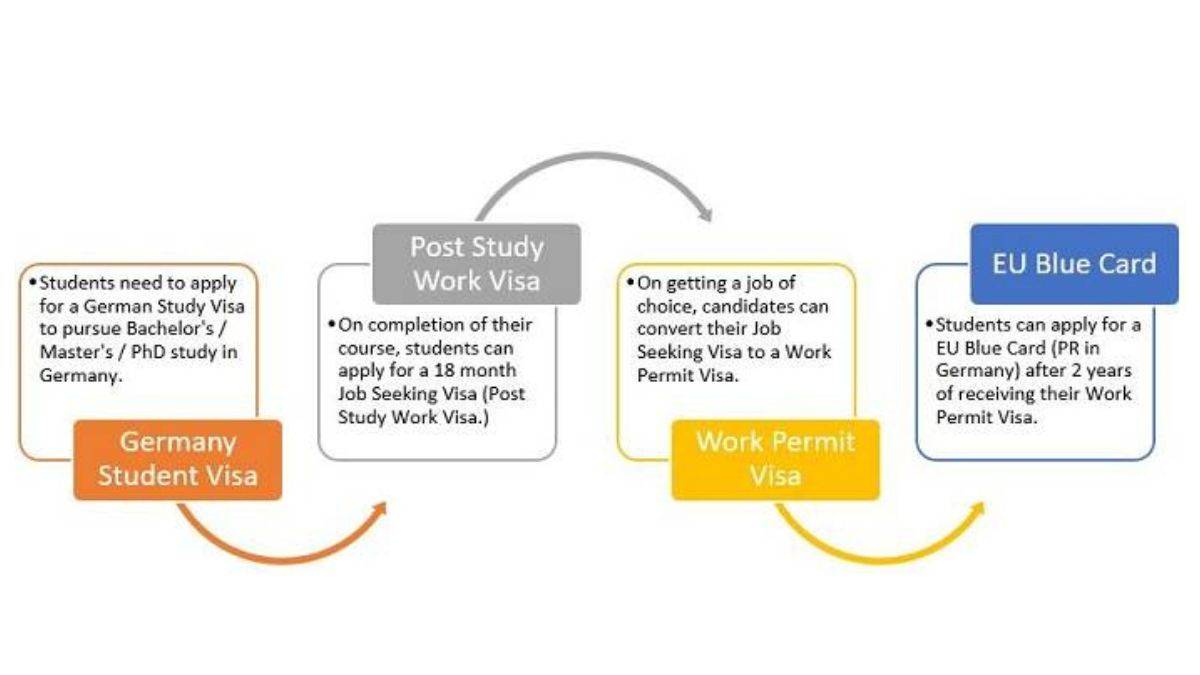
Once a candidate has found a job that he would like to accept, he is required to switch to the work permit from his Job Seeking Visa in Germany. If the candidate is looking to permanently settle down and get PR in Germany, he/she can apply for an ‘EU Blue Card’. One can apply for PR after completing a minimum of two years on a work permit if they graduated from a German university.
What is an EU Blue Card?
Once the candidate has been offered a job, they are required to convert their Job Seeking visa to a Permanent Residence permit. The EU Blue Card is a permanent residence permit for European countries. However, if the candidate is looking to apply for an EU Blue Card he will be allowed to work and live in any of the EU states. To be eligible to apply for an EU Blue Card, the applicant must be offered a job that pays at least €53,000 a year or at least €41,808 a year for mathematicians, engineers, natural scientists, technicians or physicians.
What is a German Opportunity Card (Chancenkarte)?
The German Opportunity Card (Chancenkarte) is a point-based residence permit that allows skilled professionals and recent graduates to stay in Germany and search for employment. Applicants are evaluated on criteria such as educational qualifications, language proficiency, work experience, age, and existing ties to Germany. A minimum of 6 points is required to qualify.
Here are the key details of the German Opportunity Card:
| Parameter |
Details |
|---|---|
| Eligibility |
Direct: German university graduates; Indirect: Foreign graduates via points |
| Duration |
12 months (extendable up to 18 months for German graduates) |
| When to Apply |
After graduation or from the home country |
| Purpose |
Search for full-time jobs and work part-time, meanwhile |
| Work Rights |
Up to 20 hours/week; short-term trial employment allowed |
| Financial Proof |
EUR 1,091/month (approx. INR 1.05L) |
| Health Insurance |
EUR 130–150/month (approx. INR 13k–15k), this is mandatory |
| Required Documents |
Degree certificate, proof of funds, language certificate, CV, passport, proof of accommodation, motivation letter, VIDEX form, 2 photos, insurance, work experience certificates |
Whether you are a graduate from a German university or a skilled professional from abroad, the Opportunity Card offers a structured pathway to transition into Germany’s job market and move closer to permanent residency.
The cost of studying in Germany (combining the low or no tuition fee and living expenses) is one of the lowest in the top student destinations in the world. Furthermore, the excellent automotive and heavy machinery sector makes MS Colleges in Germany a top choice for Indian Students. But studying is all very well…every student who aspires to go abroad does so with a wish to find a job on completion of the studies. The reasons can be many – to offset the heavy student loans or indeed to get an opportunity to make that country his/her home.

Commonly asked questions
Yes, Germany offers a Post Study Work Visa for international students who have graduated from recognised German universities. This visa allows graduates to stay in Germany for 18 months to search for jobs related to their field of study.
International students can stay in Germany for 18 months after graduation on the Post Study Work Visa. This time is meant for job searching related to their studies.
One has to learn German. This is a basic necessity to get a job. After creating a proper CV, one can apply for a job through job portals.
Applicants planning to study in Germany would require German Student Visa for their entire duration of stay while completing their degree. Student visa would also allow students access to part-time work for 20 hours a week for entire duration of study or 120 full or 240 half days per year. Candidates should note that on completion of their study, they would be allowed 18 months post-study period to find employment in their field of study. Candidates will have to pay around EUR 110 as visa application fee. Generally, the processing time for a Residence Permit visa is 3 months (8 to 12 weeks).

 Statement of Purpose
 Letter of Recommendation
 Student Visa Application
 Admission Essay Writing
 Student Curriculum Vitae
Comments
(28)
B
4 years ago
R
3 years ago
Hello Bhakti. You can check out our Germany vs Australia comparison page to understand the benefits of studying in either of the countries and making a decision by yourself: https://studyabroad.shiksha.com/country-comparison-germany-vs-australia-guidepage-1095
S
4 years ago
R
4 years ago
S
4 years ago
R
4 years ago
R
4 years ago
View More Replies (1)
U
4 years ago
R
4 years ago
N
4 years ago
R
4 years ago
Hello Nabanko. You can learn all about Public Universities in Germany from the links below: https://studyabroad.shiksha.com/germany https://studyabroad.shiksha.com/list-of-public-universities-in-germany-articlepage-1995 https://studyabroad.shiksha.com/universities-in-germany-that-teach-in-english-
Study Abroad Expert | Education Writer | International Admissions Specialist
Raushan Kumar is a Study Abroad Expert and Education Writer with over 6.5 years of experience in international higher education and educat
Read Full Bio