
Sapienza University of Rome Vs Vrije Universiteit Amsterdam (VU Amsterdam): Compare Fees, Placement, Reviews
Compare Sapienza University of Rome Vs Vrije Universiteit Amsterdam (VU Amsterdam) based on their rankings, fees, programs, acceptance rate, admission requirements, placements, and more. Analyze Sapienza University of Rome Vs Vrije Universiteit Amsterdam (VU Amsterdam) on various parameters to choose the right university for International students.
Compare Sapienza University of Rome Vs Vrije Universiteit Amsterdam (VU Amsterdam) based on their rankings, fees, programs, acceptance rate, admission requirements, placements, and more. Analyze Sapienza University of Rome Vs Vrije Universiteit Amsterdam (VU Amsterdam) on various parameters to choose the right university for International students.

Sapienza University of Rome
Choose Course ->

Vrije Universiteit Amsterdam (VU Amsterdam)
Choose Course ->

Add College


Sapienza University of Rome
Choose Course ->

Vrije Universiteit Amsterdam (VU Amsterdam)
Choose Course ->
Add College
Sapienza University V/s VU AmsterdamStudent Ratings

Rating of colleges
4.1/5
 4 Verified Reviews
 3 Internships
- 4 Part time work
- 3.8 Post study jobs
- 4.5 Quality of faculty
- 3.8 Student Life
View More Ratings
4/5
1 Verified Reviews- 4 Internships
- 4 Part time work
- 4 Post study jobs
- 4 Quality of faculty
- 4 Student Life
View More Ratings
Add college to view Student's Rating
Sapienza University V/s VU AmsterdamCourse Comparison
4 Popular courses in colleges
Sapienza University V/s VU Amsterdam MS
View Detailed MS comparision ->
Sapienza University V/s VU Amsterdam B.E. / B.Tech
View Detailed B.E. / B.Tech comparision ->
Sapienza University V/s VU Amsterdam M.Sc.
View Detailed M.Sc. comparision ->
Sapienza University V/s VU Amsterdam M.A.
View Detailed M.A. comparision ->
Other courses
- M.Arch (3 courses)
- MDS (1 course)
- M.Des (1 course)
View More course
- MBA/PGDM (1 course)
- B.A. (14 courses)
- M.Phil (4 courses)
- Executive MBA/PGDM (1 course)
- LL.B. (1 course)
View More course
Add college to view Courses
Sapienza University V/s VU AmsterdamCollege Comparison
About College
Established Year
1303
Number of Campus
1
Number of Scholarships
-/-
Campus Size
-/-
Accepted Exams
TOEFL+2 More

Established Year
1880
Number of Campus
1
Number of Scholarships
-/-
Campus Size
-/-
Accepted Exams
TOEFL+2 More
Established Year
-/-
Number of Campus
-/-
Number of Scholarships
-/-
Campus Size
-/-
Accepted Exams
-/-
Sapienza University V/s VU AmsterdamCampus Comparison
Campus videos & images
 _video
 Sapienza University of Rome
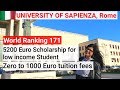 study in world best university
 Admissions
 Facts and Figures
 Sapienza University of Rome picture
 Sapienza University of Rome picture
 Sapienza University of Rome picture
 Rome
Rome University Front
 Aerial View
 Campus
 Main Building
 Hall Room
 Class room
 Students
 Why study at VU University Amsterdam
 VU University Amsterdam Campus Tour
 Master programme at VU Amsterdam
 VU International Business Administration
 Vu University Accommodation
 University Campus
 Science Building
 Campus
 Cultural Centre
 Campus Building
 Science Building
 Campus
 Basketball Court
 Campus
 VU University Amsterdam picture
Get a detailed campus view, add a college
Country Facts
Study in Italy
 Cheap and Affordable
 Education in Italy is cheap and affordable for international students
- Italy public universities offer some of the cheapest and the best courses
 High Living Standards
- Italy has a rich culture and standards of living are high
- Italy is the 8th biggest economy in the world, hence high living standards
 Plethora of Courses to Choose
- Over 90 Italian universities offer over 1000 plus courses
- Italy is known for its MBA, MS and specialised designing courses
Study in Netherlands
Top Ranked Universities- Home to top universities in the world as per QS Ranking.
- Universities offer renowned technical programmes and research options
English is widely used- Universities offer 2000 English taught programs in Bachelor and Masters
- Most Dutch speak English so it is easy to communicate in daily life.
Safety and Happiness- Netherlands is one of the safest countries in the world.
- The country also features among the top 10 happiest countries in the world.
Get a detailed view about the country. Add a college!
Student’s views on campus
Views on Sapienza University campus
J
Joan Joseph Thomas
MSc Artificial Intelligence and Robotics - Batch of 2026
3.8
Strong academics, limited campus life but rich in growth and discovery.
Tips: One of the most important things to be aware of before coming here is the language barrier. Even if your course is taught in English. Learning Italian is essential; you will have to use it almost every day to navigate your life in Italy, and especially for part-time work, knowing Italian is a must. The cultural transition is a mix of excitement and challenge. There is definitely a huge shift from India, from classrooms to the overall pace of life. It can feel a little bit isolating at first with limited campus life and the language difference, but over time, with friends, exploration of the cities and adapting to local customs, it starts feeling like home. There are a number of scholarships available, including regional ones. If you are selected, the fees will be waived off and also receive around 7000 euros in general and around 9000 euros if you are a female in STEM, as a 20% extra is issued if you are a female in STEM courses to cover your living expenses. The overall experience is very good and recommended. The academic experience is good, and Italy in general has a lot of experiences to offer in terms of culture, history and travel. There are Erasmus programs wherein you can study a semester or two at partner universities in Europe or other countries.
Likes (Public transportation): The campus is well connected by public transport like metro, buses, trams and trains. Buses are almost 24/7 available. There are annual metrobus cards available for 250 euros per year or at a discount of 130 euros per year if you are eligible for a scholarship. The card can be used for all types of available transport within a particular zone in Rome.
Dislikes (Student Life): Unlike campuses in India, there isn't really a central campus experience here. You typically go to classes, interact with classmates and return. While there are events and competitions, most of them are in Italian, which can feel quite accessible for international students. There are clubs and student communities, but information about them isn't well communicated. You often have to search explicitly and try to find it out; there isn't much visibility otherwise.
Total Monthly ExpenseEuro 550
Prepping time for classes35 hours/Week
Expected Annual SalaryEuro

Shreeja Chitty
MSc Environmental and Sustainable Building Engineering - Batch of 2026
4.3
There's a language barrier and fewer companies and opportunities.
Tips: Poor college life because of a language barrier. Most English-taught courses' campus is on the outskirts, making the university less enjoyable for international students. I have a merit scholarship that covers my entire tuition. I am satisfied with the university only because it offered me a scholarship. If not, I would join/prefer other countries.
Likes (Permanent Immigration): It is easier to immigrate and settle in Italy compared to other countries like the UK and the US. This country is a good place to retire, health improves, and the culture is generous. There are no major complaints except for the Schengen travel being hampered because of the longer wait time for a residence permit every year.
Dislikes (Internships): It's done by self/minimal guidance from the university. There's a language barrier and fewer companies and opportunities. It's difficult to find an internship relevant to your field, so I usually apply outside of Italy or in my home country. I'm currently working for an Indian company part-time remotely while I study. It's easier to manage both that way.
Total Monthly ExpenseEuro 600
Prepping time for classes40 hours/Week
Expected Annual SalaryEuro 10000
L
Lakshmi Narayana Phaneendra Peri
MSc Space and Astronautical Engineering - Batch of 2022
4.4
Great place for studies and research.
Tips: The Italian education system is way different from the Indian education system and is one of the toughest in the world. Being a student in Italy, learning the Italian language is a compulsory thing to do because it is one of the greatest barriers to break for easy survival. Once you are off the campus, you can hardly find someone who speaks English. Here, the professors have excellent knowledge of the subjects they teach and are always available if we need any help. They expect us to have a strong understanding of the fundamental concepts, which is particularly important during lectures. There are various scholarships available for international students from the government and the university. The students have to meet certain criteria set by the university in order to get a scholarship. During my Master's degree, I received a scholarship of around 5600 euros per year from the government. I obtained a Special Master's degree in Aerospace Engineering from the School of Aerospace Engineering, Sapienza University of Rome and earning this degree has been one of the best decisions I've ever made.
Likes (Value for money): In general, education in Italy is quite affordable. The tuition fee I paid for my Master's degree was around 1440 euros per year, which is significantly less expensive when compared with the tuition fee of the universities in the USA, Canada or the UK. At the same time, the quality of education offered here is very high.
Dislikes (Indian Food): There are very few Indian restaurants in Rome, and the food is expensive compared to other cuisines. The taste of Indian food here is not even close to the ones we find in India. In some restaurants, the quality of food is very poor. They store leftover food in refrigerators and use it for multiple days. I have tried almost all the Indian restaurants in Rome and have not been satisfied with the food there. I mostly prefer cooking my own food.
Total Monthly ExpenseEuro 600
Prepping time for classes10 hours/Week
Expected Annual SalaryEuro 28000
S
Samarth Ghoslya
Masters in Transport Systems Engineering - Batch of 2025
3.8
Strong academics and great facilities.
Tips: I received a fully funded scholarship. Scholarships are available for both bachelors and masters degrees. They should seek them out. Learning Italian makes your experience 10 times better in Italy. The faculty is highly knowledgeable and will assist you with your research work.
Total Monthly ExpenseEuro 650
Prepping time for classes8 hours/Week
Expected Annual SalaryEuro
Views on VU Amsterdam campus
R
Rajath Rao
Master in Computer Science (Parallel Computing Systems) - Batch of 2029
Offered by Vrije Universiteit Amsterdam (VU Amsterdam)
4.0
The university has a rich heritage and stands for excellence.
Tips: Amsterdam is a fun and interesting place to explore. There are many museums to explore and with a museum card you can visit over 500 museums in the Netherlands. There are also many academic institutions in the Netherlands.
Likes (Indian Food): There are many Indian stores in Amsterdam due to the large Indian population and the prices are affordable. There are also many diverse food options available. I prefer cooking for myself as it is more affordable and there are good canteens at the university as well.
Dislikes (Public transportation): The campus is well connected to the city via trams and buses. It is affordable with the OV chip. Most people use separate cycle lanes. Hence it is a very good city in terms of transportation. Also it is easy to travel to nearby countries.
Total Monthly ExpenseEuro 1600
Prepping time for classes11 hours/Week
Expected Annual SalaryEuro 45000
A
Anonymous
Master in Biomolecular Sciences - Batch of 2024
Offered by Vrije Universiteit Amsterdam (VU Amsterdam)
3.6
A Great Milestone to Achieve My Dreams
Tips: Moving abroad is honestly such a massive test of how independent you can actually be—you’ve got to be really on top of your own time and just open to a totally different vibe. When I first moved from India to Amsterdam for my Biomolecular Sciences degree at VU, it was such a mix of being super excited but also kind of overwhelmed by everything. The teaching style at Vrije Universiteit is way more focused on research and actually thinking for yourself instead of just memorizing stuff, which was a pretty big shift for me. Even things like the weather and the way people communicate took a bit of getting used to, but just hanging out with other international students made it way easier to settle in. I didn't actually get a scholarship myself, but they're definitely out there if your grades are solid. Honestly I'm glad I made the move as the education is top-tier and living in the Netherlands has given me so many cool opportunities in life sciences that I just wouldn't have found otherwise.
Likes (Internships): I went with a 4 for internships because, even though they're out there, trying to land one as an international student was honestly a bit of a nightmare. The uni didn't really give us much to go on—most of the work was just me hunting down companies and networking on my own, which got pretty overwhelming. They had some general stuff like career portals and CV workshops, but it wasn't specific enough for someone in Biotech or Molecular Biology, and they definitely didn't help with the whole sponsorship side of things. Most of what I saw was either too general or just admin work. Honestly, you can find a good spot, but don't expect the uni to do any of the heavy lifting for you—it's pretty much all on you.
Dislikes (Post study jobs): I gave it a 3 for job prospects because, honestly, it’s a bit of a mixed bag for international students in the Netherlands. Most local companies really prefer people who speak the language and already have the right permits, so it feels like a lot of doors are closed at first. But, there’s definitely a light at the end of the tunnel if you’re in stuff like IT, engineering, or biotech—places like Amsterdam and Leiden have a decent number of big firms that actually will sponsor your visa if you’ve got a STEM Master’s. You’ll mostly see roles for things like Lab Techs or Research Associates, and the pay usually starts around €2,500 to €3,500, which is okay but definitely depends on where you end up living. It’s an attractive place to work, for sure, but you really have to be smart about networking and targeting the right companies if you don't want to get stuck.
Total Monthly ExpenseEuro 1700
Prepping time for classes21 hours/Week
Expected Annual SalaryEuro
Add college to view Student's Review
Similar colleges 👇
Politecnico Di Milano
Milan, ItalyPublic
₹ 4.34 L - 42.39 L
Leiden University
Leiden, NetherlandsPublic
₹ 2.82 L - 25.1 L
University of Bologna
Bologna, ItalyPublic
₹ 1.12 L - 4.55 L
Utrecht University
Utrecht, NetherlandsPublic
₹ 12.27 L - 31.7 L
KTH Royal Institute of Technology
Stockholm, SwedenPublic
₹ 2.89 L - 29.48 L
University of Groningen
Groningen, NetherlandsPublic
₹ 2.9 L - 35.7 L
University of Helsinki
Helsinki, FinlandPublic
₹ 14.5 L - 20.08 L
IHE Delft Institute for Water Education
Delft, NetherlandsPrivate
₹ 7.44 L - 40.72 L
University of Bern
Bern, SwitzerlandPublic
₹ 2.31 L
Radboud University
Nijmegen, NetherlandsPrivate
₹ 2.9 L - 25.1 L
Sapienza University V/s VU AmsterdamRank Comparison
Ranks
Want to save this comparison?

Sapienza University V/s VU Amsterdam Popular & recent articles
Netherlands
Italy




View all News & Updates
