
Japan Student Visa 2026 For Indian Students: Eligibility, Steps to Apply, Cost
 Talk to Expert
Indian students planning to study in Japan in 2026 must apply for a Japan student visa for any full-time course longer than three months. This visa allows you to study at a Japanese university, stay legally, and work part time under specific rules.

Japan is fast emerging as a preferred study destination for Indian students. Ideal for students who are planning to study abroad in 2026. Why? You will get affordable public universities and a strong demand for skilled professionals. and a safe living environment. Japan is an alternative to destinations like US, UK, and Canada. Public universities in Japan are much cheaper than Indian private colleges.
To turn an admission offer into reality, you should understanding process of Japan student visa. For many applicants, the visa stage feels confusing.
The good news is that the Japan student visa for Indian students follows a structured process. The process is completely transparent. If you meet the requirements and apply on time, the approval rate is relatively high. Also, no issue like a cap on numbers of approved student visas.
This article is specifically for Indian students applying for the Japan student visa 2026 intake. In simple language, you will get to know financial requirements, application timelines, and common mistakes that you can make. Just understand the Japan student visa requirements and prepare your application with confidence.
- What Is a Japan Student Visa?
- Who Can Apply for a Japan Student Visa?
- Japan Student Visa Requirements for Indian Students (2026)
- What Is a Certificate of Eligibility (COE)?
- How Much Bank Balance Is Required for Japan Student Visa?
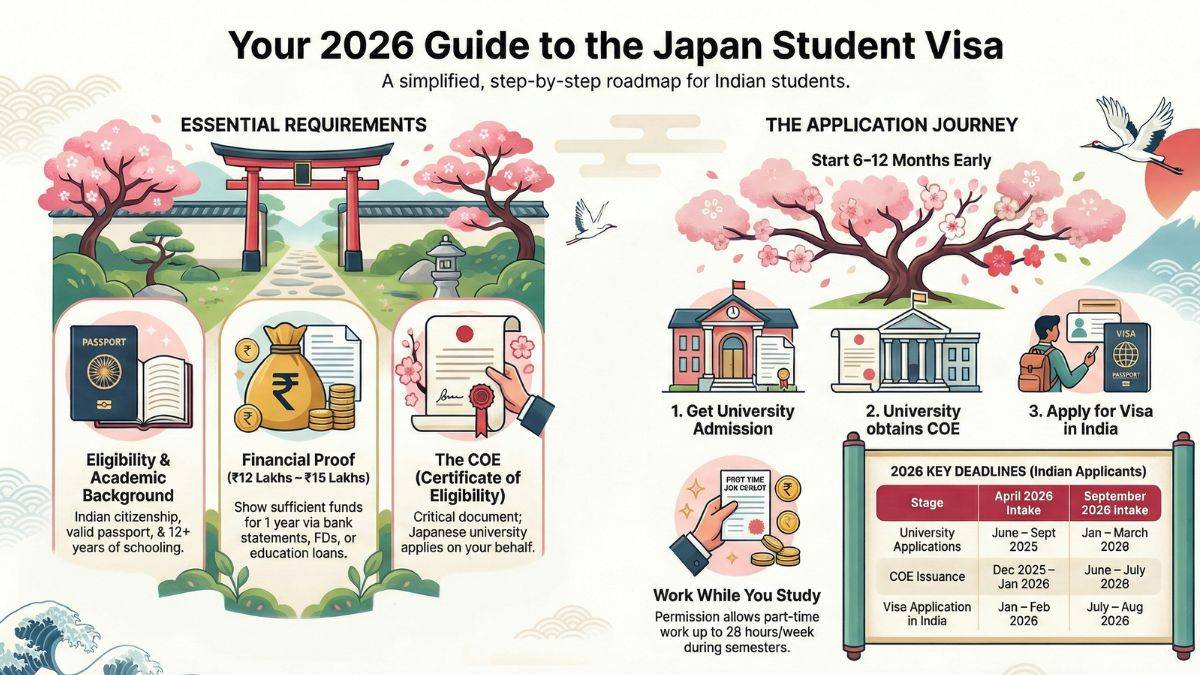
- Step by Step Japan Student Visa Process (2026)
- Part-Time Work Rules on a Japan Student Visa

What Is a Japan Student Visa?
A Japan student visa is a long-term visa issued to international students who are enrolled in a full-time academic program in Japan. Indian students need this visa if their course duration is more than 3 months. It includes degree programs at universities and colleges.
This visa allows you to legally study in Japan, stay for the full duration of your course. You can also work part time in Japan after receiving special permission. The visa is issued under Japan’s “College Student” residence status and is applicable for: UG, PG, and PhD programs
For Indian students, the process is well-defined and largely documentation-based, which means accuracy and early preparation play a major role in approval.
-
Application Timeline: Start the process 6 to 12 months before your course starts.
-
Financial Proof: You generally need to show approx. YEN 2,000,000 ( INR 11 Lakhs) in a bank account for a 1-year stay.
-
Japanese Proficiency: Many language schools require proof of 150+ hours of study or a JLPT N5 certificate. You can read about JLPT exam here.
-
Residence Card: Upon arrival at major airports, you will receive a Zairyu Card, which acts as your primary ID in Japan.
Who Can Apply for a Japan Student Visa?
The Japan student visa for Indian students is available to applicants who meet basic academic and institutional conditions. You do not need prior travel history or Japanese language skills to apply, as long as you fulfill the requirements.
You can apply for a Japan student visa if:
-
Citizenship: You are an Indian citizen with a valid passport.
-
Admission: You have a confirmed offer for a full-time course (3+ months) from a recognized Japanese university.
-
Education: You have completed at least 12 years of formal schooling (10+2).
-
Financial Backing: You can prove you have sufficient funds to cover tuition and living costs in Japan.
Students applying for April or September 2026 intake are equally eligible. The visa process is the same for undergraduate, postgraduate, and doctoral students.
Japan Student Visa Requirements for Indian Students (2026)
To apply for a Japan student visa, Indian students must submit a set of mandatory documents. These documents help Japanese immigration verify your identity, academic intent, and financial capability. Below is a short checklist with brief explanations, as required:
-
Valid Passport: Must cover your entire study duration
-
Certificate of Eligibility (COE): Issued by Japanese Immigration
-
University Admission Letter: Proof of confirmed enrollment
-
Academic Documents: Marksheets and certificates
-
Proof of Financial Capability: Bank statements or education loan papers
-
Visa Application Form: Filled and signed
-
Passport-Size Photographs: As per Japan visa specifications
All documents must be clear, consistent, and genuine. Any mismatch between your academic background, course choice, or financial proof can delay or impact the visa decision.
Predict your IELTS, TOEFL, and PTE in just 4 steps!
What Is a Certificate of Eligibility (COE)?
The Certificate of Eligibility (COE) is the most important document in Japan student visa process. Think that you can not get your student visa without this. The COE is issued by the Japanese Immigration Bureau and confirms that you meet all the conditions required to enter Japan as a student.
Indian students do not apply for the COE themselves. The Japanese universities applies on your behalf after you accept the admission offer.
Key points about the COE:
-
Applied by the Japanese institution
-
Confirms your purpose of stay
-
Includes course and duration details
-
Takes around 4 to 8 weeks to be issued
Once the COE is issued, it is sent to you electronically or by courier. You then submit it along with other documents when applying for the Japan student visa in India.
How Much Bank Balance Is Required for Japan Student Visa?
Indian students applying for a Japan student visa must show sufficient funds to cover cost of studying and living expenses for at least one academic year. For a 1-year course, Japanese immigration typically looks for a bank balance of INR 12 Lakhs to 15 Lakhs.
The total amount should cover:
-
Tuition Fees: Your full cost for the first year.
-
Living Costs: Rent, food, and insurance for at least 12 months.
Ways to Show Proof of Funds
You can show your financial strength using any of these documents:
-
Bank Statements: Personal or parents' account records for the last 6 months.
-
Fixed Deposits (FD): Savings that can be withdrawn if needed.
-
Education Loan: An official letter from a bank promising the funds.
-
Scholarship Letter: If you have received financial aid like MEXT or JASSO Scholarship.
Important Financial Rules
-
Stability: Large, sudden deposits right before applying can lead to rejection.
-
Sponsorship: If your parents are paying, you must provide a "Sponsorship Letter" and proof of their annual income (like ITR).
-
Fresh Records: All financial documents should be issued within the last 3 months.
Step by Step Japan Student Visa Process (2026)
Japan student visa process is systematic and predictable. If you follow the steps correctly, chances are high to get approval. Below is a simplified guide for Indian students to apply for Japanese Student Visa:
-
Apply to Japanese universities
-
Receive an official admission offer
-
Accept the offer and submit documents
-
University applies for your COE
-
COE is issued by Japanese Immigration
-
Submit visa application at Japan Visa Application Centre
-
Receive your Japan student visa
Most delays happen due to incomplete documents or late applications, so early planning is strongly recommended for the Japan student visa 2026 intake.
Timeline to Apply for Japan Student Visa
| Stage | April Intake (Main Intake) | September Intake (Secondary Intake) |
|---|---|---|
| University Applications | June to September 2025 | January to March 2026 |
| COE Application by University | October to November 2025 | April to May 2026 |
| COE Issuance | December 2025 to January 2026 | June to July 2026 |
| Japan Student Visa Application in India | January to February 2026 | July to August 2026 |
Part-Time Work Rules on a Japan Student Visa
Indian students holding a valid Japan student visa are allowed to work part-time, but only after receiving special permission "Shikakugai Katsudo Kyoka". You can learn basic Japanese words, if you want to work here.
Key rules you should know:
-
Maximum 28 hours per week during semesters
-
Full-time work allowed during official vacations
-
Work permission must be taken after arriving in Japan
-
Violating work limits can lead to visa cancellation
Part-time work in Japan helps manage living expenses, but studies must always remain the top priority.
For help with university applications, students seeking to study abroad can contact our Shiksha Study Abroad Counsellors. The comments section below allows candidates to contact us as well.

Commonly asked questions
Tokyo University is selective and competitive for any course so students need to score high in academics and must have extra curriculars to show as part of their profile. Along with that, students must fulfill eligibility requirements set by university. Students must submit some required documents such as university transcripts, LOR, CV, video and timed writing reflection and TOEFL or IELTS scores.
We have provided below the general admission requirements for undergraduate and graduate admission at Tokyo University:
University of Tokyo Undergraduate Admission Requirements
- Submit your official high school transcripts
- Meet the English language proficiency test requirements
- Additional test scores for ACT/SAT (optional)
- Submit two letters of recommendation
University of Tokyo Graduate Admission Requirements
- Must complete a bachelor’s degree in a relevant discipline
- Meet the English language proficiency test requirements
- Additional test scores for GMAT/GRE
- A Resume?
- Provide Two Letters of Recommendation
- The university also asks you to submit Two Essays
Japan is known for Science and innovation related studies in world. There are also many educational universities here to offer language course. Japan is affordable for Indian students as compared to other English speaking countries. Some famous courses in Japan are Science, Technology, Innovation and Research. All these reasons make Japan good study destination for Indian students.
As per the Embassy of Japan in India, around 12 Indian applicants qualifies for first screening of MEXT scholarship for studying in the year 2025. There are additional levels of scrutiny and the total number of Indian students who got the scholarship will be released.
 Statement of Purpose
 Letter of Recommendation
 Student Visa Application
 Admission Essay Writing
 Student Curriculum Vitae
Raj Vimal is an education writer and editor with over 8 years of experience. He helps Indian students find the right universities, visas, and courses abroad. Currently, he leads content strategies at InfoEdge India
Read Full Bio