
GMAT Data Insights Questions for 2026: Types, 50+ Sample Q&As & Prep Tips
 Talk to Expert
GMAT Data Insights questions test how well you read, sort, and reason with data. This article breaks down all 5 DI question types, shares real sample questions with answers, and gives an India-focused prep plan to help you score higher on this GMAT Focus Edition section.

If you've started GMAT Focus Edition prep, you've likely noticed that Data Insights (DI) questions don't look like anything from the old GMAT. There's no separate "Integrated Reasoning" add-on anymore. DI is now one-third of your total score on GMAT exam, sitting right alongside Quant and Verbal. That alone makes it worth taking seriously.
The GMAT Data Insights section blends five different question formats - Data Sufficiency, Table Analysis, Graphics Interpretation, Multi-Source Reasoning, and Two-Part Analysis into a single 45-minute, 20-question block. Each format tests a slightly different skill, but they all come back to the same core ability: pulling the right conclusion out of a pile of data under time pressure.
This guide walks through what each GMAT DI question type actually looks like, includes worked sample questions with answers, and closes with a GMAT study plan built around common mistakes Indian test-takers make. A companion PDF with 50+ practice Data Insights questions and full answers is linked at the end.
- What Is the GMAT Data Insights Section?
- Is GMAT Data Insights Difficult?
- Sample GMAT Data Insights Questions - Category-wise
- How Is the GMAT Data Insights Section Scored?
- How Many Data Insights Questions are Expected Category-wise?
- GMAT Data Insights Questions' Preparation Tips
What Is the GMAT Data Insights Section?
Data Insights is the newest of the three GMAT Focus Edition sections, introduced alongside Quantitative Reasoning and Verbal Reasoning. It replaced the old Integrated Reasoning section and absorbed Data Sufficiency questions that used to live inside Quant.
| Details | GMAT Data Insights Section |
|---|---|
| Number of questions tested | 20 |
| Time limit | 45 minutes |
| Question types | 5 (DS, TA, GI, MSR, TPA) |
| Score contribution | 1 of 3 sections used to calculate the 205–805 Total Score |
| Section score range | 60–90 (in 1-point increments) |
| Calculator use | On-screen calculator provided |
| Question order | Adaptive | Questions appear in a mixed, unpredictable sequence |
Your Data Insights sub-score carries the same statistical weight as Quant and Verbal when GMAC calculates your Total Score. Treating DI as an afterthought is one of the most common GMAT DI question prep mistakes.
Is GMAT Data Insights Difficult?
GMAT Data Insights is less about raw difficulty and more about logic and data-related practical approach. There's very little advanced math or vocabulary involved in this section of the GMAT exam format.
- DI tends to feel easier for: Engineers and data/analytics professionals used to spreadsheets and structured data, strong readers who can skim a table or chart, and anyone already comfortable with Data Sufficiency logic from the old GMAT Quant section.
- DI tends to feel harder for: Test-takers from a pure humanities or non-quantitative background, slower readers (MSR punishes re-reading), and anyone who tries to fully solve Data Sufficiency problems instead of just judging sufficiency.
Most Indian test-takers with an engineering or analytical background find DI approachable within a few weeks of targeted practice. GMAT Data Insights section rewards process over raw ability, which means it responds well to structured prep.
Sample GMAT Data Insights Questions - Category-wise
Every Data Insights question on test day is just one of five formats in disguise. Spot the format, and you already know how to attempt it. Below is a sample of each, with the same answer choices you'll see on the real exam. These categories are also part of GMAT exam syllabus for DI section.
1. Data Sufficiency (DS)
Tests whether the given information is enough to answer the question -and not the actual number. You get a stem plus two statements, judged against the same five choices every time.
SAMPLE DS QUESTIONS TESTED ON DI SECTION
| Sample Q1 - Data Sufficency | Sample Q2 - Data Sufficency |
|---|---|
| Is x > 0? (1) x² > 0 (2) x³ > 0 A) Statement (1) alone is sufficient B) Statement (2) alone is sufficient C) Both together are sufficient, neither alone is D) Either alone is sufficient E) Not sufficient even together |
A university received 5,000 applications from India. What per cent were admitted? (1) 750 Indian applicants were admitted. (2) The India offer rate was 5 points higher than the overall rate.
A) Statement (1) alone is sufficient B) Statement (2) alone is sufficient C) Both together are sufficient; neither alone is D) Either alone is sufficient E) Not sufficient even together |
| Answer: B -- x³ > 0 only if x is positive | Answer: A -- 750 / 5,000 = 15% |
2. Table Analysis (TA)
Tests whether you can sort a spreadsheet-style table and mark statements True or False. Sort by the column a statement references before judging it rather than an unsorted table. Sample TA questions are:
SAMPLE TA QUESTION TESTED ON DI SECTION
| Country | Avg DI score |
|---|---|
| India | 82 |
| China | 84 |
| USA | 78 |
| UK | 80 |
| Nigeria | 76 |
Q. Statement: India's average DI score is higher than the UK's.
○ True ○ False
Answer: True (82 > 80).
3. Graphics Interpretation (GI)
Tests whether you can read a chart and complete a statement from it using dropdown menus. Check axis labels and units first -- a misread axis is the most common cause of wrong GI answers. Sample GMAT Di question for GI is as follows:
SAMPLE GI QUESTION TESTED ON DI SECTION
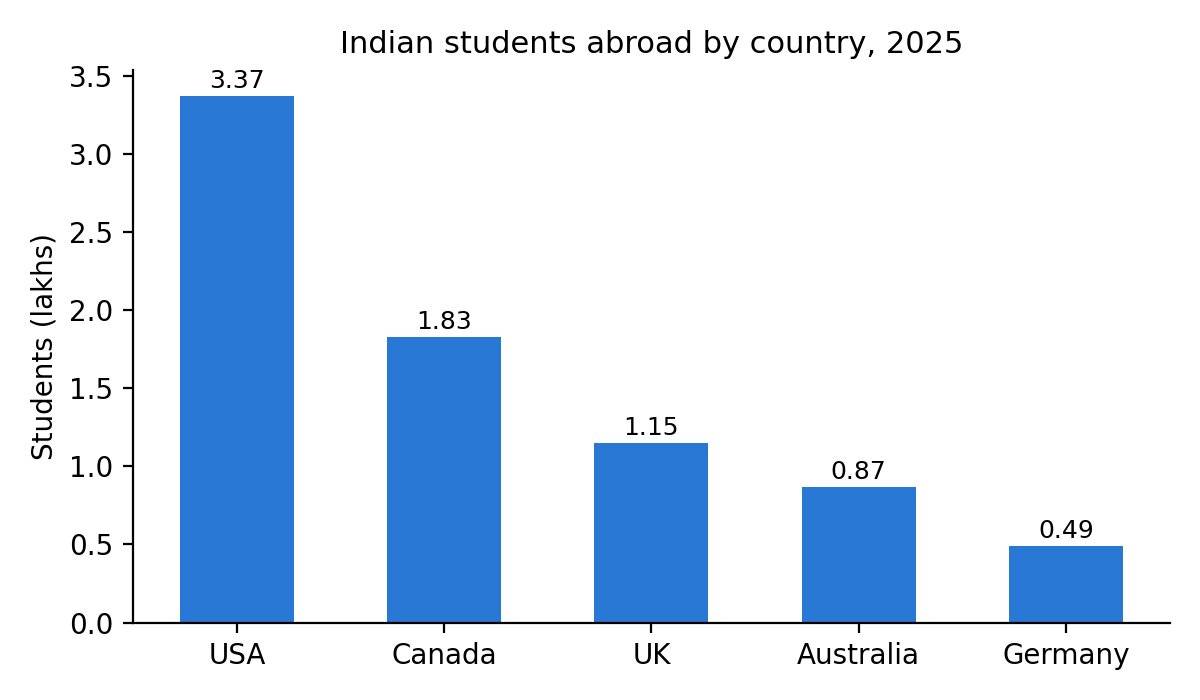
Q. Based on the chart above, which country ranks second in Indian students sent abroad?
Dropdown options: USA / Canada / UK / Australia / Germany
Answer: Canada.
4. Multi-Source Reasoning (MSR)
MSR tests whether you can pull facts scattered across 2-3 tabs -- only one tab is visible at a time. Skim every tab once first, so you know where each fact lives before you start answering. Here is a sample question for multi-source reasoning:
SAMPLE MSR QUESTION TESTED ON DI SECTION
Tab 1 (table): University Beta's Round 1 deadline is Oct 1.
Tab 2 (note): Only Round 1 applicants qualify for the merit scholarship.
Q. A student applies to Beta on Oct 5. Is she scholarship-eligible?
○ Yes ○ No
Answer: No, she missed the Round 1 deadline.
5. Two-Part Analysis (TPA)
Tests whether you can solve two related unknowns that share one answer table. Work out whether the two parts depend on each other before you start calculating.
SAMPLE TPA QUESTION TESTED ON DI SECTION
Q. Consultancy A charges a flat ₹50,000. Consultancy B charges ₹20,000 + ₹2,000/hour. For 10 hours of counselling, which is cheaper, and by how much?
| Consultancy Options | Charges |
|---|---|
| Consultancy A | ₹5,000 |
| Consultancy B | ₹10,000 |
| Consultancy C | ₹15,000 |
| Consultancy D | ₹20,000 |
Answer: Consultancy B, ₹10,000 cheaper (₹40,000 vs ₹50,000)
A 50+ GMAT Data Insights question set with answers, across all five formats. The downloadable PDF is here -
| GMAT DI 50+ Sample Questions with Answers: Free Download Sample GMAT DI Q&As Free PDF |
How Is the GMAT Data Insights Section Scored?
Each of the three GMAT exam sections - Quant, Verbal, and Data Insights is scored on a 60 to 90 scale. GMAC then converts your three section scores into a single total GMAT score of 205 to 805. Because DI carries equal statistical weight, a weak DI sub-score can pull your overall score down even if your Quant and Verbal scores are strong.
For Indian applicants specifically: competitive programs at top B-schools generally expect a DI sub-score in the high 70s to mid-80s, alongside similarly strong Quant and Verbal sub-scores. Since GMAT Data Insights is a newer section, many Indian test-takers under-prepare for it relative to Quant. This is exactly where a score advantage is easiest to build.
How Many Data Insights Questions are Expected Category-wise?
GMAC doesn't publish an exact fixed split for questions on DI. But based on GMAT official practice paper sets, the approximate distribution for GMAT DI questions looks like this:
| Question Types on GMAT DI | Approx. Count on Test Day | Approx. Time per Question |
|---|---|---|
| Data Sufficiency (DS) | 5–7 questions | ~2.0 minutes |
| Multi-Source Reasoning (MSR) | 4–6 questions (2–3 datasets) | ~3.0 minutes |
| Graphics Interpretation (GI) | 3–4 questions | ~2.5 minutes |
| Table Analysis (TA) | 3 questions | ~2.5 minutes |
| Two-Part Analysis (TPA) | 3–4 questions | ~2.3 minutes |
This is just an average. Timings are suggestions only; they can vary per applicant.
GMAT Data Insights Questions' Preparation Tips
Practice by question type, not by mock test. Isolate DS, TA, GI, MSR, and TPA separately before mixing them because each has its own trap.
- Get comfortable sorting spreadsheet-style tables. Sorting data and answering correctly is part of GMAT prep for DI.
- You should be at roughly the 22-23 minute mark halfway through the section. Make checkpoints for managing time.
- Treat Data Sufficiency as a logic puzzle, not a solve-it problem. You can judge sufficiency, not calculate a final value.
- Read MSR tabs before answering. Jumping between tabs mid-question wastes more time than a slower first read.
- Use official GMAT Data Insights practice questions first. Official GMAT books and study material calibrate difficulty and format far more accurately than third-party sets.
GMAT Data Insights isn't the section to leave for the last week of prep. It carries one-third of your GMAT exam score report. The fastest way to get comfortable is simple: learn what each of the five question types is actually asking of you, drill them individually before mixing them in a mock, and keep a pace checkpoint so Multi-Source Reasoning doesn't eat time meant for the rest of the section. None of that requires natural "data intuition". It's a learnable skill, and it responds quickly to structured, type-wise practice.
Predict your IELTS, TOEFL, and PTE in just 4 steps!
 Statement of Purpose
 Letter of Recommendation
 Student Visa Application
 Admission Essay Writing
 Student Curriculum Vitae
Aishwarya Bhatnagar is a specialised content curator with 8+ years of experience in EdTech content, particularly in studying abroad. She is a Study Abroad Expert at Shiksha.com (InfoEdge India Ltd) si
Read Full Bio