
GMAT score reports are often difficult to understand, because they have a lot of information in them. If you are about to give the GMAT soon, you must know how to read your GMAT score card and how to interpret your scores before sending them to B-schools.

If you are taking the GMAT exam for the first time, you should know that the official scores are released within 3-5 business days. GMAT score reports can be accessed from mba.com account. GMAT exam is conducted at test centres and also online, yet the GMAT score release timeline is the same. Those who will get their GMAT score cards for the first time would need to know everything about it.
There are different components on a GMAT score card. There are not just different types of scores - overall and sectional, but there are sectional analysis as well. Plus, there are GMAT score vs percentile based on comparison with peers who took GMAT in the same time.
GMAT score reports are extensive and comprehensive. They aim to give a complete view of your performance. So once you get your GMAT score reports you will see multiple things and we have discussed them in detail here. We have also attached a sample GMAT score card for your reference. If you also want to know how to read your GMAT score cards, then check out this article.
- What is a GMAT Score Report?
- How to Access GMAT Score Report?
- Understanding Your GMAT Score Report
- Sample GMAT Score Report
- Breaking Down the GMAT Scoring Components
- What Does Your GMAT Score Really Mean?
- How to Improve Based on Your GMAT Score Report?

What is a GMAT Score Report?
A GMAT score report is a summary of the scores on Quantitative Reasoning, Verbal Reasoning and Data Insights. The score reprot of GMAT is primarily used by various B- schools to evaluate your readiness for graduate management programs. It provides a standardized measure of your skills in quantitative reasoning, verbal ability and data literacy. There are two types of GMAT score reports - official and unofficial. Check out how they differ from one another below-
Difference Between Official and Unofficial GMAT Score Report
After completing the GMAT Online or GMAT at test centre, you can immediately see your unofficial scores on the screen. But after a few days, the official GMAT score report is released for everyone. Here is where the main difference lies-
| Feature |
Unofficial GMAT Score Report |
Official GMAT Score Report |
|---|---|---|
| Availability |
Immediately upon completing the exam. |
Typically within 3 to 5 business days. |
| Format |
On-screen preview only; cannot be saved, printed, or screenshotted. |
Digital PDF available for download via your mba.com account. |
| Score Content |
Total Score (205–805) and individual section scores. |
Total Score, section scores and final percentile rankings. |
| Detailed Insights |
None; provides only high-level scores. |
Includes full performance analytics (pacing, accuracy by question type, etc.). |
| Academic Use |
For personal reference and immediate decision-making (accept/cancel). |
The only version recognized and accepted by B-schools for applications. |
| Official Validity |
Temporary; subject to verification by GMAC. |
Verified and valid for 5 years from the test date. |
You cannot copy or take pictures or screenshot your unofficial scores that you see right after the exam completes. If you are caught doing this, you GMAT scores can be cancelled by GMAC.
How to Access GMAT Score Report?
Obtaining your GMAT score is very easy! You can log into your “My Account” at the official MBA website to look up, save, or print off an official GMAT score. Here is the process to access the official GMAT score report:
- Log in to the MBA website.
- After logging in go to the ‘My Account’ tab, and you will see the list of your GMAT scores.
- Your Unofficial Score Report will be available to you immediately following your GMAT exam.
- But the official GMAT score will be provided to you approximately 3-5 business days. For this, you only have to log on to get your GMAT score report.
You may print or download your Official Score Report if you want; your score will be valid for five years.
Understanding Your GMAT Score Report
Understanding your GMAT score report for FE requires looking beyond the total score. GMAT score report is highly analytical and provides a deeper insights around reasoning and data literacy skills. Here is how you can understand your GMAT score report.
1. Three Primary GMAT Scores - Overall, Sectional & Percentile
Your total GMAT score is a composite of three sections, each of which is weighted equally toward your final result. Being able to score well is important, most importantly, meeting the GMAT cutoffs based on -
- Overall Score- GMAT scores are between 205 and 805 which is followed for the GMAT Focus Edition.
- Section Scores (60-90)- You receive an individual score for Quantitative Reasoning, Verbal Reasoning and Data Insights.
- Percentile Rankings- These tell you what percentage of test-takers you outperformed over the last three years.
2. Built-in Performance Insights
The modern report automatically includes detailed analytics that used to be sold separately as the "Enhanced Score Report". Based on how well you prepared for GMAT exam syllabus, your performance is evaluated. You should pay close attention to-
- Performance by Content Domain- This breaks down your accuracy within specific areas, such as Algebra vs. Arithmetic in Quant, or Critical Reasoning vs. Reading Comprehension in Verbal.
- Time Management- The report tracks your average response time per question and identifies where you may have rushed or stalled.
- Question Review & Edit History- It shows how you used the feature to change up to three answers per section and how those changes impacted your score.
3. Comparing to Historical Averages
Because the current scale is different, numerical scores look lower than in the past. Admissions committees use concordance tables to compare your results to the old 800-point scale-
| Current GMAT Score |
Approx. Percentile |
Equivalent "Old" Score |
Competitive Level |
|---|---|---|---|
| 705 |
98th |
750 |
Elite (Top programs) |
| 675 |
95th |
720 |
Very Strong |
| 645 |
86th |
700 |
Strong (Top 15–20) |
| 615 |
77th |
670–680 |
Competitive |
Predict your IELTS, TOEFL, and PTE in just 4 steps!
Sample GMAT Score Report
For those who do not know how an actual GMAT score report looks like, here is a sample. This sample GMAT score report is only for reference, check it out below:
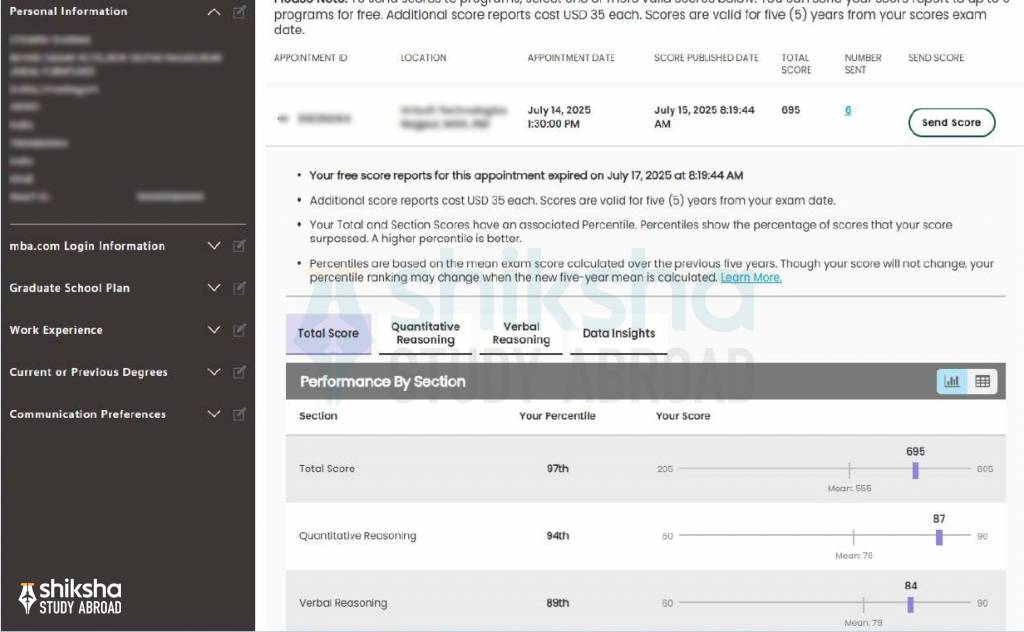
This is how GMAT scores are given on a report. There are overall and sectional scores mentioned. Applicants must note, that is only for reference and should not be used for any other purpose.
Breaking Down the GMAT Scoring Components
Multiple components together make one consolidated GMAT score report. These components show not just the scores but also sectional scores including percentile rankings. Here is a complete analysis of all the components of the GMAT score report-
- Total Score- Ranges from 205 to 805, with all scores ending in a 5. It is a composite of all three sections, each weighted equally.
- Section Scores- You receive a score for each of the three sections of Quantitative Reasoning, Verbal Reasoning and Data Insights, on a scoring scale of 60 to 90.
- Percentile Rankings- These show the percentage of test-takers you performed better than over the past three years.
- Performance Insights- Modern reports include detailed analytics formerly found in the "Enhanced Score Report," such as performance by question type, time management and focus areas, all included at no extra cost.
What is GMAT Enhanced Score Report?
The GMAT Enhanced Score Report (ESR) provides in-depth knowledge of a candidate’s performance and provides an extensive overview of his execution in the examination. The ESR provides a detailed analysis of a candidate’s performance – by question type, areas for focus and pacing, so they can further develop their preparations and do even better in the next time around. GMAT ESR also provides candidates with an opportunity to focus better on test-taking strategy, preparation and future study. However, the candidates should keep in mind that the ESR is available to better evaluate one's strengths and weaknesses and should NOT be treated as the Official Score Report.
What Does Your GMAT Score Really Mean?
Think of your GMAT score like a report card, but for business school readiness. It tells colleges how comfortable you are with things like numbers, logic and understanding written information. Not how smart you are in general. Just how well you handled this specific test. This is how your GMAT scores are analysed by B-schools abroad-
-
The most important part isn’t the raw score (like 645 or 705), but the percentile. A score of 705+ (FE) is roughly 90th+ percentile. This is what business schools care about most, how you rank globally, not just your GMAT preparation or score.
- Your GMAT exam performance measures math + data skills on the QR section; (reading, logic, argument analysis on VR section and, interpretation, multi-source reasoning on DI. It does not measure your creativity, leadership, emotional intelligence or real-world business ability.
-
A GMAT score is just one part of your MBA eligibility abroad for application. Schools also look at your work experience, achievements and personality. In simple terms, your GMAT score answers one question for colleges- “Can this student handle our academic workload?” If Ad coms feel confident, you can get admission.
- GMAT exam results also play a crucial role in helping you get GMAT score based scholarships. While there are not a lot of them, but whatever are available, universities automatically consider applicants for scholarships. This is an added advantage.
Overall, B-schools typically look for a balanced profile across all three sections rather than a very high score in one and a low score in another.
How to Improve Based on Your GMAT Score Report?
Based on the GMAT score report, you can improve on your sectional or overall scores. The report shows time management skills per question and some skill based analysis, based on which preparation can be tweaked. Here are some tips to improve scores based on GMAT score report:
- First, check your sectional scores and understand how you performed. Whichever section sees the lowest score, check the report to know what went wrong.
- Second, if you are dissatisfied with your overall GMAT scores, then plan to fix them as well.
- If time management was a problem, understand how to go about and make it right when preparing for GMAT at home.
- Next, devise a GMAT exam preparation plan based on section or overall score improvement.
- Ensure you retake GMAT as per the rules and not before the cooling period.
- Take GMAT practice tests before the second attempt and simulate exam like conditions to be able to perform better on the exam day.
This was all about the GMAT exam report. There multiple layers to understanding what goes into a GMAT score report and how interpreting scores is essential to assess performance. If you are also planning to apply for MBA abroad, sign up for free Shiksha Abroad Counselling and request for an expert session.

Commonly asked questions
GMAT Cut Off is the minimum GMAT score required to get into your desired business school. The GMAT Cut Off is decided by the universities themselves. A GMAT score of 700 or above will be accepted by a majority of business schools. Majorly, it is the top B-schools that require a score of more than 700. Students must understand that a GMAT score is only a part of their application and is not the only criteria. In order to get selected in top MBA colleges, student must focus on building a holistic profile which has a fine balance of academics, a good GMAT score, and extracurricular activities.
645 on the GMAT is 88th percentile. Usually, candidates get a score even less than a good GMAT score. With a 645 GMAT score they may qualify for most of the top business schools.
No, there is no provision for superscoring GMAT scores upon multiple retakes. The last exam that applicant takes will be the final score. They send all your GMAT results. However, some business schools might pick your best sections. But the official GMAT score report shows every exam separately.
A good GMAT score will only improve your academic profile and application when applying for MBA or MIM abroad. However, GMAT score is not the only deciding factor for their selection to business schools. Application documents are equally important.

 Statement of Purpose
 Letter of Recommendation
 Student Visa Application
 Admission Essay Writing
 Student Curriculum Vitae
Aishwarya Bhatnagar is a specialised content curator with 8+ years of experience in EdTech content, particularly in studying abroad. She is a Study Abroad Expert at Shiksha.com (InfoEdge India Ltd) si
Read Full Bio