
Indian Politicians with Foreign Degrees: What Global Education Taught India’s Leaders
 Talk to Expert
Did you know Dr. Manmohan Singh, Dr. B.R. Ambedkar, and Jyotiraditya Scindia all share a common link beyond politics? They were once students in foreign classrooms. This article reveals verified educational journeys of India’s top leaders. Explore how studying abroad shaped their thinking.

When Indian students think about studying abroad, they imagine better jobs, global exposure, and a chance to see the world. Very few pause to ask a deeper question: What does studying abroad actually do to the way you think?
Long before YouTube, LinkedIn, or ChatGPT existed, some Indians packed their bags. They crossed oceans and studied in foreign classrooms. They were not chasing comfort. They were chasing perspective. Many of them would later return and contribute to shape India’s economic policies, legal frameworks, governance systems, and global relationships.
This article is not about politics. It is about learning journeys. It is about how exposure to international education sharpened minds, widened worldviews, and helped Indian leaders think beyond borders. It will help you to know why that matters deeply for Indian students planning to study abroad in 2026.
If you’re an Indian student wondering whether studying abroad is “worth it”. These stories matter to you. Because before they became decision-makers, they were students too. Just like you are. This article is all about the story of Indian politicians who earned foreign degrees. To ignite every young Indian who is dreaming of a bigger future.
- Verified Indian Politicians with Foreign Degrees
- Why This Matters for Indian Students in 2026
- What These Indian Leaders Have in Common (Before the Names)
- Journeys of Top 10 Indian Politicians With Foreign Degrees
- What Studying Abroad Gave These Leaders (Beyond Degrees)
- Myths Indian Students Believe About Studying Abroad
- FAQs About Indian Politicians with Foreign Degrees

Verified Indian Politicians with Foreign Degrees
This table lists Indian politicians who have completed foreign degrees from universities abroad. Every name included here has been strictly verified using official sources such as Parliament records, government biographies, or election affidavits submitted to the Election Commission of India. The focus is not on politics, but on their educational journeys. To show how global learning shaped individuals who later played important roles in India’s public life.
| Name | Office(s) Held | Foreign Degree(s) | University / College |
|---|---|---|---|
| Jawaharlal Nehru | Prime Minister | Tripos (Natural Sciences); Bar-at-Law | Trinity College, University of Cambridge (UK) |
| Dr. Manmohan Singh | Prime Minister, MP | Economics Tripos; D.Phil |
|
| Rahul Gandhi | MP | Bachelor’s; M.Phil (Dev. Studies) |
|
| Akhilesh Yadav | CM, MP | Master’s (Env. Engineering) | University of Sydney (Australia) |
| Dr. B. R. Ambedkar | Law Minister | MA, PhD (Economics); MSc, DSc |
|
| Shankar Dayal Sharma | President of India | PhD (Law) | Fitzwilliam College, University of Cambridge (UK) |
| P. Chidambaram | Finance & Home Minister | MBA | Harvard Business School (USA) |
| Kapil Sibal | Law Minister, MP | LL.M. | Harvard Law School (USA) |
| Subramanian Swamy | Union Minister, MP | PhD (Economics) | Harvard University (USA) |
| Sachin Pilot | Minister of State, MP | MBA | The Wharton School, University of Pennsylvania (USA) |
| Shashi Tharoor | Minister of State, MP | MA; MALD; PhD | The Fletcher School, Tufts University (USA) |
| Jyotiraditya Scindia | Union Minister, MP | BA; MBA |
|
| Salman Khurshid | External Affairs Minister | BCL; MA | St Edmund Hall, University of Oxford (UK) |
| Mahua Moitra | MP | BA (Economics & Math) | Mount Holyoke College (USA) |
| Omar Abdullah | CM, Minister of JK | MBA | University of Strathclyde (Scotland, UK) |
| Naveen Jindal | MP | MBA | University of Texas at Dallas (USA) |
How We Define a “Completed Foreign Degree”
To maintain accuracy and transparency, we followed strict criteria while compiling this list:
- What we considered as a completed foreign degree:
- Bachelor’s, Master’s, or Doctoral degrees formally awarded by a university located outside India
- Degrees explicitly mentioned as completed in official records
- Academic qualifications that required full-time or formally structured study
- What we did not include:
- Short-term courses, executive programs, certificates, or fellowships
- Exchange programs or partial study without degree completion
- Cases where a person is described as having “studied at” a foreign universities without earning a degree
Why This Matters for Indian Students in 2026
Decades ago, when politicians like Dr. Ambedkar or Jawaharlal Nehru chose to study abroad, they weren’t chasing corporate salaries. They left at a time when travel was rare, expensive, and uncertain.
Today, careers are no longer limited by geography. Companies work across time zones. Ideas travel faster than passports, they do not need visa. In this landscape, the ability to think globally has become just as important as technical skill. For students planning to study abroad in 2026, the goal is no longer just to get a foreign degree. It is to develop a “Global Mindset.”
What is ROI of Studying Abroad
- Confidence & Perspective: These political leaders gained more than just book knowledge. This builds the confidence to see problems from multiple angles.
- Resilience: Navigating a new culture and the best educational systems forces you out of your comfort zone, building the grit needed for modern leadership.
For Indian students planning to study abroad in 2026, this story is relevant because the goal is no longer just a foreign degree. It is about developing a mindset that allows you to navigate complexity, adapt across cultures, and contribute meaningfully in a global environment.
What These Indian Leaders Have in Common (Before the Names)
Before they became prime ministers, ministers, or lawmakers, these individuals shared a few similarities that had nothing to do with power or politics.
- Focus on Systems and Not on Exams: Most of them chose subjects like economics, law, engineering, or public policy. It teaches how systems function, not just how exams are cleared.
- Culture of Questioning: They studied in academic environments. Their questioning was encouraged, and disagreement was considered part of learning.
- Evidence Over Authority: They learned to think independently. To defend ideas with logic and evidence rather than authority.
All these learning helped them. In leadership and decision making. Long before they held any public office. You can explore the benefits of studying abroad in detail.
Predict your IELTS, TOEFL, and PTE in just 4 steps!
Journeys of Top 10 Indian Politicians With Foreign Degrees
Now, let's know about the journeys of Indian politicians who have contributed to shaping the country. Their learning helped them to make policies for India. From constitution to leading the country after Independence. Their studies helped them to think at broder level. Let's know about them one by one.
Jawaharlal Nehru: First Prime Minister of India
- Tripos (Natural Sciences), Trinity College, University of Cambridge
- Fields: Science, Philosophy, Global Affairs
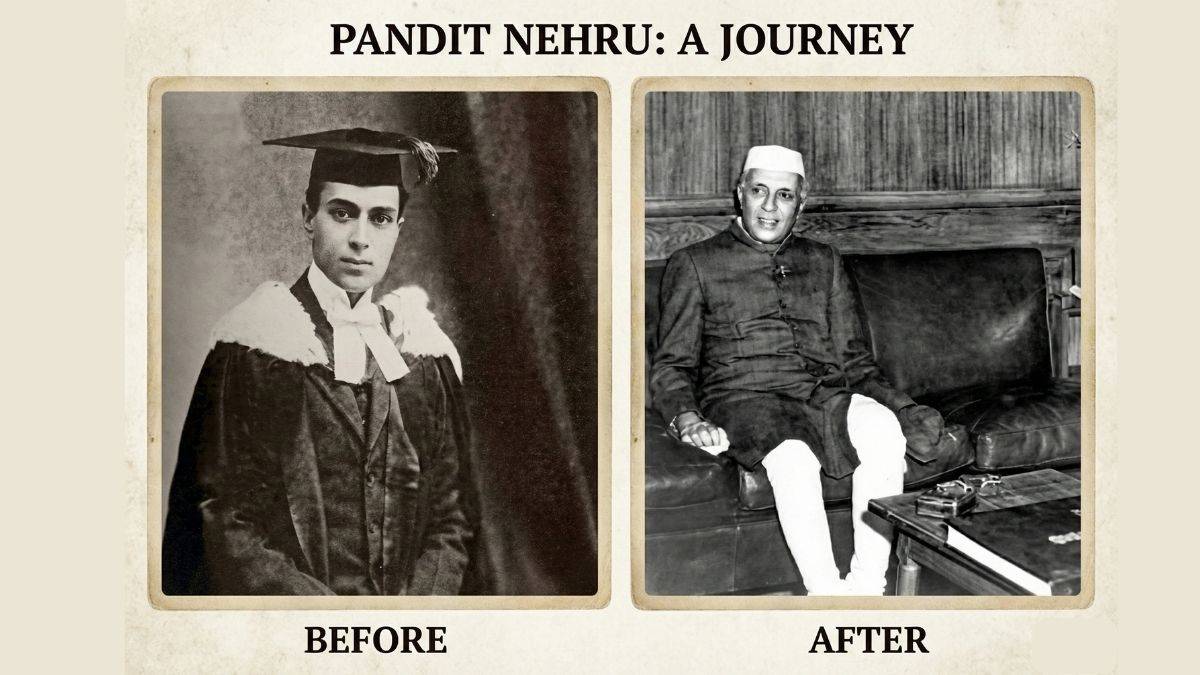
Why He Inspires Indian Students
Jawaharlal Nehru left India when travel was rare. He went to Cambridge University to study. There, he studied world politics and learnt new ideas. He learned to ask questions and listen to opinions. Later, Jawaharlal Nehru became the first prime minister of India. He is the longest serving PM of India, till now.
If you are going to study abroad this year, you can learn many things from Nehru. How studying abroad can change your perspective on seeing the world
Dr. B. R. Ambedkar: Father of the Indian Constitution
- MA & PhD (Economics), Columbia University; MSc & DSc, London School of Economics
- Fields: Economics Law, Social Justice
Why He Inspires Indian Students
In 1891, a boy was born in the home of Ramji Maloji Sakpal (a Subedar in the British Indian Army) in Madhya Pradesh. He was not allowed to drink water in school if the peon was absent. Only the peon could pour water for him; if no peon, no water. He studied hard and gained admission to Columbia University and the London School of Economics. Ambedkar understood democratic rights and later became the Chief Architect of the Indian Constitution.
Education gave him intellectual confidence and the tools to challenge injustice using reason and law. His life proves that studying abroad is not about privilege. It can be about empowerment, dignity, and transforming society through knowledge.
Dr. Manmohan Singh
- Economics Degree, University of Cambridge; D.Phil, University of Oxford
- Fields: Economics, Public Policy, Finance
Why He Inspires Indian Students
A boy born into a poor Sikh family in West Punjab (Pakistan) saved the Indian economy in 1991. He was none other than the former Prime Minister of the Republic of India, Dr. Manmohan Singh. He is considered the architect of India's major economic reforms (liberalization, privatization, and globalization)
Dr. Manmohan Singh came from modest beginnings and rose through academic excellence. He has degrees from Cambridge and Oxford. Both universities are among the top 10 universities in the world.
Studying abroad shaped his calm, analytical approach and belief in evidence-based decision-making. For students, his journey shows how strong academic foundations and global exposure can quietly shape long-term leadership and impact.
Rahul Gandhi
Rahul Gandhi completed his undergraduate studies in the United States. Later earned an M.Phil in Development Studies from the University of Cambridge. Studying abroad improved his viewpoints and debate-driven learning. For Indian students, his experience highlights how international education builds perspective and independent thinking beyond classroom outcomes.
Akhilesh Yadav
Akhilesh Yadav earned a master’s degree in environmental engineering from the University of Sydney. His education introduced him to sustainability and infrastructure planning. For students, his journey shows how technical education abroad can shape how you approach real-world development challenges back home.
P. Chidambaram
Former finance minister and home minister of India, P. Chidambaram earned an MBA from Harvard Business School. Yes, he has the dream to study in USA, just like some of you have. There, he was trained in analytical thinking and global economic frameworks. Studying abroad helped him to understand international perspectives on finance and governance. For students, his journey highlights how management education overseas sharpens strategic thinking.
Kapil Sibal
Kapil Sibal completed his LL.M. at Harvard Law School. One of the world’s most reputed institutes in the world. Studying law abroad trained him in constitutional debate and clarity of argument. For Indian law students, his journey shows how global education strengthens intellectual confidence and critical thinking.
Shashi Tharoor
Shashi Tharoor pursued advanced studies in international affairs at The Fletcher School, Tufts University. His education developed global awareness, communication skills, and diplomatic thinking. For Indian students, his journey shows how studying abroad can build both academic depth and the ability to navigate multicultural environments.
Jyotiraditya Scindia
The 56th Minister of Communications of India, Jyotiraditya Scindia, studied at Harvard University. Later, he earned an MBA from Stanford Graduate School of Business. His education blended liberal arts thinking with modern management principles. For Indian students, his journey shows how combining global exposure with academic rigor prepares individuals for complex leadership roles.
Omar Abdullah
Omar Abdullah earned an MBA from the University of Strathclyde in the United Kingdom. Studying in an international academic environment broadened his perspective on management and leadership. For Indian students, his journey highlights how global education builds adaptability and confidence in unfamiliar settings.
What Studying Abroad Gave These Leaders (Beyond Degrees)
A foreign degree alone does not transform a person. But the experience surrounding it often does. Living and studying in another country forces you to adapt to new cultures. Over time, this shapes how you approach problems, people, and responsibility.
- Global Perspective: Exposure to international ideas helped these leaders understand how different societies solve problems and what India could adapt or avoid.
- Confidence: Succeeding in rigorous academic environments abroad builds belief in one’s own thinking and voice.
- Independent Reasoning: They learned to question systems, challenge assumptions, and think beyond inherited frameworks.
- Long-Term Networks: Relationships formed during study abroad often last a lifetime and quietly shape future collaboration.
These qualities did not fade after graduation. They continued to influence how these individuals thought and worked long after they returned.
Myths Indian Students Believe About Studying Abroad
You have information about Indian politicians with foreign degrees. Some of you may think that they have studied abroad because they have big pockets. Well, this is not all true. We have mentioned some of the important myths vs reality points to help you. This will clear you confunsions regarding studying abroad:
| Myth | The Reality |
|---|---|
| Only rich students can study abroad. | Many Indian students study overseas through scholarships, assistantships, and education loans. Financial background matters less than preparation and clarity. |
| A foreign degree automatically guarantees success. | A degree opens doors, but long-term success depends on your mindset and efforts. All it matters is how well you apply what you learn. |
| Studying abroad disconnects you from India. | Global exposure often strengthens perspective and increases the desire to contribute meaningfully back home. |
| You must study at a top-ranked university to succeed. | The quality of learning, thinking style, and exposure matters more than rankings alone. |
FAQs About Indian Politicians with Foreign Degrees

Commonly asked questions
Mahatma Gandhi studied law. He studied at University College London. He completed his law degree. He was called to Bar in 1891. He was just 22 years old at that time.
Dr. Ambedkar is one of most educated Indian leaders. He received a PhD in Economics from Columbia University. He got a DSc from LSE. Ambedkar became a barrister at Gray's Inn in London. Later, he contributed in drafting Indian Constitution.
Jawaharlal Nehru studied at Trinity College, Cambridge. He received a degree in natural sciences in 1910. Later he moved to London to study law. He became a barrister in 1912.
Nehru returned to India. Contributed in freedom fight. Became first prime minister of India in 1947.
Rahul Gandhi has a UG degree from Rollins College in Florida, USA. He also holds an M.Phil degree in Development Studies. Rahul received this PG degree from Trinity College. Currently, he is a member of Indian parliament. Before joining politics, he worked for three years with Monitor Group. A management consulting firm in London
 Statement of Purpose
 Letter of Recommendation
 Student Visa Application
 Admission Essay Writing
 Student Curriculum Vitae
Raj Vimal is an education writer and editor with over 8 years of experience. He helps Indian students find the right universities, visas, and courses abroad. Currently, he leads content strategies at InfoEdge India
Read Full Bio