
M.Tech in Germany: Fees, Top Colleges & Requirements
 Talk to Expert

M.Tech in Germany usually means an engineering master's degree such as an MSc or MEng, as German universities do not commonly use the Indian M.Tech title. Over 60,000 Indian students enrolled in Germany last year, a 20% jump from the previous year. Most of them came for engineering master's programs that cost close to nothing at public universities. This guide covers everything about M.Tech in Germany for the 2027 intake, from fees to job salaries.
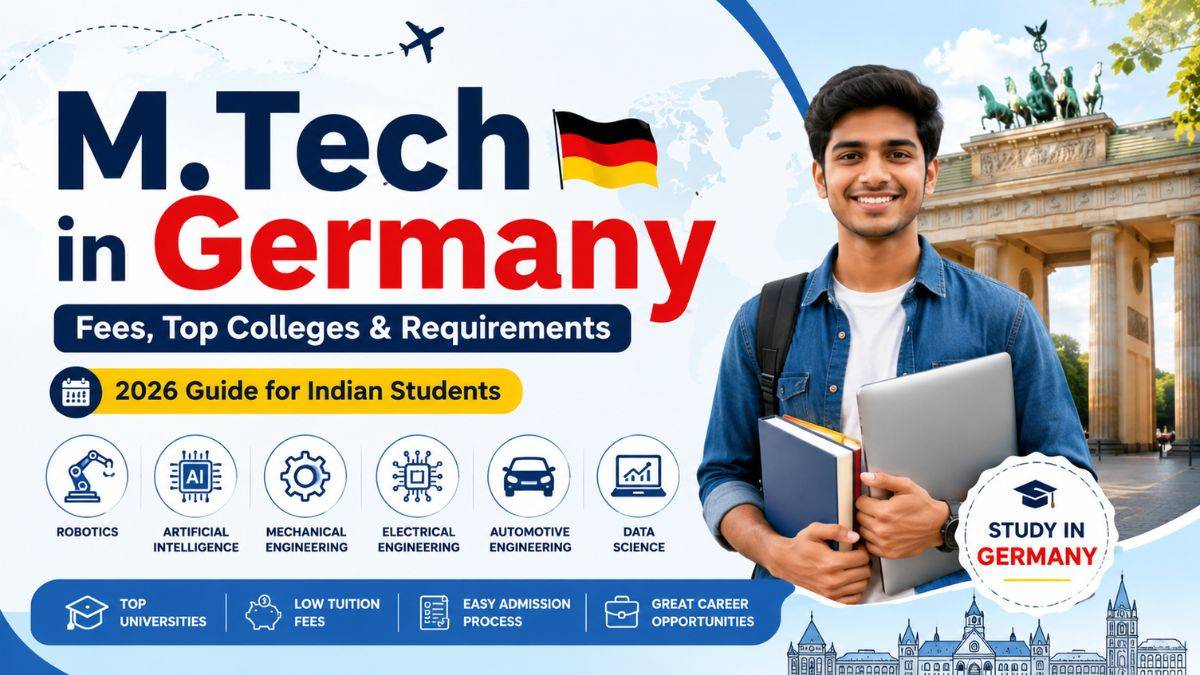
Germany is a popular destination for an M.Tech in Germany or an equivalent engineering master's degree at a world-ranked university. Many public universities do not charge general tuition for consecutive master's programmes, but students pay a semester contribution. This is usually EUR 70 to EUR 430 (about INR 7,472 to INR 45,898) per semester. Some states and universities charge additional tuition for non-EU students. Costs below use EUR 1 = INR 106.74 (October 2026).
Germany offers globally ranked universities, research-led teaching, industry links and engineering master's programmes in areas such as mechanical engineering, computer science, automotive engineering and renewable energy. Tuition rules depend on the state, university and course.
In the QS World University Rankings 2027, TUM ranks 25th globally, RWTH Aachen ranks 104th and KIT ranks 110th. These are overall university rankings, not subject-specific engineering rankings. The rankings were published on 18 June 2026.
Most universities in Germany do not offer a traditional Indian-style M.Tech degree. Instead, students study MS (Master of Science) or MEng (Master of Engineering in Germany) programs that are considered equivalent to M.Tech in India. These programs focus on research, practical learning, and technical skills required in global industries.
M.Tech in Germany prepares you for jobs in Europe's largest economy. This guide explains the top universities, Germany M.Tech fees, eligibility, scholarships, admission process, and career opportunities for Indian students planning to pursue M.Tech in Germany in 2027.
- Why Study M.Tech in Germany?
- Admission Intakes for M.Tech in Germany
- Top Universities for MTech in Germany
- Top Specialisations in M.Tech in Germany
- MTech in Germany: Admission Requirements for Indian Students
- How to Apply for M.Tech in Germany?
- Cost of Studying for M.Tech in Germany
- Scholarships to Pursue M.Tech in Germany
- Career Opportunities After M.Tech in Germany
- M.Tech in Germany FAQs

Why Study M.Tech in Germany?
Germany gives you a globally respected engineering degree, strong industry exposure, and a real path to working in Europe after graduation. Here is what makes it stand out for Indian students.
- Low or no tuition fees at many public universities in Germany. Semester contributions generally range from EUR 70 to 430 (about INR 7,472 to INR 45,898), while additional tuition may apply at some universities and in certain states.
- QS-ranked programs with TUM at rank 25 and RWTH Aachen at rank 104 globally in the QS World University Rankings 2027.
- Direct industry links with BMW, Siemens, Bosch, Volkswagen, and SAP.
- 18-month post-study work visa to find a job in Germany after graduation.
- English-taught programs available at all major TU9 universities.
- Large Indian student community of over 60,000 students makes it easier to settle in.
Admission Intakes for M.Tech in Germany
Germany runs two intakes every year. The winter semester is the main intake and has the most programs open. The summer semester has limited options. Indian students targeting the Germany 2027 intake should start the APS certificate process at least 6 to 8 weeks before applying, since it is mandatory and takes time.
Here are the key dates for 2027:
| Intake |
Application Deadline |
Notes |
|---|---|---|
| Winter (October Intake) |
May to July |
Main intake, most programs open |
| Summer (April Intake) |
November to January (Next Year) |
Limited programs |
If you are targeting the German Winter Semester 2027/28, check each programme's deadline early. Deadlines vary by university and course; many winter-intake applications close between May and July 2027. For summer semester 2027, some deadlines fall between November 2026 and January 2027. Apply for APS and prepare language scores well before the relevant deadline.
Top Universities for MTech in Germany
Several leading options for M.Tech in Germany are public universities, including members of the TU9 alliance, Germany's group of leading technical universities. Tuition depends on the state and programme, so do not assume that every public university is tuition-free. The table below uses the QS World University Rankings 2027.
| University |
QS World University Rankings 2027 |
Top Specialisations |
|---|---|---|
| TU Munich (TUM) |
#25 |
CS, Mechanical, Data Engineering |
| KIT Karlsruhe |
#110 |
Mechanical, CS, Environmental |
| RWTH Aachen |
#104 |
Mechanical, Automotive, Robotics |
| TU Berlin |
#158 |
EE, Civil, CS |
| TU Dresden |
#185 |
Mechanical, EE, Civil |
| TU Darmstadt |
#250 |
EE, Mechanical, CS |
| University of Stuttgart |
#318 |
Aerospace, Automotive, Mechanical |
Ranking source: QS World University Rankings 2027.
Top Specialisations in M.Tech in Germany
Germany is known for technical depth across engineering fields. These are the most popular specialisations Indian students pick, based on job demand and program quality.
- Computer Science and Engineering - High demand across Germany, especially in AI, software systems, and cloud.
- Mechanical Engineering - Germany's core strength, automotive and manufacturing focused.
- Electrical and Electronics Engineering - Strong at TU Berlin, TUM, and KIT
- Automotive Engineering - RWTH Aachen and the University of Stuttgart are the top picks.
- Data Engineering and Artificial Intelligence - Fast-growing with strong placement rates.
- Civil and Structural Engineering - Good program options at TU Dresden and TU Berlin.
- Aerospace Engineering - University of Stuttgart has a globally respected program.
- Renewable Energy Engineering - Aligned with Germany's energy sector growth and hiring.
MTech in Germany: Admission Requirements for Indian Students
To get into M.Tech in Germany, you need a bachelor's degree with good marks, English test scores, and an APS certificate. Requirements vary slightly by university and program. Here is a clear breakdown.
Academic Requirements
Most programmes ask for a B.Tech or B.E. degree from a recognised university in a relevant engineering field. There is no single percentage or CGPA accepted by every German university; each programme checks subject match, grades, credits and other admission criteria.
- Minimum marks and CGPA requirements are set by each programme; check the official course page.
- Competitive programmes may require strong grades and specific subject credits. Do not treat a single percentage as a universal admission rule. You can read more about CGPA conversion.
- Your B.Tech subject must match the M.Tech program you are applying to
- German universities check your transcript for math, core engineering, and lab credits separately
Language Requirements
Most M.Tech programs in Germany at public universities are in English. Some programs at smaller universities require German proficiency.
- English-taught programmes: IELTS or TOEFL requirements vary by course. Check the minimum score and accepted tests on the official programme page.
- German programs: TestDaF TDN 4 or DSH-2 certificate
- Some universities may accept a Medium of Instruction (MOI) certificate or waive a test if your previous degree was taught in English. This is not automatic: confirm the waiver in the university's official rules before applying.
Documents Checklist for M.Tech in Germany
| Document |
Details |
|---|---|
| APS Certificate |
Mandatory for all Indian students. Takes 6 to 8 weeks. Apply first |
| B.Tech Transcripts |
All semester mark sheets and degree certificate |
| Statement of Purpose (SOP) |
Tailored to each university and program |
| Letters of Recommendation |
2 to 3 LORs from professors or employers |
| CV or Resume |
Updated with projects, internships, and research |
| IELTS or TOEFL Score |
Sent directly to the university |
| Valid Passport |
Minimum 2 years validity at time of application |
| Blocked Account Proof |
EUR 11,904 (about INR 12.71 lakh) for one year, based on the 2026 requirement; confirm the amount with the German mission before applying |
How to Apply for M.Tech in Germany?
The application process for studying in Germany is mostly online. Indian applicants generally need an APS certificate unless an official exemption applies. Check the university and APS India requirements before submitting an application.
- Shortlist universities based on program, ranking, and location. Do this 3 months before the deadline.
- Apply for the APS certificate at the APS India office in New Delhi. Processing takes 6 to 8 weeks.
- Book IELTS or TOEFL at least 3 months before your target application deadline.
- Prepare SOP and collect LORs. Give your recommenders at least 4 weeks' notice.
- Apply via uni-assist or the university portal. Some universities use uni-assist for international applicants; others accept applications through their own portals. The fee is EUR 75 (about INR 8,006) for the first chosen course in a semester and EUR 30 (about INR 3,202) for each additional chosen course, based on uni-assist's published fee schedule.
- Wait for the offer letter. Decision timelines vary by university and programme.
- Apply for a German student visa at the German consulate with an offer letter, a blocked account proof, and APS certificate.
- Set up a blocked account and book accommodation. Use Fintiba or Expatrio to open your Sperrkonto before the visa appointment.
Predict your IELTS, TOEFL, and PTE in just 4 steps!
Cost of Studying for M.Tech in Germany
M.Tech in Germany at a public university costs almost nothing in tuition. But you need to plan your monthly living expenses carefully, since they vary a lot by city.
M.Tech Fees and Cost of Living in Germany
Tuition depends on the university, state and programme. Many public universities do not charge tuition for consecutive master's degrees, but all students pay a semester contribution. The cost table below uses one exchange rate throughout: EUR 1 = INR 106.74, dated 26 October 2026. INR values are estimates.
| Cost item |
Cost in EUR |
Approx. cost in INR |
Period/note |
|---|---|---|---|
| Semester contribution |
EUR 70 to 430 |
INR 7,472 to 45,898 |
Per semester; university-specific |
| Additional tuition in Baden-Württemberg for many non-EU/EEA students |
EUR 1,500 |
INR 1,60,110 |
Per semester; exemptions may apply |
| Private university tuition (indicative) |
EUR 10,000 to 20,000 |
INR 10,67,400 to 21,34,800 |
Per year; programme-specific |
| Accommodation |
EUR 300 to 600 |
INR 32,022 to 64,044 |
Per month |
| Food and groceries |
EUR 150 to 250 |
INR 16,011 to 26,685 |
Per month |
| Public transport |
EUR 50 to 100 |
INR 5,337 to 10,674 |
Per month |
| Health insurance |
EUR 80 to 110 |
INR 8,539 to 11,741 |
Per month; varies by age and provider |
| Miscellaneous |
EUR 50 to 100 |
INR 5,337 to 10,674 |
Per month |
| Total estimated monthly living cost |
EUR 630 to 1,160 |
INR 67,246 to 1,23,818 |
Sum of the five monthly living-cost items above; tuition and semester contribution excluded |
| Blocked account/proof of funds |
EUR 11,904 |
INR 12,70,633 |
One year at EUR 992 per month, as stated by German authorities for 2026; verify current visa rules |
Source: DAAD cost guidance and official German student-visa information. DAAD states that semester contributions typically range from EUR 70 to EUR 430 and that students should budget around EUR 900 to EUR 1,200 per month overall. The itemised range above is a planning estimate, not a guaranteed cost. Fees and living expenses vary by city, university and course.
Munich and Frankfurt are the most expensive cities. Dresden, Darmstadt, and Hannover offer similar academic quality at noticeably lower living costs.
Scholarships to Pursue M.Tech in Germany
A few scholarships are available for Indian students doing M.Tech in Germany. These mostly cover living costs and sometimes travel. Many public universities do not charge tuition for consecutive master's programmes, but exemptions and state-specific tuition rules apply. Scholarships can help with living expenses and other study costs.
| Scholarship |
INR Approx. |
Key Eligibility |
|---|---|---|
| DAAD Postgraduate Scholarship |
Scheme-specific; check the current call |
Eligibility and academic criteria depend on the DAAD scholarship programme |
| Deutschlandstipendium |
EUR 300/month (about INR 32,022/month) |
Merit-based, awarded by individual universities |
| Konrad-Adenauer-Stiftung |
Scheme-specific; check the foundation's current call |
Strong academic record and social engagement |
| Erasmus+ |
Varies |
Exchange and mobility programs |
| University Scholarships |
Varies |
Check individual university websites |
DAAD does not set one universal 85% minimum for every scholarship. Eligibility, academic requirements, work experience and funding amounts depend on the specific scheme and country profile. Check the DAAD scholarship information and the official DAAD scholarship database for the relevant 2027 application call. Do not assume that meeting a single percentage guarantees eligibility.
Career Opportunities After M.Tech in Germany
Germany has a growing shortage of skilled engineers. After completing a German degree, eligible graduates can apply for a residence permit of up to 18 months to look for qualified employment. You do not need a job offer before you apply for this visa. Top hiring sectors include IT, automotive, mechanical manufacturing, energy, and data science. Munich, Berlin, Frankfurt, and Stuttgart offer the highest starting salaries.
Average Starting Salary After M.Tech in Germany (indicative)
| Specialisation |
Annual Salary (EUR) |
Annual Salary (INR approx.) |
|---|---|---|
| Computer Science and IT |
EUR 55,000 to 70,000 |
INR 58.7 lakh to 74.72 lakh |
| Mechanical Engineering |
EUR 50,000 to 65,000 |
INR 53.37 lakh to 69.38 lakh |
| Electrical Engineering |
EUR 50,000 to 58,000 |
INR 53.37 lakh to 61.91 lakh |
| Automotive Engineering |
EUR 50,000 to 65,000 |
INR 53.37 lakh to 69.38 lakh |
| Data Engineering and AI |
EUR 55,000 to 70,000 |
INR 58.7 lakh to 74.72 lakh |
| Aerospace Engineering |
EUR 48,000 to 60,000 |
INR 51.24 lakh to 64.04 lakh |
The EU Blue Card salary threshold for 2026 is EUR 50,700 for most jobs and EUR 45,934.20 for eligible shortage occupations and certain recent graduates, subject to the applicable rules. A Blue Card can support a settlement permit after 21 months of qualifying employment if you have German language skills at B1 level. With A1 German, the standard qualifying period is 27 months. You must also meet the other settlement-permit requirements, including pension contributions and eligible employment. This is not an automatic route to permanent residence. Germany is one of the destinations Indian engineering students can consider for postgraduate study. The country offers globally ranked universities, low tuition fees, strong research opportunities, and excellent career prospects.
Although Germany mainly offers MS and MEng programs instead of traditional Indian-style M.Tech, these degrees are widely accepted and valued globally. Top Public universities in Germany also make education affordable for Indian students. With proper planning, good academic scores, and early applications, Indian students can build strong engineering careers through M.Tech programs in Germany.
M.Tech in Germany FAQs

Commonly asked questions
Yes, the APS (Academic Evaluation Centre) certificate is mandatory for all Indian students applying to German universities. It verifies your academic documents. The process takes 6–8 weeks and must be done before submitting university applications.
Students must hold UG degree from a recognised uni plus provide proof of English proficiency with at least 6.0 in IELTS (minimum 5.5 in each component)/ at least 50 in PTE to apply for MA in Germany
Also note that minimum age requirement to study Masters in Germany is 21 plus a residence permit will also be required
There are many good colleges, but Technical University of Munich (TUM) and LMU Munich are considered the best. For engineering, RWTH Aachen is also very top level. It depends on your course which one is best for you.
Winter intake is better for Master's programs. It offers more programme choices, larger student cohorts, and better alignment with scholarship cycles. Most top universities in Germany admit PG students only in Winter intake.
Explore popular universities
Pick your stage and get free guidance from counsellors who've helped thousands get into top universities.
 Starting research
 Shortlisting colleges
 Exam preparation
 SOP/LOR writing
 Scholarship & finance
 Visa application
 Statement of Purpose
 Letter of Recommendation
 Student Visa Application
 Admission Essay Writing
 Student Curriculum Vitae
Study Abroad Expert | Education Writer | International Admissions Specialist
Raushan Kumar is a Study Abroad Expert and Education Writer with over 6.5 years of experience in international higher education and educat
Read Full Bio