
Intakes in Germany for Indian Students
 Talk to Expert
Germany has two intakes: Winter (October) and Summer (April). For most Indian students, Winter 2027 is the right choice. This guide covers deadlines, APS requirements, top universities, documents, and a month-by-month plan built around the Indian academic calendar.
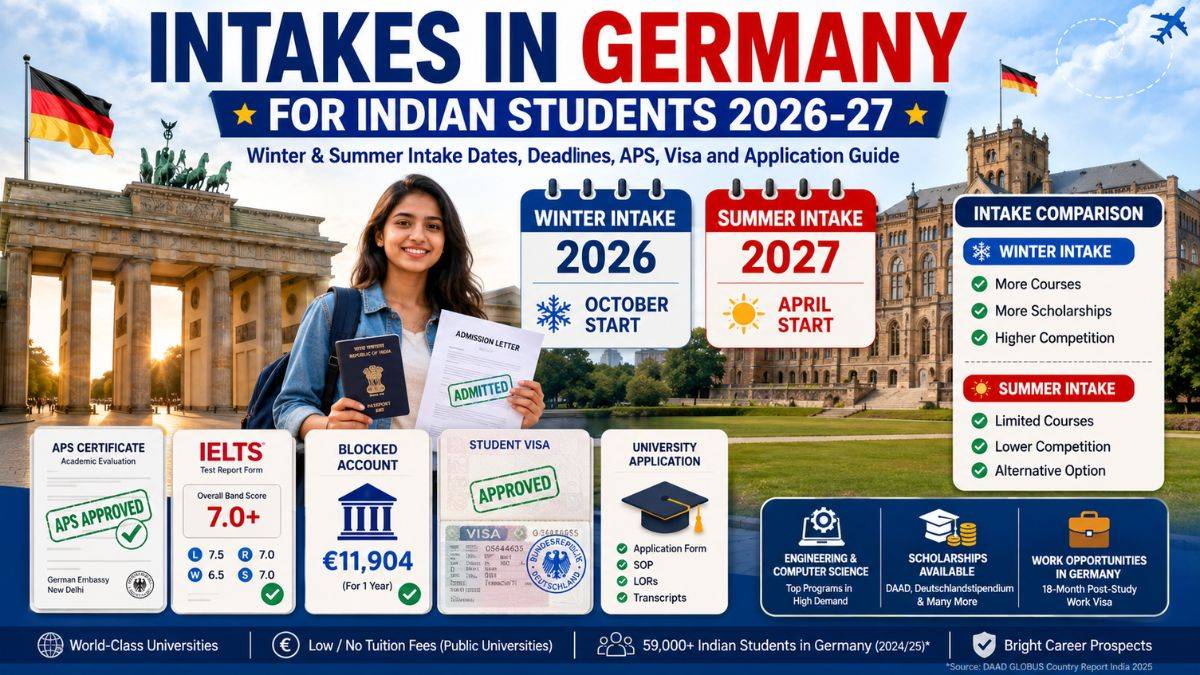
Germany is known for its globally ranked universities, low or no tuition fees at public universities, popular engineering courses, and excellent post-study work opportunities. Thousands of Indian students choose Germany every year to pursue bachelor’s and master’s degrees in fields such as Computer Science, Mechanical Engineering, Data Science, Artificial Intelligence, Automotive Engineering, and Business Analytics.
One of the most important decisions you must make before applying is selecting the right intake. In Germany, universities generally admit students in two academic sessions each year: the Winter Intake, which begins in October, and the Summer Intake, which starts in April. The intake you choose affects the number of courses available, scholarship opportunities, application deadlines, and your student visa timeline.
For Indian students, intake planning is even more important because you must complete additional formalities such as obtaining the APS Certificate, appearing for IELTS or TOEFL, arranging a blocked account, and applying for a German student visa. Since these steps can take several months, starting early is essential.
This detailed guide explains everything Indian students need to know about the intakes in Germany, including intake dates, deadlines, required documents, APS processing, visa timelines, and expert tips to help you with the application.
- How Many Intakes Are There in Germany?
- Germany Intakes Overview: Winter vs Summer 2027-28
- Winter Intake in Germany 2027: The Primary Option for Indian Students
- Summer Intake in Germany 2028: A Limited but Real Option
- What Is the APS Certificate and Why Do Indian Students Need It?
- Eligibility Criteria for Germany Intakes: Indian Students
- Documents Required for Germany Intake Applications
- Month-by-Month Timeline for Indian Students: Winter Intake 2027
- Scholarships in Germany for Indian Students: Winter vs Summer Intake
- Blocked Account for Germany: What Indian Students Need to Know

How Many Intakes Are There in Germany?
Germany offers two intakes each year for international students. The Winter semester (Wintersemester) starts in October and is the primary intake. The Summer semester (Sommersemester) starts in April and is the secondary option with fewer program choices. A small number of private universities in Germany also offer rolling admissions or additional intake windows in January and June, but the two main ones (October and April) are what most Indian students need to plan around.
Choosing the right intake is not just a calendar decision. It affects which programs you can apply to, which scholarships are open to you, and when you can enter the German job market after graduating. Getting this right from the start saves months of wasted effort.
Germany Intakes Overview: Winter vs Summer 2027-28
The table below summarises the key differences between the two intakes for Indian students who want to study in Germany and are applying for the upcoming intake.
| Factor |
Winter Intake 2027 |
Summer Intake 2028 |
|---|---|---|
| Classes begin |
October 2027 |
April 2028 |
| Application window |
April to 15 July 2027 |
November 2027 to January 2028 |
| Standard deadline |
15 July 2027 |
15 January 2028 |
| Program availability |
Most courses |
Limited courses |
| Germany intakes for Masters |
Full range across all fields |
Mostly limited to select Sciences and Management programs |
| Scholarship access |
High (DAAD and most major scholarships align with Winter) |
Reduced (most funding cycles tied to Winter) |
| Competition level |
Higher volume, larger cohorts |
Lower volume, smaller cohorts |
| APS certificate requirement |
Mandatory for all Indian students |
Mandatory for all Indian students |
| Blocked account requirement |
EUR 11,904 (approx. INR 1,28,627) |
EUR 11,904 (approx. INR 1,28,627) |
| Visa processing time from India |
Approximately 12 weeks |
Approximately 12 weeks |
| Best suited for |
BTech/BSc/BCom graduating May–June 2027 |
Students who missed Winter 2027, PhD applicants with a confirmed supervisor |
Currency note: EUR figures above use 1 EUR = INR 108.05. Always check the live exchange rate before any financial transfer.
Winter Intake in Germany 2027: The Primary Option for Indian Students
The Winter intake in Germany is the right choice for the large majority of Indian students. According to the DAAD GLOBUS Country Report India 2025, 59,419 Indian students enrolled at German universities in the Winter semester 2024/25, making India the largest source country for international students in Germany. The timing suits Indian graduates well, B.Tech. and BSc students who finish in May or June have enough time to apply before the July 2027 deadline, as long as APS and language tests are already underway.
Application Deadlines for Winter 2027
Deadlines vary by university and program type. Most programs follow the standard Uni-Assist deadline, but highly competitive programs close much earlier.
| Deadline Type |
Date |
Who It Applies To |
|---|---|---|
| Competitive programs (e.g., TU Munich CS, Data Science) |
March–April 2027 |
Selective master's at top-ranked universities |
| Standard Uni-Assist deadline |
15 July 2027 |
Most public university programs |
| Practical internal target |
End of May 2027 |
Uni-Assist recommends applying 8 weeks before the deadline; processing takes 4–6 weeks |
Always check the specific program page directly, not just the university homepage. Deadlines at the program level sometimes differ from the university-wide date.
How to Apply: Two Routes
There are two main application routes for the Winter Semester in Germany 2027, and the correct one depends on your specific program.
Uni-Assist handles document verification and forwarding on behalf of most participating public universities. The fee is EUR 75 (approx. INR 8,104) for the first application and EUR 30 (approx. INR 3,242) for each additional application within the same semester. These fees are non-refundable.
Direct application through the university's own portal applies to some programs, including those at RWTH Aachen and LMU Munich. Confirm which route your chosen program uses on its admissions page before preparing your documents.
Top German Universities for Winter Intake 2027
Below are the most popular German universities among Indian students, along with their QS 2027 rankings and typical application deadlines.
| University |
Popular Programs for Indian Students |
Typical Deadline |
|---|---|---|
| Technical University of Munich (TUM) |
Computer Science, Mechanical Engineering, Data Science |
March–April (competitive); 15 July (standard) |
| LMU Munich |
Physics, Business Administration, Life Sciences |
15 July |
| Heidelberg University |
Natural Sciences, Medicine, Humanities |
15 July |
| Engineering, Computer Science, Business |
15 July |
|
| KIT Karlsruhe |
Engineering, Physics, Computer Science |
15 July |
| TU Berlin |
Electrical Engineering, Urban Planning, Management |
15 July |
| University of Stuttgart |
Aerospace, Mechanical Engineering, Architecture |
15 July |
Source: QS World University Rankings 2027. Program-specific deadlines should always be verified on the university's own admissions page.
Counsellor insight: If your final mark sheet is not yet available when you apply, which is normal for BTech students graduating in May or June, apply with semester transcripts and a provisional certificate, and clearly state the expected issue date for your final documents. Most universities accommodate this. What they do not accommodate is silence. Always communicate proactively with the admissions office.
Summer Intake in Germany 2028: A Limited but Real Option
The Summer intake in Germany is a genuine option in specific situations, but it is not a straightforward backup to Winter. Program availability is less, major scholarships are fewer, and for Indian students the visa timeline is tighter because the April start date leaves very little margin after admission offers arrive in January or February.
For mainstream Engineering and Computer Science programs at public universities, the Summer intake effectively does not exist for international applicants. Programs like RWTH Aachen's CS master's are Winter-only. Always confirm intake availability at the program level, not just at the university level, before building your plan around a Summer application.
Application Deadlines for Summer 2028
The Summer 2027 intake has already closed (deadline was 15 January 2027). The next Summer intake is April 2027, with applications typically opening around November 2027.
| Deadline Type |
Date |
Notes |
|---|---|---|
| Standard deadline |
15 January 2028 |
Per Uni-Assist; some programs close in December |
| Universities of Applied Sciences |
1 March start |
Earlier application recommended |
| Traditional universities |
1 April start |
January 15 deadline |
| Private universities (e.g., IU International, EU Business School) |
Rolling admissions |
No fixed semester deadline |
The same two application routes apply (Uni-Assist or direct university portal) at the same fees as the Winter intake.
Top German Universities for Summer Intake 2028
Not all public universities in Germany open their Summer intake to international applicants. The ones below do, for selected programs.
| University |
Type |
Deadline |
|---|---|---|
| TU Munich (TUM) |
Public |
15 January |
| LMU Munich |
Public |
15 January |
| RWTH Aachen |
Public |
15 January |
| University of Freiburg |
Public |
15 January |
| University of Stuttgart |
Public |
15 January |
| IU International University |
Private |
Rolling |
| EU Business School |
Private |
Rolling |
Counsellor insight: Most students who plan a Summer intake around TU Munich or RWTH Aachen discover their chosen program is Winter-only, after months of preparation. Spend at least two weeks confirming at the program level that Summer intake is open to international applicants before committing to this path.
Predict your IELTS, TOEFL, and PTE in just 4 steps!
What Is the APS Certificate and Why Do Indian Students Need It?
The APS (Akademische Prüfstelle) certificate is a document verification issued by the German Embassy in India. It confirms that your academic qualifications are genuine and recognised for admission to German universities. All Indian students must have an APS certificate; there are no exceptions, regardless of which intake or university you are applying to.
The APS process takes up to 8 weeks, which means you need to start it well before your application deadline. Here is what you need to know:
| APS Detail |
Information |
|---|---|
| Who needs it |
All Indian students applying to German universities |
| Issued by |
German Embassy in India (New Delhi, Mumbai, Chennai, Kolkata) |
| Processing time |
Up to 8 weeks |
| When to start |
At least 3–4 months before your application deadline |
| Cost |
Approximately INR 18,000 (subject to change; check the embassy website) |
| Valid for |
Once issued, the certificate does not expire |
Start your APS application as early as possible. It is the single most common reason Indian students miss their intended intake deadline.
Eligibility Criteria for Germany Intakes: Indian Students
The following requirements apply to both the Winter and Summer intakes. Meeting these criteria is necessary to apply to German universities; it does not guarantee admission.
For Bachelor's Programs
Indian students applying to undergraduate programs at German universities need to meet the following baseline requirements. Competition is high at public universities, and strong academic scores matter.
- Class 12 from a recognised board with strong academic scores.
- Some programs require a Studienkolleg (preparatory year) for Indian applicants.
- English proficiency: IELTS 6.0 or above, or TOEFL iBT 80 or above (for English-medium programs).
- German proficiency: TestDaF Level 4 or DSH Level 2 (for German-medium programs).
- APS certificate: mandatory
For Master's Programs
Postgraduate applicants need to demonstrate subject relevance, a minimum academic standard, and language readiness. Most Indian students target master's programs.
- Relevant bachelor's degree with a minimum of 60–65% aggregate marks or equivalent GPA
- English proficiency: IELTS 6.5 or above, or TOEFL iBT 80 or above (for English-medium programs)
- German proficiency: TestDaF Level 4 or DSH Level 2 (for German-medium programs)
- APS certificate: mandatory
- Statement of Purpose (SOP): 500 to 800 words
- Letters of Recommendation (LOR): 2 to 3
- Updated CV/Resume
Gap year policy: German universities generally accept up to 2 years of gap for undergraduate applicants and up to 5 years for postgraduate applicants. The gap must be clearly explained in your SOP. An unexplained gap raises more concern than the gap itself.
Documents Required for Germany Intake Applications
Having your documents ready well in advance avoids last-minute delays, especially since some documents like APS and language test scores take weeks to arrive.
| Document |
Applicable For |
Notes |
|---|---|---|
| Academic transcripts and certificates |
UG and PG |
All semesters; attested copies |
| APS certificate |
All Indian students |
Start 3–4 months before deadline |
| Proof of English proficiency (IELTS/TOEFL) |
English-medium programs |
Scores should be recent (within 2 years) |
| Proof of German proficiency (TestDaF/DSH) |
German-medium programs |
TestDaF 4 or DSH 2 |
| Statement of Purpose (SOP) |
PG applicants |
500–800 words; program-specific |
| Letters of Recommendation (LOR) |
PG applicants |
2–3 LORs from academic or professional referees |
| Updated CV/Resume |
PG applicants |
Include academic and work experience |
| Copy of valid passport |
All applicants |
Must be valid for the duration of your studies |
| Proof of financial resources |
Visa stage |
Blocked account of EUR 11,904 per year |
| Provisional certificate / Degree certificate |
All applicants |
Provisional acceptable if final not yet issued |
Month-by-Month Timeline for Indian Students: Winter Intake 2027
This timeline is built around the Indian academic calendar, where most BTech and BSc students graduate in May or June 2027.
| Month |
Action |
|---|---|
| October-November 2027 |
Research programs and universities; shortlist 5–8 options at the program level |
| November-December 2027 |
Book IELTS/TOEFL/TestDaF exam; begin APS document preparation |
| December 2027-January 2027 |
Submit APS application (allow 8 weeks for processing) |
| January-February 2028 |
Receive APS certificate; begin drafting SOP and requesting LORs |
| February-March 2028 |
Take language proficiency exam; confirm intake availability at program level |
| March 2028 |
Apply to competitive programs (TUM, Heidelberg) with early deadlines |
| April-May 2028 |
Apply via Uni-Assist or university portals for standard-deadline programs |
| May 2028 (end) |
Practical internal Uni-Assist deadline (8 weeks before 15 July) |
| June 2028 |
Graduate; request final transcripts and provisional certificate |
| July 2028 |
Hard deadline (15 July 2027 for most programs) |
| August-September 2028 |
Receive admission offers; apply for a student visa (allow 12 weeks) |
| October 2028 |
Arrive in Germany; semester begins |
Scholarships in Germany for Indian Students: Winter vs Summer Intake
Scholarship availability in Germany is significantly better for Winter intake applicants. Most major funding bodies align their cycles with the October semester start.
| Scholarship |
Intake Alignment |
Amount (approx.) |
|---|---|---|
| DAAD Scholarship |
Winter (primary) |
EUR 861/month (master's) |
| Heinrich Böll Foundation |
Winter |
EUR 850/month + allowances |
| Deutschlandstipendium |
Winter |
EUR 300/month |
| Konrad Adenauer Foundation |
Winter |
EUR 850/month + allowances |
| Friedrich Ebert Foundation |
Winter |
EUR 850/month + allowances |
Summer intake applicants can still apply to some scholarships, but the selection of open funding windows is significantly narrower. If scholarship access is a priority, the Winter intake is the stronger choice.
Blocked Account for Germany: What Indian Students Need to Know
A blocked account (Sperrkonto) is a mandatory requirement for obtaining a German student visa. It proves you have enough funds to support yourself during your studies.
- Required amount: EUR 11,904 per year (approx. INR 1,28,627 at 1 EUR = INR 108.05)
- What it does: The account releases a fixed monthly amount (EUR 992) to you after you arrive in Germany
- Who needs it: All international students applying for a German student visa
- Providers: Fintiba, Expatrio, Deutsche Bank (among others)
- When to open it: After receiving your admission offer, before applying for the visa
- Processing time: Allow 2–4 weeks for the account to be set up and verified
Open your blocked account as soon as you receive your admission letter. Visa applications cannot proceed without it.

Commonly asked questions
Germany has two main intakes: Winter semester (October) and Summer semester (April). A small number of private universities also take rolling admissions.
Winter intake is better for most Indian students. It offers more programs, better scholarship access, and aligns naturally with the Indian graduation calendar (May–June). Summer is suitable for students who missed Winter or PhD applicants with a confirmed supervisor.
The standard deadline is 15 July 2027 for most public university programs via Uni-Assist. Competitive programs at TU Munich and similar universities may close in March or April 2026. Always verify at the programme level.
Prof. Susumu Kitagawa recently won the Nobel in the field of Chemistry. He is associated with TU Munich since 2018 through an honorary doctorate. He is currenty working as the Director of the Institute for Integrated Cell-Material Sciences at Kyoto University in Japan. Kitagawa was rewarded for his research work in the field of organometallic framework compounds.
Pick your stage and get free guidance from counsellors who've helped thousands get into top universities.
 Starting research
 Shortlisting colleges
 Exam preparation
 SOP/LOR writing
 Scholarship & finance
 Visa application
 Statement of Purpose
 Letter of Recommendation
 Student Visa Application
 Admission Essay Writing
 Student Curriculum Vitae
Study Abroad Expert | Education Writer | International Admissions Specialist
Raushan Kumar is a Study Abroad Expert and Education Writer with over 6.5 years of experience in international higher education and educat
Read Full Bio