
dMAT Figure Sequence: Rules, How to Answer & Free Practice Questions (2026)
 Talk to Expert
'Figure Sequence' is an important topic tested in the Core Module of the dMAT exam. The question types on figure sequences are based on shapes, colours and orientation. If you are also preparing for dMAT, then check out everything about dMAT figure sequences with all major details.

Figure sequences, or completing a figure series, is a common logical reasoning topic. If you are preparing for the dMAT (aptitude test for German universities), you will find this topic here also. Figure sequencing is one topic that trips up even the strongest students.
If you are taking up the core modules on dMAT exam first for preparation, consider taking this topic first. To solve questions around figure sequence on dMAT, remember that your logical ability is tested. The 20 questions tested here check how accurately you spot the pattern and complete the series within the defined time.
Let us look at figure sequences on DMAT closely. Understand the rules, pattern of questions and how much time per question is ideal. Also get free PDFs with sample Q/A for figure sequencing on dMAT through this article.
- About dMAT's Figure Sequence Topic: Highlights
- What is Figure Sequence on dMAT's Core Module?
- Question Pattern & Rules for dMAT Figure Sequence
- dMAT Figure Sequence Sample Question
- How to Attempt Figure Sequence Questions on dMAT?
- dMAT Figure Sequence Topic FAQs
About dMAT's Figure Sequence Topic: Highlights
| Aspects | Details of Figure Sequence on dMAT |
|---|---|
| Figure Sequence Tested on dMAT | Core Module |
| Chronology of Testing | 1st topic on Core Module |
| No. of Questions Tested | 20 |
| Total Time Allocated | 25 minutes |
| Total Marks for Figure Sequence | No individual score | Marked based on overall Core Module score |
| Aim of Testing | Logical Reasoning |
| Types of Questions Tested | 4 Matrices given; identify the next based on the pattern/movement of symbols |
| Total Rules Followed | 7 |
| Taking Notes Allowed | No |
| Negative Marking | No for unanswered/incorrect answers |
What is Figure Sequence on dMAT's Core Module?
On the Core Module of dMAT, the figure sequence will be the first topic of testing. You will get a series of grid-based matrices. Each matrix will have one or more small figures inside them. It could be a dot, circle, square, triangle, arrow, anything really.
As you move from the first matrix to the last, the figure will keep changing. Either the figure will shift its position, rotate, or switch colour. There will always be a pattern/rule behind the change. What you have to do on figure sequence questions on dMAT is simple!
- Work out the rule,
- Spot the pattern, and,
- Pick the matrix that comes next in the sequence.
Remember, the right answer is whatever keeps that pattern going logically. Note that none of the questions tested on figure sequence requires pre-knowledge. There is no need for any formulae, vocabulary, or subject knowledge. You don't have to memorise anything beforehand. dMAT's figure sequence will just test how sharp your observation is.
Question Pattern & Rules for dMAT Figure Sequence
There are 7 rules for figure sequence-based questions. The dMAT exam pattern and rules are predefined by APS. The rules for figure sequence include:
| Rules on Figure Sequence (dMAT) | Details |
|---|---|
| 1. Colour | The shape's colour can change from one box to the next. |
| 2. Rotation/Spinning | The shape can turn or rotate in place. It stays put but faces a different direction. |
| 3. Position (Movement) | The shape can shift up, down, sideways, or diagonally across the grid. Once it starts moving diagonally, it has to keep moving diagonally for the rest of that series, as it can't switch to a straight-line move partway through. |
| 4. Growing Pattern or x+1 Rule | Sometimes the change (steps moved, degrees rotated, etc.) increases by one each time. For ex: 1 step, then 2, then 3, then 4. Always check for this building pattern before assuming the change is random. |
| 5. No Vanishing & No Overlapping | Every shape has to stay visible in each box, and two shapes can never sit on top of each other. |
| 6. Sliding at the Edge of Matrix | If a shape hits the wall of the grid, it does one of two things and sticks to that behaviour for the whole series:
|
| 7. Bouncing at Boundaries/Edge | At the edge, a figure can bounce back and forth or be the same way it came in. |
Knowing the pattern of each tested topic on dMAT is important. If you are eligible to take the dMAT, ensure you don't skip any topic during preparation.
dMAT Figure Sequence Sample Question
Want to know what figure sequence questions look like? Here is a sample question if you are preparing.
Question:
What should Matrix 5 look like?
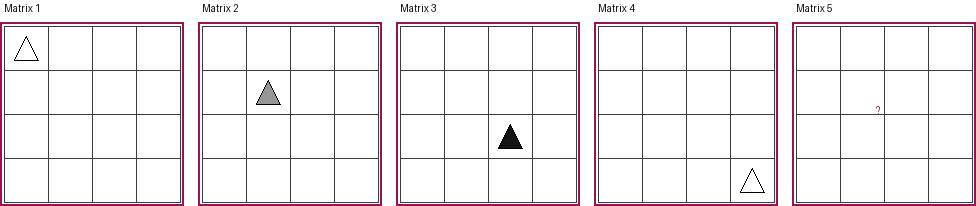
Answer:
Two things to notice: the position of the triangle and its colour. Based on this, answer the question.
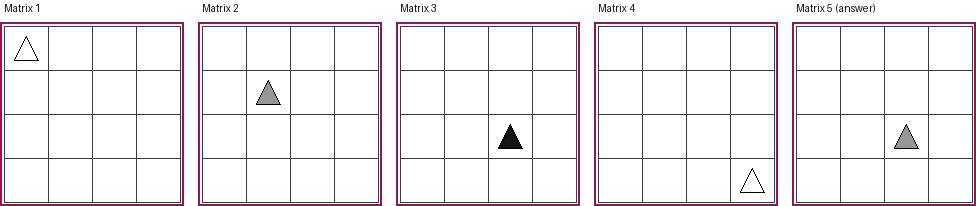
This is what a question on figure sequence on dMAT looks like. You will be given options to choose from a set as well.
Want more practice? Download our free PDF consisting of practice questions on Figure Sequence on dMAT's Core Module - Figure_Sequences_Test1_Shiksha
How to Attempt Figure Sequence Questions on dMAT?
The figure sequence on dMAT has just rules. So preparation is really about familiarising a process, not memorising anything. Here's how to prepare to answer figure sequencing questions on dMAT's Core Module:
- Scan one variable at a time. Check position, followed by colour and rotation. Tracking all three at once is where most mistakes happen.
- Identify the edge behaviour early. Figure what's near the grid's edge. Decide immediately if it is bounce or slide.
- Watch for x+1 rule. Some sequences go 1 step, then 2, then 3, not a steady 1-step move.
- 75 seconds per question is ideal to complete 20 questions in 25 minutes without revision.
- If you want to revise, aim for 66 seconds per question. Practise timed dMAT mock tests, or the pace will cause problems for you on test day.
- No negative marking, so do not freeze. Guess, flag, move on. Come back later if time allows.
- Skip the scratch paper in practice. dMAT doesn't give you any, so train your mental tracking now.
Figure Sequences isn't testing German engineering standards or business theory. It's testing raw abstract-reasoning speed under pressure. The Core Module is where structured practice matters more than prior knowledge. Studying in Germany for courses eligible for dMAT helps Indian students score higher on pattern-based puzzles than they would for a subject.
Planning to study at German universities and need help with admissions and applications? Sign up for our free Shiksha Abroad Counselling and request a callback from our team of experts.
dMAT Figure Sequence Topic FAQs

Commonly asked questions
No. The dMAT Core Module allows no notes or rough paper for any subtest. Every answer prediction has to be worked out mentally even for figure sequence.
Abstract pattern recognition and reasoning speed. Along with logical reasoning. There is no subject knowledge, formulas, or memorised facts needed. It's designed to be equally unfamiliar (and equally learnable) for every applicant, regardless of academic background.
Stopping at the first pattern they spot is the biggest mistake. Students forget to check whether a figure is changing on more than one dimension at once. They miss position and colour, for instance, changing in the same sequence. This is the biggest mistake on figure sequence questions.
Its just differently hard. The Subject Module rewards your academic background; Figure Sequences rewards structured practice, since there's genuinely no prior knowledge that gives anyone a head start.
Predict your IELTS, TOEFL, and PTE in just 4 steps!

 Statement of Purpose
 Letter of Recommendation
 Student Visa Application
 Admission Essay Writing
 Student Curriculum Vitae
Aishwarya Bhatnagar is a specialised content curator with 8+ years of experience in EdTech content, particularly in studying abroad. She is a Study Abroad Expert at Shiksha.com (InfoEdge India Ltd) si
Read Full Bio