
How to Study in Japan for FREE: Complete Guide for 2026 Intake
 Talk to Expert
Japan is steadily emerging as one of the most affordable and student-friendly country for higher studies. Unlike countries such as US, UK, Japan offers generous government scholarships and low-cost public universities. This makes the idea of studying in Japan for free achievable.

Indian students planning to study in Japan in 2026 can realistically study in Japan for free or near zero cost. You need to combine scholarships, tuition waivers, and part-time work. Study in Japan for free is a realistic goal for Indian students in 2026 if you know how to navigate the country’s unique financial aid systems.
Moving abroad usually costs a fortune. Japan offers a specific mix of government backing and university support. It can bring your out-of-pocket expenses down to zero.
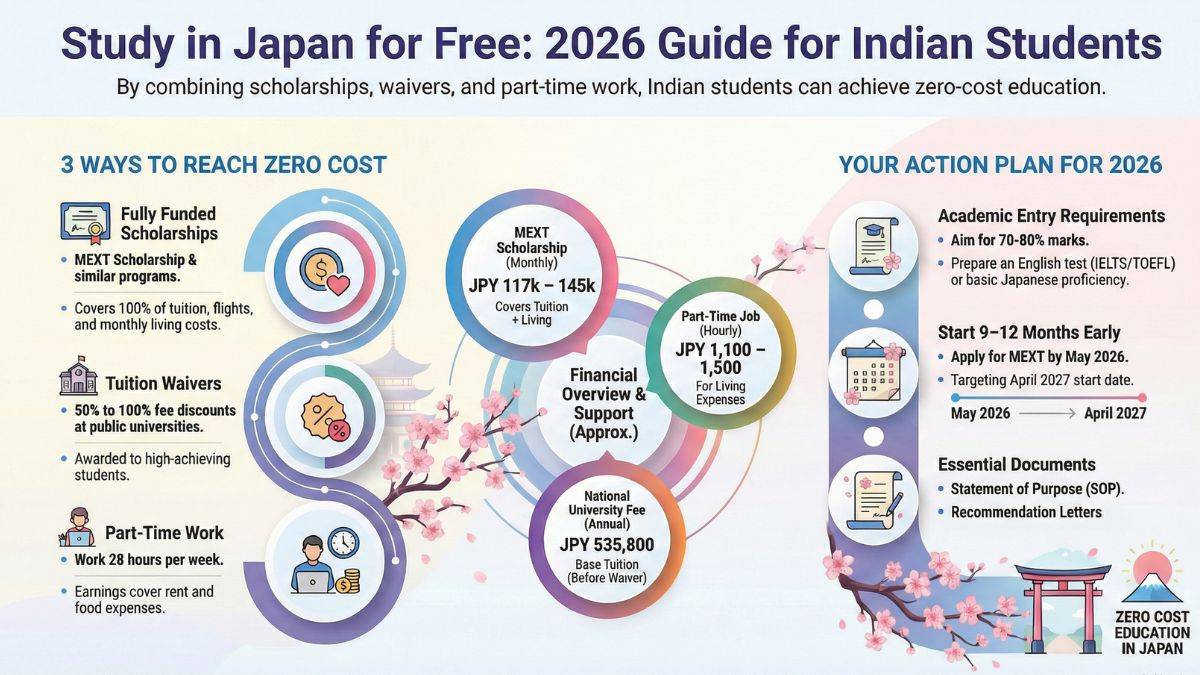
You can achieve this through three main paths:
-
Fully Funded Scholarships in Japan: Programs like MEXT scholarship cover your tuition, flights, and give you a monthly allowance.
-
Tuition Waivers + Stipends: Many Japanese public universities waive 50% to 100% of fees for high-achieving international students.
-
Work-Study Balance: Using part-time income to cover living costs while on a partial scholarship.
This guide lists genuine options, timelines, and a short action plan for Indian students applying for 2026. If you are looking to study in Japan for free, the following sections will show you exactly how to secure your spot without falling for common myths.
- Is It Possible to Study in Japan for Free?
- Fully Funded Scholarships in Japan: No Need to Pay for Your Studies
- Eligibility & Documents Needed to Study in Japan for Free
- Timeline for Studying in Japan: When to Start
- Tips to Study in Japan for Free in 2026
Is It Possible to Study in Japan for Free?
Yes, Indian students can study in Japan for free. But mostly through structured routes such as scholarships or tuition support. Japan does not offer completely free education by default, but its funding system makes education highly affordable.
In recent years, Japan has hosted over 45,000 international students from South Asia. It includes Indian students. Most Indian students are interested in IT, engineering, and research opportunities. They are shifting here moving there for high-tech and research roles.
| 3 Genuine Ways to Study in Japan for Free in 2026 | |
|---|---|
| Fully Funded Scholarships in Japan (Tuition + Living Cost) | This is the most direct way to study in Japan for free.
|
| Tuition Waivers and University Grants | Many Japanese public universities offer partial or full tuition waivers.
|
| Low-Cost Education + Part-Time Work in Japan | Even without a full scholarship, students can reach near-zero net cost.
|
Fully Funded Scholarships in Japan: No Need to Pay for Your Studies
There are multiple scholarships in Japan that cover your 100% tuition fee and living expenses. So, as a student, you do not need to worry about financial stress. You need to focus on your studies only. Here are 5 scholarships in Japan that cover 100% of your expenses:
- MEXT Scholarship: Government-funded, highly competitive, covers tuition + stipend.
- JASSO Scholarship: Monthly allowance for self-financed students.
- University Scholarships: Offered by national and private universities.
- Research Grants: Especially for STEM and PhD students.
Other than this, you can explore information about ADB-Japan scholarship program and Joint Japan/World Bank Graduate Scholarship (JJ/WBGSP). Scholarship amounts usually range between JPY 117,000 and 145,000 per month (≈ INR 65,000 to 80,000), depending on level.
Eligibility & Documents Needed to Study in Japan for Free
To study in Japan for free, you must prove both academic merit and a clear study plan. Check out the eligibility and the list of documents that you need to arrange:
-
Academic Transcripts: Minimum 70 to 80% marks are usually required for full scholarships.
-
Research Proposal: Essential for PG/PhD students to show their project fits a Japanese lab.
-
English Test Scores: TOEFL or IELTS are required for English-taught programs. JLPT (Japanese Language Proficiency Test) is not mandatory but helps.
-
Recommendation Letters (LORs): Typically from your Dean, Principal, or HOD in your previous college.
-
Statement of Purpose: A clear essay on why you chose to study in Japan and your career goals.
-
Certificate of Eligibility (COE): Your university handles this after you are accepted; it is the key document for your Japan student visa.
Predict your IELTS, TOEFL, and PTE in just 4 steps!
Timeline for Studying in Japan: When to Start
The two main windows for entering Japan are April (Spring) and September/October (Autumn).
For April 2027 Intake (Main Intake)
-
April to May 2026: Apply for the MEXT Embassy Track Scholarship.
-
June to August 2026: Research universities and contact potential professors.
-
October to December 2026: Submit university applications and apply for COE.
For September 2026 Intake
-
October to January 2026: Apply for University-Track MEXT or private scholarships.
-
February to April 2026: Finalize university admissions.
-
May to July 2026: Complete visa processing after receiving your COE.
Actionable Tip: Start your scholarship search at least 9 to 12 months before your intended start date.
Tips to Study in Japan for Free in 2026
You have fair idea about different ways to pursue higher studies in Japan at zero cost. Now, we have mentioned some of the tips that can increase the chances of reducing your cost to a minimum.
-
Apply Widely: Don't rely only on MEXT scholarship. Apply for university-specific grants and JASSO simultaneously. You can explore popular Japanese scholarships.
-
Perfect Your SOP: Focus on how your study in Japan will benefit both India and Japan. Also mention how it is aligned with your goals.
-
Legal Finances: Even with a scholarship, have bank statements ready to show "financial health" for the visa process.
-
Learn Basic Japanese: Even 150 hours of basic study (N5 level) significantly boosts your scholarship and visa approval odds. Check out some popular Japanese words.

Commonly asked questions
Tokyo University is selective and competitive for any course so students need to score high in academics and must have extra curriculars to show as part of their profile. Along with that, students must fulfill eligibility requirements set by university. Students must submit some required documents such as university transcripts, LOR, CV, video and timed writing reflection and TOEFL or IELTS scores.
We have provided below the general admission requirements for undergraduate and graduate admission at Tokyo University:
University of Tokyo Undergraduate Admission Requirements
- Submit your official high school transcripts
- Meet the English language proficiency test requirements
- Additional test scores for ACT/SAT (optional)
- Submit two letters of recommendation
University of Tokyo Graduate Admission Requirements
- Must complete a bachelor’s degree in a relevant discipline
- Meet the English language proficiency test requirements
- Additional test scores for GMAT/GRE
- A Resume?
- Provide Two Letters of Recommendation
- The university also asks you to submit Two Essays
Japan is known for Science and innovation related studies in world. There are also many educational universities here to offer language course. Japan is affordable for Indian students as compared to other English speaking countries. Some famous courses in Japan are Science, Technology, Innovation and Research. All these reasons make Japan good study destination for Indian students.
As per the Embassy of Japan in India, around 12 Indian applicants qualifies for first screening of MEXT scholarship for studying in the year 2025. There are additional levels of scrutiny and the total number of Indian students who got the scholarship will be released.
 Statement of Purpose
 Letter of Recommendation
 Student Visa Application
 Admission Essay Writing
 Student Curriculum Vitae
Raj Vimal is an education writer and editor with over 8 years of experience. He helps Indian students find the right universities, visas, and courses abroad. Currently, he leads content strategies at InfoEdge India
Read Full Bio