
 / IELTS

IELTS 2026: The IELTS exam is an English language test accepted by universities, employers, and immigration authorities in many countries. IELTS is accepted by more than 13,500+ institutions in countries such as the UK, Canada, Australia, New Zealand, the USA, and Ireland. IELTS has two main types: IELTS Academic and IELTS General Training. The academic test is conducted for University admissions, while the General Training is for people who want to work abroad. As per IDP India, the IELTS exam fee 2026 is INR 19,000 for both test types.
There are only two modes of the IELTS exam: IELTS on Computer or IELTS on Computer (Writing on Paper). The Computer mode is the popular mode, while in the new Writing on Paper, the Writing section is completed by hand. The results of IELTS test will be available within 1-2 days. To know more about the IELTS exam, registration, eligibility, syllabus, exam pattern, fees, preparation, results, and test dates, scroll down.
Approximately 1.5 to 1.8 million candidates take the IELTS exam in India every year. So, the relevance of the IELTS test is very high among Indian students who want to study abroad. The key highlights of the IELTS 2026 exam are provided below:
| IELTS Exam Particulars | IELTS Details |
|---|---|
| IELTS full form | International English Language Testing System |
| What is the IELTS exam? | English language proficiency test |
| Who conducts IELTS in India? | IDP IELTS |
| IELTS exam level | International |
| Types of IELTS | IELTS Academic and IELTS General Training |
| What are the IELTS sections? | Listening, Reading, Writing and Speaking |
| What is the IELTS exam mode? | IELTS on Computer and IELTS on Computer (Writing on Paper) |
| What is the IELTS exam duration? | Around 2 hours 45 minutes |
| IELTS fees | INR 19,000 |
| IELTS scoring system | 0 to 9 band scale |
| IELTS overall band score | Average of the four section scores, rounded to the nearest whole or half band |
| Is there negative marking in IELTS? | No |
| How often is IELTS conducted? | Multiple times throughout the year |
| Where is IELTS accepted? | Universities, employers and immigration authorities worldwide |
| What is the purpose of IELTS? | Study, work, professional registration and migration |
| Is IELTS paper-based available in India? | No. Traditional paper-based IELTS is no longer available in India from September 1, 2026. |
| What is the IELTS result time in India? | Usually 1–2 days for IELTS on Computer |
| How long is IELTS score valid? | 2 years |
| IELTS India official website | ieltsidpindia.com |
Latest IELTS Updates:
- The traditional paper-based IELTS test is no longer available in India from September 1, 2026.
- IELTS on Computer (Writing on Paper) is available in India for candidates who prefer to write the Writing section by hand.
- IELTS on Computer results in India are generally available within 1-2 days after the test.
- IELTS for UKVI does not offer the Writing on Paper option.
- Eligible candidates can take IELTS One Skill Retake to improve one section without taking the complete IELTS test again.
Yes, 7.5 is a very good score! It means your English is excellent. Most top universities abroad ask for 7 plus band score. If you have this much band score, you are 100% safe for admission. It also makes your visa profile very strong.
There is no pass or fail in the IELTS exam. All will be graded based on their performance in Listening, Reading, Speaking and Writing between 1 and 9. Based on which an overall IELTS band score will be provided to test takers.
Students who are not satisfied with their IELTS score can retake the IELTS exam. There is no fixed limit on the number of times a candidate can take the exam. However candidates have to pay the IELTS exam fee for every new attempt. Students can also check if IELTS One Skill Retake is available at their test centre if they only want to improve one section.
- What is IELTS Exam?
- Types of IELTS Test: Academic vs General Training
- IELTS Exam Dates 2026
- IELTS Eligibility Criteria 2026
- Which Countries Accept IELTS?
- IELTS 2026 Syllabus
- What Is the IELTS Exam Pattern?
- IELTS Exam Fees in India 2026
- Documents Required for IELTS Registration
- How to Register for IELTS Exam in 2026?
- IELTS Test Centres in India
- IELTS Slot Booking 2026
- IELTS Preparation Tips to Score Band 7, 8, or 9
- Guidance for IELTS by Shiksha Expert
- IELTS Sample Papers
- IELTS Results & Score 2026
- IELTS 2026 Cut-off
- IELTS Frequently Asked Questions (FAQs)


What is IELTS Exam?
International English Language Testing System (IELTS) is an English language proficiency test used to assess the English skills of candidates who want to study, work, or migrate abroad. IELTS was launched in 1989 and is jointly owned by the British Council, IDP IELTS, and Cambridge University Press & Assessment. The IELTS exam tests four English language skills: Listening, Reading, Writing, and Speaking. IELTS scores are accepted by universities, employers, and immigration authorities in many countries. The IELTS exam has two main types: IELTS Academic and IELTS General Training. Candidates can also take IELTS for UKVI and IELTS for UKVI Life Skills for specific UK visa and immigration requirements. IELTS exam dates are available throughout the year in India, depending on the city and test centre availability.
IELTS Exam Full Form
The full form of IELTS is the International English Language Testing System. This is an English language test for students and professionals applying for study abroad, jobs abroad, visas, and immigration.
| IELTS Full Form Components | What Do They Actually Mean? |
|---|---|
| International | Refers to a test accepted by universities, employers, governments, and immigration authorities in different countries. |
| English Language | Indicates that IELTS checks a person’s English language skills. |
| Testing | Refers to checking Listening, Reading, Writing and Speaking abilities. |
| System | Means IELTS follows a standard format, scoring system, and assessment process. |
IELTS is mainly taken by applicants who need to show that they can use English for education, work, or life in an English-speaking country.
Types of IELTS Test: Academic vs General Training
The IELTS test has two main types: IELTS Academic and IELTS General Training. Apart from these two tests, IELTS also offers IELTS for UKVI and IELTS for UKVI Life Skills for candidates who need to meet specific UK visa and immigration requirements. In IELTS Academic and General Training, the Listening and Speaking sections are the same, while the Reading and Writing sections are different. Here are the details of the different types of IELTS tests:
- IELTS Academic: IELTS Academic is mainly for candidates who wish to study at a university or pursue higher education in an English-speaking country. It can also be taken for certain professional registration purposes.
- IELTS General Training: IELTS General Training is mainly for candidates who wish to migrate to an English-speaking country, gain work experience, undertake training, or study below degree level. It assesses English language skills used in everyday and workplace situations.
- IELTS for UKVI: IELTS for UKVI is a Secure English Language Test (SELT) accepted by UK Visas and Immigration (UKVI) for certain visa and immigration applications. It is available in Academic and General Training versions, depending on the requirements of the visa route.
- IELTS for UKVI Life Skills: IELTS for UKVI Life Skills is designed for candidates who need to prove their Speaking and Listening skills for certain UK visa and immigration applications. It is available at A1, A2 and B1 levels and is assessed as Pass or Fail rather than through the usual IELTS band score.
Modes of IELTS Exam
The IELTS exam is currently available in two main delivery modes: IELTS on Computer and IELTS on Computer (Writing on Paper). Both modes assess the same English language skills, but the Writing component is completed differently.
- IELTS on Computer: Candidates complete the Listening, Reading, and Writing sections on a computer. The Speaking test is conducted with an examiner.
- IELTS on Computer (Writing on Paper): Candidates complete the Listening and Reading sections on a computer and take the Speaking test with an examiner. However, the Writing questions are displayed on the computer and the answers are written by hand on an IELTS Writing Answer Sheet.
The Writing task types, scoring, and time allocation remain the same in both modes. The main difference is whether the Writing responses are typed or handwritten.
Note: IELTS on Computer (Writing on Paper) is available for IELTS Academic and IELTS General Training in selected countries. It is not available for IELTS for UKVI.
IELTS Exam Dates 2026
IELTS exam dates in India are available throughout the year, giving students flexibility to choose a convenient test slot. In 2026, the IELTS test is conducted by IDP Education and is offered in computer mode.
IELTS test dates in India are generally available multiple times each month, including weekends and selected weekdays. Major cities such as Delhi, Mumbai, Bangalore, Chennai, Hyderabad, Pune, and Kolkata usually have more frequent test availability and faster slot filling.
Most candidates book their IELTS exam 3 to 4 weeks in advance. It should be booked earlier during peak admission seasons.
IELTS Test Dates 2026 - Monthly Calendar
| Month | IELTS Dates |
|---|---|
| October 2026 | October: 1, 3, 4, 5, 8, 9, 10, 11, 12, 15, 16, 17, 18, 19, 22, 23, 24, 25, 26, 29, 30, 31 |
| November 2026 | November 1, 2, 5, 6, 7, 12, 13, 14, 15, 16, 19, 20, 21, 22, 23, 26, 27, 28, 29, 30 |
How to Check IELTS Test Dates in India
The most accurate and up-to-date IELTS exam schedule can be checked through the official IDP website:
- Visit the official IDP IELTS India portal
- Select your preferred city
- Choose your desired month
- View available test dates and time slots
Booking early is highly recommended, as popular dates fill up quickly. Check which universities accept your score. Connect with Shiksha Study Abroad Counsellors and get any doubts cleared!
IELTS Eligibility Criteria 2026
IDP has not specified any IELTS eligibility criteria for Indian students. Means, there are no specific educational qualifications or minimum marks required to appear for the IELTS exam. Indian students can take the IELTS test if they want to prove their English language skills for higher education, work, or migration abroad. There is also no fixed age limit for taking IELTS. However, the test is generally recommended for candidates who are 16 years or older. Students should check the IELTS requirements of their chosen university, organisation, or immigration authority before booking the test, as the required IELTS type and band score may vary.
| Category |
Details |
|---|---|
| Age |
The recommended minimum age is 16 years, and there is no maximum age limit. |
| Educational Qualification |
No minimum qualification needed. |
| Nationality |
Open to all nationalities |
| Test Attempts |
No limit |
Which Countries Accept IELTS?
IELTS is accepted by more than 13,500+ organisations in over 140 countries, including universities, employers, professional bodies, and immigration authorities. The exact IELTS test type and required band score depend on the university, visa, job, or professional registration you are applying for.
The table below shows some of the major countries where IELTS is accepted:
| Country | Where IELTS is Accepted |
|---|---|
| Australia | Universities & Visas |
| Canada | Universities & Visas. For Express Entry, IELTS General Training is accepted. |
| New Zealand | Universities & Visas. IELTS is one of the English tests recognised for New Zealand immigration requirements. |
| UK | Universities and colleges, UK visa and immigration applications where an approved SELT is required; professional purposes. IELTS for UKVI is an approved SELT for eligible routes. |
| USA | Universities & Visas. IELTS test is among the popular English language tests used by US colleges and universities. |
| Ireland | Universities and higher education institutions; immigration and employment-related purposes where English proficiency is required. IELTS is recognised by organisations in Ireland. |
Important Note for Students
IELTS acceptance does not mean that every university or visa category in a country accepts every IELTS test type. For example, Canada accepts IELTS General Training for Express Entry, while universities may require IELTS Academic. Similarly, Australia accepts both IELTS Academic and General Training for specified visa requirements, subject to the relevant visa rules.
Therefore, students should check the official website of their university or immigration authority before booking IELTS to confirm the required IELTS type, minimum band score, and test format.
IELTS 2026 Syllabus
The IELTS exam syllabus tests your English in four main parts: Listening, Reading, Writing, and Speaking. The total test takes about 2 hours and 45 minutes. Listening and Speaking are the same for both Academic and General Training. Reading and Writing change a little depending on which type you take.
IELTS Syllabus- Section wise
| Section | Duration | Questions / Tasks | Key Topics / Parts |
|---|---|---|---|
| Listening | 30 minutes | 40 questions |
|
| Reading | 60 minutes | 40 questions |
Question types: True/False/Not Given, Matching, MCQs |
| Writing | 60 minutes | 2 tasks | Academic: Task 1 (chart/graph), Task 2 (essay) General: Task 1 (letter), Task 2 (essay) |
| Speaking | 11–14 minutes | 3 parts |
|
What Is the IELTS Exam Pattern?
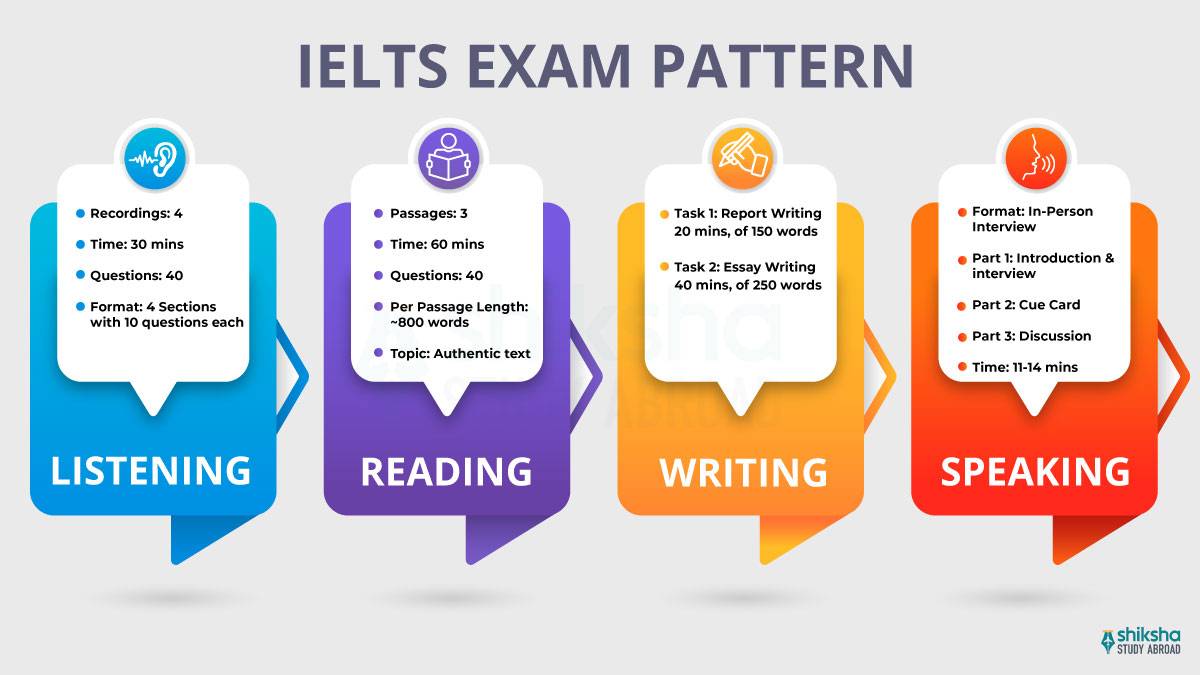
The IELTS Pattern is the most important thing to know before you start your preparation. The IELTS Exam consists of four different sections: Listening, Reading, Writing, and Speaking. These sections of IELTS test are designed to assess your English language capabilities accurately. The IELTS test pattern can be checked below with its duration and description.
| Section |
Duration |
Description |
|---|---|---|
| IELTS Listening |
30 mins |
4 sections, 40 questions |
| 60 mins |
3 passages, 40 questions |
|
| IELTS Writing |
60 mins |
A total of 2 tasks (Task 1: 150 words, Task 2: 250 words) |
| 11–14 mins |
3 parts: Introduction, Long Turn, Discussion |
IELTS Exam Fees in India 2026
Documents Required for IELTS Registration
Predict your IELTS, TOEFL, and PTE in just 4 steps!

How to Register for IELTS Exam in 2026?
IELTS Test Centres in India
IELTS Slot Booking 2026
IELTS Preparation Tips to Score Band 7, 8, or 9
Guidance for IELTS by Shiksha Expert
IELTS Sample Papers

IELTS Results & Score 2026
IELTS 2026 Cut-off
IELTS Frequently Asked Questions (FAQs)

Commonly asked questions
IELTS is accepted by immigration authorities in the UK, Australia, Canada, and New Zealand for migration and work visa applications.
After learning the complete format familiarize yourself with all the topics that you need to cover while preparing for the test. You can get online practice tests and make sure to do it while following the time. Prepare for the Listening test by listening to the audio recordings. Similarly, prepare for the Reading and Writing sections accordingly. Make sure you do as much practice as possible in order to get a decent IELTS score.
If you study about 2 to 3 hours daily, it's enough. Give time to all 4 parts: Listening, Reading, Writing, Speaking. You can change subjects every day so it don't feel boring.
You should try to register for IELTS at least 1 or 2 months early. Test dates get booked fast, especially during busy times. The advance booking of IELTS exam also gives you more time to prepare for IELTS properly.
 Statement of Purpose
 Letter of Recommendation
 Student Visa Application
 Admission Essay Writing
 Student Curriculum Vitae
Comments
(1342)
5 months ago
L
7 months ago
L
7 months ago
S
7 months ago