



The International English Language Testing System, or IELTS, is a standardized test of English language proficiency for non-native English language speakers.
- Shiksha Study Abroad launches Free IELTS Online Classes
- IELTS Exam Format
- Score / Grade Range
- Tips to Achieve a High Score in IELTS
Shiksha Study Abroad launches Free IELTS Online Classes
Latest Update: From June 2023 onwards, Shiksha Study Abroad would be conducting free IELTS online classes on all weekdays of the month. In these classes, we would be discussing all four topics that are covered in the four sections of the IELTS exam – Reading, Writing, Listening and Speaking in detail. Candidates would also be given an opportunity to clear their doubts at the end of every class by directly interacting with our IELTS preparation expert, Disha Wahi (TESOL Certified Trainer). That is not all, Disha would also be providing you with online questionnaires at the end of every section and IELTS practice papers for candidates to self-assess their IELTS preparations. To register for your Free Online IELTS Classes, Click Here
IELTS Exam Format
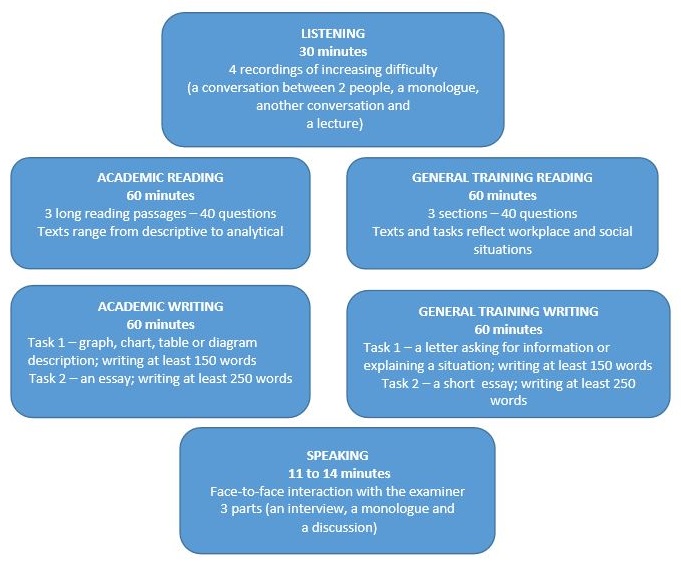
The IELTS Academic module tests the language skills of non-native English language speakers who want to study at a college or university in an English-speaking country where the medium of instruction is English. IELTS is recognized by most academic institutions and professional organizations in Europe, Australia, Canada, New Zealand and the United States.
The IELTS General Training module tests the language ability of non-native English language speakers who intend to go abroad, especially to English-speaking countries for vocational training programmes (not for degree), work or immigration. Employers, professional bodies and immigration departments in Australia, Canada, New Zealand, the UK, the USA and more than 140 other countriesrecognize IELTS exam as proof of English language pro?ciency level.
Read: IELTS Academic vs IELTS General?

Both the modules consist of four parts: Listening, Reading, Writing and Speaking. Listening and Speaking are the same for both modules.
Score / Grade Range
You can receive a score from 1 to 9 in each part of the test (Listening, Reading, Writing and Speaking). Your overall band score is equal to the average of the scores of the four parts. You can receive a whole (e.g. 6.0, 7.0, 8.0) or a half (e.g., 6.5, 7.5, 8.5) bands in each part of the test.
Related Reads
Tips to Achieve a High Score in IELTS
Listening
Before the IELTS Listening test:
- Listen to radio programmes, news, and lectures; watch films and online videos in English. Try to familiarize yourself with British English. You can take the help of British news channels such as BBC for this purpose.
- Familiarize yourself with each listening test question type such as multiple choice, matching and labelling.
During the IELTS Listening test:
- Listen to the audio instructions before each section carefully. These instructions are not printed in the test booklet.
- Read the instructions in the test booklet carefully for the number of words you need to write on the answer sheet. If you write more words than required, you will lose marks.
- Read the questions before listening. 30 to 60 seconds are given for reading the questions and instructions.
- Underline the key words in the question. However, listen to the synonyms and paraphrases too.
- Visualize the situation and try to predict the answer.
- Pay special attention to negatives (not, never, none, no one, barely, hardly, scarcely, etc.)
- Check your answers during the 30-second pause time after each section.
- During the 10-minute time, transfer the answers from the test booklet onto the answer sheet.
- Make sure you have transferred all answers onto the answer sheet. Do not leave empty spaces even if you don’t know the answer; make your best guess
- Make sure you have used correct grammatical form and correct spelling of the word(s) in your answer.
Reading
Before the IELTS Reading test:
- Read newspapers, magazines, journals, and books in English. While reading, underline or highlight less common words.
- Practice guessing the meaning of an unknown word from the context. If you still do not understand the meaning of the word, check it in a dictionary.
- Keep up with the news. The topics of the reading passages often deal with current affairs.
- Be familiar with each Academic or General Training reading test question type.
- Practise reading within a time frame. You need to be able to read fast in order to be able to read all three passages and answer 40 questions in 60 minutes.
- Practise reading techniques such as skimming, scanning and intensive reading.
During the IELTS Reading test:
- Read the instructions carefully during the test as they may slightly differ from the ones you got familiar with while practicing the test.
- Underline key information and/or make notes in the reading passages in the test booklet.
- Divide your time wisely: if you spend more than a minute answering a question and still do not have an answer, leave it and proceed to the next question. If you have some time left after you answer the rest of the questions, you may return to the question.
- Make sure you have transferred all answers onto the answer sheet. Do not leave empty spaces even if you don’t know the answer; take your best guess.
Download this guide to read it offline
Writing
Before the IELTS Writing test:
- If you plan to take the IELTS Academic module, look for model graph/chart/diagram descriptions (model Writing Task 1 answers) online and analyse them in terms of organization of ideas and vocabulary.
- If you plan to take the IELTS General Training module, look for model letters (model Writing Task 1 answers) online and analyse them in terms of organization of ideas and vocabulary.
- Find model IELTS essays online and analyse them in terms of task response, essay structure, coherence, vocabulary, and sentence variety.
During the IELTS Writing test:
- Analyse each task carefully and underline the keywords.
- Do not use the task words in your writing; use your own words and sentence structures.
If you plan to take the IELTS Academic Module:
- Make sure you understand the ‘essay question’. Are you asked to give an opinion, to compare or contrast, to discuss causes and/or effects or to present solutions to problems?
- Make sure to answer what has been asked. Do not deviate from the topic.
- Try to limit your essay to 350 words. Your priority should be quality not quantity.
- Keep track of time. Leave about 3 minutes for revising Writing Task 1 and at least 5 minutes for revising your essay.
If you plan to take the IELTS General Training Module:
- Do not start writing your letter and your essay without planning them first.
- Write at least 150 words but try to limit your writing to 200 words in Writing Task 1.
- Keep track of time. Leave about 3 minutes for revising Writing Task 1 and at least 5 minutes for revising Writing Task 2.
- Write at least 250 words but try to limit your essay to 350 words in Writing Task 2.
Speaking
Before the IELTS Speaking test:
- Practise speaking as much as possible.
- Read books, watch movies and TV, listen to the radio, preferably in English. While reading, watching or listening, think why you like or dislike it.
- Speak in English with other students before entering the exam room. It will help you to switch to English more easily.
During the IELTS Speaking test:
- Keep calm. If you are relaxed, you will be able to give a better performance.
- Say as much as you can when speaking; give extended responses.
- Don’t think about grammar or vocabulary. Concentrate on answering the questions to the best of your ability.
- Correct yourself if you make a mistake.
- Ask the examiner to clarify or repeat the question if there is anything you do not understand.
- Pay attention to your body language; do not overuse gestures.
- Keep to the topic.
- As the exam is a formal situation, use neutral or semi-formal language.
Preparation for any exam is a continuous process that requires time and effort. Every practice test you do, every listening, reading and writing activity you complete and every speaking practice you undertake improves your language skills and adds to your confidence during the exam.
About the Author:
 Audrone Raškauskiene is a co-author of the new titles, The Definitive Guide to IELTS Academic: Preparation and Practice. Oxford University Press, 2018 and The Definitive Guide to IELTS General Training: Preparation and Practice. Oxford University Press, 2019.

Commonly asked questions
After learning the complete format familiarize yourself with all the topics that you need to cover while preparing for the test. You can get online practice tests and make sure to do it while following the time. Prepare for the Listening test by listening to the audio recordings. Similarly, prepare for the Reading and Writing sections accordingly. Make sure you do as much practice as possible in order to get a decent IELTS score.
Shiksha Study Abroad has introduced a new, 1-month free online IELTS course to help students prepare for their IELTS Exam. Students associated with Shiksha get complementary free IELTS training for a month. This programme aims to help students prepare for studying abroad without any additional costs.
Starting in early February 2024, the course has already attracted over 1,000+ participants. Shiksha Study Abroad reports impressive results: 80% of students have succeeded in their goals, with the average participant achieving an IELTS score of 7.0.
Key Features of Free IELTS Training
Some of the key features of the Shiksha Study Abroad Free IELTS Training programme typically include:
- Live online classes are accessible from anywhere and on any device
- 1 Month Free Training - Option to choose from Weekend and Weekday Batches
- Learn from experienced British Council and Cambridge-certified trainers
- Coverage of all IELTS modules: Reading, Writing, Listening, and Speaking
- Option for students to retake classes if needed at 0 cost
- Mock Tests for the students to practice before the exam
Pick your stage and get free guidance from counsellors who've helped thousands get into top universities.
 Starting research
 Shortlisting colleges
 Exam preparation
 SOP/LOR writing
 Scholarship & finance
 Visa application
 Statement of Purpose
 Letter of Recommendation
 Student Visa Application
 Admission Essay Writing
 Student Curriculum Vitae