

Chemistry
Get insights from 6.9k questions on Chemistry, answered by students, alumni, and experts. You may also ask and answer any question you like about Chemistry
Follow Ask QuestionQuestions
Discussions
Active Users
Followers
New answer posted
a year agoContributor-Level 10
This is a multiple choice answer as classified in NCERT Exemplar
Option (C) and (D)
Explanation: Fibers are thread-forming solids. They possess high tensile strength and high modulus. They have strong intermolecular forces of attraction like hydrogen bonding. Nylon and Terylene are used as fibers.
New answer posted
a year agoContributor-Level 10
This is a multiple choice answer as classified in NCERT Exemplar
Option (A) and (D)
Explanation: Thermoplastic polymers are linear or slight branched-chain polymers. This type of polymer softens on heating and hardens on cooling. For example, Teflon and polystyrene are thermoplastic polymers.
So, options (A) and (D) are correct.
New answer posted
a year agoContributor-Level 10
This is a multiple choice answer as classified in NCERT Exemplar
Option (A) and (C)
Explanation: Thermosetting polymers are cross linked polymers. These polymers on heating undergo cross linking in moulds. They become infusible on heating so cannot be reused again.
New answer posted
a year agoContributor-Level 10
This is a multiple choice answer as classified in NCERT Exemplar
Option (B) and (C)
Explanation: Buna-S and neoprene are the polymers that needs at least one diene monomeric unit. Buna- S is a polymer formed from the polymerization of 1,3-butadiene and styrene. While, Neoprene is formed by the polymerisation of chloroprene.
New answer posted
a year ago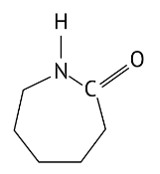
Contributor-Level 10
This is a multiple choice answer as classified in NCERT Exemplar
Option (D)
Explanation: The given structure is caprolactam. Nylon-6 is prepared from the monomer caprolactam. It is obtained by heating caprolactam with water at a high temperature.
New answer posted
a year agoContributor-Level 10
This is a multiple choice answer as classified in NCERT Exemplar
Option (B)
Explanation: Low-density polythene is obtained from the polymerization of ethane under high pressure and temperature. Low-density polyethylene is tough, a poor conductor of electricity and has a highly branched structure.
Low-density polythene is not hard because branched structure prevents stacking and thus, reduces the intermolecular force of attraction.
So, option (B) is correct.
New answer posted
a year ago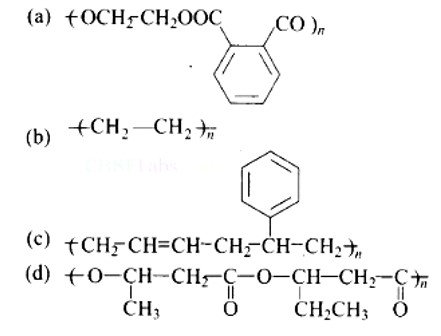
Contributor-Level 10
This is a multiple choice answer as classified in NCERT Exemplar
Option (A)
Explanation: Dacron or Terylene is formed by the condensation polymerization of ethylene glycol and phthalic acid with the elimination of water molecules. The structure of Terylene is,
New answer posted
a year ago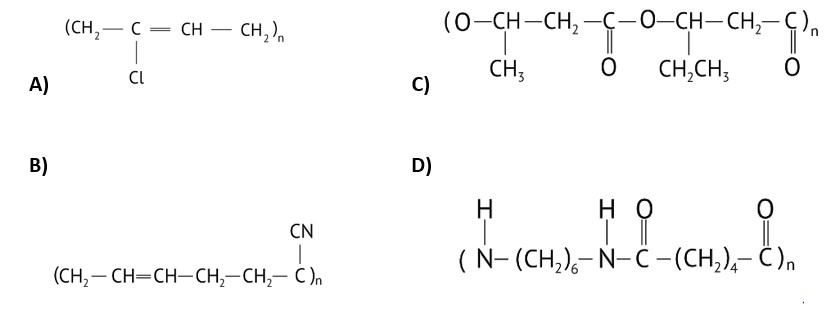
Contributor-Level 10
This is a multiple choice answer as classified in NCERT Exemplar
Option (C)
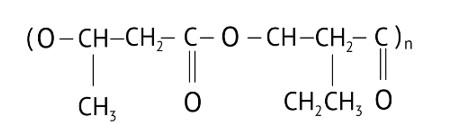
Explanation: PHBV (Poly beta-hydroxybutyrate co-beta-hydroxy valerate) is a biodegradable polymer. It undergoes bacterial degradation in the environment. The structure is shown as,
New answer posted
a year agoContributor-Level 10
This is a multiple choice answer as classified in NCERT Exemplar
Option (B)
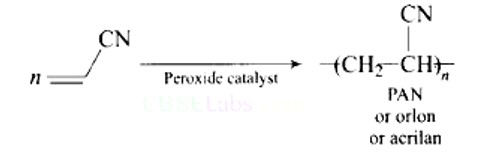
Explanation: Polyacrylonitrile is used as a wool substitute in the manufacture of commercial fibers such as orlon or acrilan.
New answer posted
a year agoContributor-Level 10
This is a multiple choice answer as classified in NCERT Exemplar
Option (A)
Explanation: Semi-synthetic polymers are obtained from natural polymers. Cellulose derivatives like cellulose nitrate, cellulose acetate rubber are examples of semi-synthetic polymers.
Cis-polyisoprene is not a semi-synthetic polymer while other examples are semi-synthetic polymer.
Taking an Exam? Selecting a College?
Get authentic answers from experts, students and alumni that you won't find anywhere else
Sign Up on ShikshaOn Shiksha, get access to
- 67k Colleges
- 1.2k Exams
- 717k Reviews
- 1850k Answers