
Ncert Solutions Maths class 12th
Get insights from 2.5k questions on Ncert Solutions Maths class 12th, answered by students, alumni, and experts. You may also ask and answer any question you like about Ncert Solutions Maths class 12th
- 2.5k
Questions
- 0
Discussions
- 1
Active Users
- 65
Followers
Have a question about Ncert Solutions Maths class 12th? Ask our experts
Keep it short & simple. Type complete word. Avoid abusive language.
The degree of the differential equation is:
(A) 3
(B) 2
(C) 1
(D) Not defined
The degree of the differential equation is:
(A) 3
(B) 2
(C) 1
(D) Not defined
In the given D.E,
is a trigonometric function of derivative . So it is not a polynomial equation so its derivative is not defined.
Hence, Degree of the given D.E. is not defined.
Option (D) is correct.
 Upvote

The highest order derivative present in the D.E. is so its order is 2.
As the given D.E. is polynomial equation in its derivative, its degree is 1.
Upvote The highest order derivative present in the D.E. is so its order is 2.
As the given D.E. is a polynomial equation in its derivative, its degree is 1.
Upvote 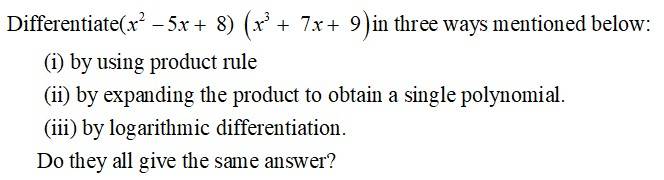
(i) by product rule
3x4 + 7x2- 15x3- 35x + 24x2 + 56 + 2x4- 5x3 + 14x2- 35x 18x-45
= 5x4- 20x3 + 45x2- 52x + 11
(ii)
Taking log in eqn (1)
Now, Differe(iii) ntiating w r t ‘x’ we get,
2x4 + 14x4 + 18x- 35x- 45 + 3x1- 15x3 + 24x2 + 7x2- 35x + 56]
&n
Upvote The given order derivative present in the D.E. is so its order is 1.
As the given D.E. is a polynomial equation in its derivative, its degree is 1.
Upvote The highest order present in the D.E. is so its order is 3.
As the given D.E. is a polynomial equation in its derivative, its degree is 1.
Upvote 84. Find the derivative of the function given by and hence f'(1)
84. Find the derivative of the function given by and hence f'(1)
84. Given, f(x) = (1 + x)(1 + x 4)(1 + x 8)
Taking log,
logf(x) = log (1 + x) + log (1 + x) + log (1 + x 4) + log (1 + x 8)
Now, Differentiating w r t ‘x’ we get,
Putting x = 1
f`(x) = (1 +1)(1 + 14)(1 +18)
Upvote The highest order derivative present in the D.E. is so its order is 3.
As the given D.E. is a polynomial equation in its derivation, its degree is 2.
Upvote As the given D.E. is a polynomial equation in its derivative, its degree is 1.
Upvote As the given D.E. is not a polynomial equation in its derivative, its degree is not defined.
Upvote