
Photoelectric Emission
Get insights from 7 questions on Photoelectric Emission, answered by students, alumni, and experts. You may also ask and answer any question you like about Photoelectric Emission
- 7
Questions
- 0
Discussions
- 0
Active Users
- 0
Followers
Have a question about Photoelectric Emission? Ask our experts
Keep it short & simple. Type complete word. Avoid abusive language.
The work function of a metal is w0 and l is wavelength of incident radiation. There is no emission of photoelectron whenThe work function of a metal is w0 and l is wavelength of incident radiation. There is no emission of photoelectron when\
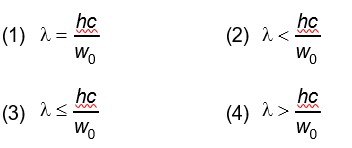
The work function of a metal is w0 and l is wavelength of incident radiation. There is no emission of photoelectron whenThe work function of a metal is w0 and l is wavelength of incident radiation. There is no emission of photoelectron when\
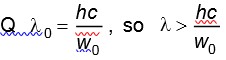
For no emission of electron
λ > λ0
 Upvote

Photons with energy 5 eV are incident on a cathode C in a photoelectric cell. The maximum energy of emitted photoelectrons is 2 eV When photons of energy 6 eV are incident on C, no photoelectrons will reach the anode A, if the stopping potential of A relative to C is
Photons with energy 5 eV are incident on a cathode C in a photoelectric cell. The maximum energy of emitted photoelectrons is 2 eV When photons of energy 6 eV are incident on C, no photoelectrons will reach the anode A, if the stopping potential of A relative to C is
According to Einstein’s photoelectric equation maximum kinetic energy of photoelectrons,
or
When then,
or
or
Upvote In a photoelectric experiment, increasing the intensity of incident light:
In a photoelectric experiment, increasing the intensity of incident light:
Intersity a number of photons kinetic Energy a f
Upvote The work functions of Caesium (Cs), Potassium (K) and Sodium (Na) are and respectively. If incident electromagnetic radiation has an incident energy of , which of these photosensitive surfaces may emit photoelectrons?
<!-- [if !supportLineBreakNewLine]-->
<!--[endif]-->
The work functions of Caesium (Cs), Potassium (K) and Sodium (Na) are and respectively. If incident electromagnetic radiation has an incident energy of , which of these photosensitive surfaces may emit photoelectrons?
<!-- [if !supportLineBreakNewLine]-->
<!--[endif]-->
Incident energy
If electron will emit.
No electron emission
Only caesium will emit electron
Upvote 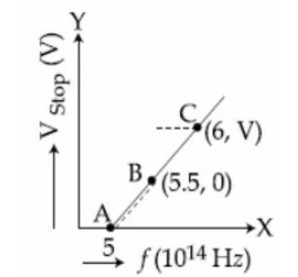
When photon of energy strikes the surface of a metal , the ejected photoelectrons have maximum kinetic energy eV and de-Broglie wavelength . The maximum kinetic energy of photoelectrons liberated form another metal B by photon of energy 4.50 is . If the de-Broglie wavelength of these photoelectrons , then the work function of metal is
When photon of energy strikes the surface of a metal , the ejected photoelectrons have maximum kinetic energy eV and de-Broglie wavelength . The maximum kinetic energy of photoelectrons liberated form another metal B by photon of energy 4.50 is . If the de-Broglie wavelength of these photoelectrons , then the work function of metal is
Relation between De-Broglie wavelength and K.E. is
Upvote Two stream of photons, possessing energies equal to twice and ten times the work function of metal are incident on the metal surface successively. The value of ratio of maximum velocities of the photoelectrons emitted in the two respective cases is x : y. The value of x is………
Two stream of photons, possessing energies equal to twice and ten times the work function of metal are incident on the metal surface successively. The value of ratio of maximum velocities of the photoelectrons emitted in the two respective cases is x : y. The value of x is………