
Physics Nuclei Overview
Get insights from 23 questions on Physics Nuclei Overview, answered by students, alumni, and experts. You may also ask and answer any question you like about Physics Nuclei Overview
- 23
Questions
- 0
Discussions
- 0
Active Users
- 0
Followers
Have a question about Physics Nuclei Overview? Ask our experts
Keep it short & simple. Type complete word. Avoid abusive language.
A radioactive sample decays with a constant of (1/3)logₑ2 s⁻¹. If initially there are 200 nuclei present, find the number of nuclei decayed during the first 9 seconds.
A radioactive sample decays with a constant of (1/3)logₑ2 s⁻¹. If initially there are 200 nuclei present, find the number of nuclei decayed during the first 9 seconds.
t? , half life = (log?2)/λ = 3 s
Initially 200 nuclei were there
After 3 half-lives, 9 seconds,
No. of nuclei = (1/2³) (200) = 25
Therefore, the number of nuclei that decayed = 200 – 25 = 175
 Upvote

A radioactive β –emission. A detector records n β –particles in 2s and by next 2s (accumulatively) it records 1.1 n β –particle. Number of β –particles recorded by detector after a long time, is
A radioactive β –emission. A detector records n β –particles in 2s and by next 2s (accumulatively) it records 1.1 n β –particle. Number of β –particles recorded by detector after a long time, is
N = [n + n/10 + n/100 + .]
= n/ (1 - 1/10) = 10/9
Upvote The decay of a proton to neutron is :
<!-- [if !supportLineBreakNewLine]-->
<!--[endif]-->
The decay of a proton to neutron is :
<!-- [if !supportLineBreakNewLine]-->
<!--[endif]-->
Always possible as it is associated only with β? decay
Upvote You are given that Mass of ?Li = 7.0160u, Mass of ?He = 4.0026u and ¹H = 1.0079u. When 20 g of ?Li is converted into ?He by proton capture, the energy liberated, (in kWh), is [Mass of nucleon = 1GeV/c²]
<!-- [if !supportLineBreakNewLine]-->
<!--[endif]-->
You are given that Mass of ?Li = 7.0160u, Mass of ?He = 4.0026u and ¹H = 1.0079u. When 20 g of ?Li is converted into ?He by proton capture, the energy liberated, (in kWh), is [Mass of nucleon = 1GeV/c²]
<!-- [if !supportLineBreakNewLine]-->
<!--[endif]-->
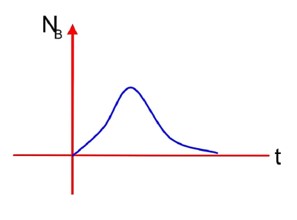
Kindly consider the following figure
Upvote The nuclear activity of a radioactive element becomes (1/8)ᵗʰ of its initial value in 30 years. The half –life of radioactive element is __________ years.
The nuclear activity of a radioactive element becomes (1/8)ᵗʰ of its initial value in 30 years. The half –life of radioactive element is __________ years.
A = A? (1/2)?
A/A? = 1/8 = (1/2)³ ⇒ n = 3
t = n T½
30 = 3 T½
T½ = 10 years
Upvote A sample of a radioactive nucleus A disintegrates to another radioactive nucleus B, which in turns disintegrates to some other stable nucleus C. Plot of a graph showing the variation of number of atoms of nucleus B vesus time is:
(Assume that a t = 0, there are no B atoms in the sample)
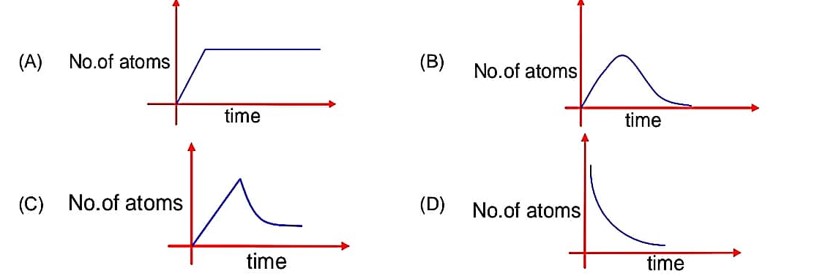
A sample of a radioactive nucleus A disintegrates to another radioactive nucleus B, which in turns disintegrates to some other stable nucleus C. Plot of a graph showing the variation of number of atoms of nucleus B vesus time is:
(Assume that a t = 0, there are no B atoms in the sample)
Read the following statements:
(A) Volume of the nucleus is directly proportional to the mass number.
(B) Volume of the nucleus is independent of mass number.
(C) Density of the nucleus is directly proportional to the mass number.
(D) Density of nucleus is directly proportional to the cube root of the mass number.
(E) Density of the nucleus is independent of the mass number.
Choose the correct option from the following options.
A sample contains 10-2kg each of two substances A and B with half lives 4s and 8s respectively. The ration of their atomic weights is 1 : 2. The ratio of the amounts of A and B after16s is <!-- [if gte mso 9]><xml>
A sample contains 10-2kg each of two substances A and B with half lives 4s and 8s respectively. The ration of their atomic weights is 1 : 2. The ratio of the amounts of A and B after16s is <!-- [if gte mso 9]><xml>