
Physics Nuclei Overview
Get insights from 23 questions on Physics Nuclei Overview, answered by students, alumni, and experts. You may also ask and answer any question you like about Physics Nuclei Overview
- 23
Questions
- 0
Discussions
- 0
Active Users
- 0
Followers
Have a question about Physics Nuclei Overview? Ask our experts
Keep it short & simple. Type complete word. Avoid abusive language.
Determine the number of nuclei that will be decayed upto one average life of radioactive material? (N0 : Initial number of nuclei)
Determine the number of nuclei that will be decayed upto one average life of radioactive material? (N0 : Initial number of nuclei)
N = N0e–λt
->t = λN = N0/e
So number of nuclei decayed = N0 – N
= N0 (1- 1/e)
 Upvote

Density of nuclei is order of 1017 kg m–3.
Upvote Power factor of series LCR circuit at resonance is
Power factor of series LCR circuit at resonance is
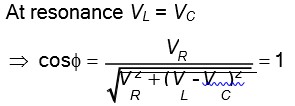
Upvote Density of nuclei is order of 1017 kg m-3.
Upvote Two radioactive substances X and Y originally have N1 and N2 nuclei respectively. Half life of X is half of the life of Y. After three half lives of Y, number of nuclei of both are equal.
The ratio will be equal to:
Two radioactive substances X and Y originally have N1 and N2 nuclei respectively. Half life of X is half of the life of Y. After three half lives of Y, number of nuclei of both are equal.
The ratio will be equal to:
Number of half lives of Y = 3
Number of half lives of X = 6 [As half life of X is half of that of Y].
Upvote The half life of a radioactive substance is 5 years. After x years a given sample of the radioactive substance gets reduced to 6/25% of its initial value. The value of x is___________.
The half life of a radioactive substance is 5 years. After x years a given sample of the radioactive substance gets reduced to 6/25% of its initial value. The value of x is___________.
According to Nuclear activity, we can write
Time required = 4 ×
Upvote 
A ray of light is incident at an angle of incidence on the glass slab of refractive index After refraction, the light ray emerges out from other parallel faces and lateral shift between incident ray and emergent ray is cm. The thickness of the glass slab is _______cm.
A ray of light is incident at an angle of incidence on the glass slab of refractive index After refraction, the light ray emerges out from other parallel faces and lateral shift between incident ray and emergent ray is cm. The thickness of the glass slab is _______cm.
cm (Lateral shift)
By Snell’s law
θ = 30
t = 12 cm
 Upvote
Mass of Bromine, Selenium and Krypton are given as:-
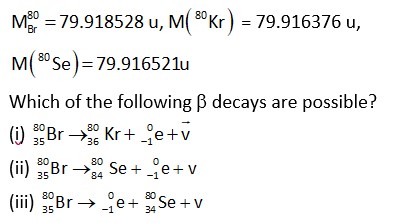
Mass of Bromine, Selenium and Krypton are given as:-
The rest mass of the deuteron, proton and neutron is equivalent to energy of 1877MeV, 939MeV, 940MeV respectively. A deuteron may disintegrate to a proton and neutron if it.
<!-- [if !supportLineBreakNewLine]-->
<!--[endif]-->
The rest mass of the deuteron, proton and neutron is equivalent to energy of 1877MeV, 939MeV, 940MeV respectively. A deuteron may disintegrate to a proton and neutron if it.
<!-- [if !supportLineBreakNewLine]-->
<!--[endif]-->
Energy of products = 939 + 940 = 1879
ΔE + E_reactions – E_productor = 1877 – 1879 = -2MeV.
Hence it must capture a γ - ray photon of energy 2MeV.
Upvote