Physics

Get insights from 5.6k questions on Physics, answered by students, alumni, and experts. You may also ask and answer any question you like about Physics

Follow Ask Question
5.6k

Questions

0

Discussions

28

Active Users

0

Followers

New answer posted

4 months ago

0 Follower 7 Views

A
alok kumar singh

Contributor-Level 10

Kindly go through the solution

New answer posted

4 months ago

0 Follower 1 View

A
alok kumar singh

Contributor-Level 10

After burning, heat exchange occurs between helium and atmospheric. Hence, irreversible, isothermal process.

New answer posted

4 months ago

0 Follower 3 Views

A
alok kumar singh

Contributor-Level 10

The mass of the cylinder M = ρV = ρ (πR²L), where ρ is the density of the material.
We can express R² in terms of L: R² = M / (πρL).
The moment of inertia is I = M (R²/4 + L²/12).
Substitute R² into the equation for I:
I (L) = M * [ (M / (4πρL) + (L²/12) ]
To find the minimum possible I, we differentiate I with respect to L and set the derivative to zero.
dI/dL = M * [ -M/ (4πρL²) + 2L/12 ] = 0
M/ (4πρL²) = 2L/12 = L/6
M/ (πρ) = (4/6)L³ = (2/3)L³
Since R² = M/ (πρL), we have R²L = M/ (πρ).
Substitute M/ (πρ) into the differentiated equation:
R²L = (2/3)L³

New answer posted

4 months ago

0 Follower 4 Views

A
alok kumar singh

Contributor-Level 10

Kindly go through the solution


New answer posted

4 months ago

0 Follower 6 Views

A
alok kumar singh

Contributor-Level 10

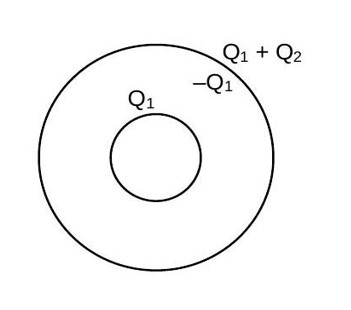
When the two conducting spheres are connected by a wire, they will reach the same electric potential, V.
The total charge Q_total = 12µC + (-3µC) = 9µC. This total charge will redistribute.
Let the final charges be q? and q? + q? = 9µC.
The potential of a sphere is V = kq/r.
V? = V?
k q? /R? = k q? /R? ⇒ q? /R? = q? /R?
q? / (2R/3) = q? / (R/3) ⇒ q? /2 = q? ⇒ q? = 2q?
Substitute this into the charge conservation equation:
2q? + q? = 9µC ⇒ 3q? = 9µC ⇒ q? = 3µC.
Then, q? = 2 * 3µC = 6µC.
The final charges are 6µC and 3µC.

New answer posted

4 months ago

0 Follower 9 Views

A
alok kumar singh

Contributor-Level 10

The internal energy of one mole of an ideal gas is given by U = (f/2)RT, where f is the number of degrees of freedom.
For a non-linear triatomic molecule (assumed to be a rigid rotator), there are:

3 translational degrees of freedom.

3 rotational degrees of freedom.
Vibrational modes are generally not considered at temperature T unless specified.
Total degrees of freedom f = 3 + 3 = 6.
U = (6/2)RT = 3RT.


New question posted

4 months ago

0 Follower 6 Views

New answer posted

4 months ago

0 Follower 5 Views

A
alok kumar singh

Contributor-Level 10

The least count (LC) of the screw gauge is the pitch divided by the number of divisions on the circular scale.
LC = Pitch / N = 0.1 cm / 50 = 0.002 cm.
A measurement taken with this instrument must be a multiple of its least count. We check the options:
(A) 2.121 / 0.002 = 1060.5 (Not a multiple)
(B) 2.123 / 0.002 = 1061.5 (Not a multiple)
(C) 2.124 / 0.002 = 1062 (Is a multiple)
(D) 2.125 / 0.002 = 1062.5 (Not a multiple)
The correctly recorded measurement is 2.124 cm.

Get authentic answers from experts, students and alumni that you won't find anywhere else

Sign Up on Shiksha

On Shiksha, get access to

  • 66k Colleges
  • 1.2k Exams
  • 681k Reviews
  • 1800k Answers

Share Your College Life Experience

×
×

This website uses Cookies and related technologies for the site to function correctly and securely, improve & personalise your browsing experience, analyse traffic, and support our marketing efforts and serve the Core Purpose. By continuing to browse the site, you agree to Privacy Policy and Cookie Policy.