

Physics
Get insights from 5.6k questions on Physics, answered by students, alumni, and experts. You may also ask and answer any question you like about Physics
Follow Ask QuestionQuestions
Discussions
Active Users
Followers
New answer posted
a year agoContributor-Level 10
This is a long answer type question as classified in NCERT Exemplar
(a) When the support of the hand is removed the body oscillates about mean position
Suppose x is the maximum extension in the spring when it reaches the lowest point in oscillation.

Loss in PE of the block=mgx
Gain in elastic potential energy =1/2 kx2
By energy conservation we cam say that
Mgx=1/2kx2
Or x= 2mg/k
Now the mean position of oscillation will be when the block is balanced by spring

If x' is the extension in that case
F= kx'
F=mg
Mg=kx'
X'=mg/k
By dividing x by x'
x/x'=
so x=2x'
x'=4/2 =2cm
but the displacement of mass from the mean position when spring attains its natural l
New answer posted
a year agoContributor-Level 10
This is a long answer type question as classified in NCERT Exemplar
(a) The weight of the body changes during oscillations.
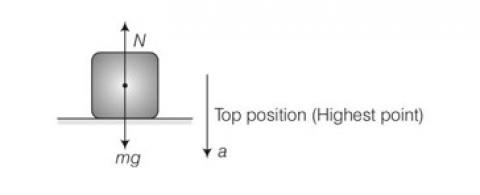
(b) Considering the situations in two extreme positions
we can say mg-N= ma
so at the highest point the platform is accelerating downward.
N=mg-ma
a=w2A
N=mg-mw2A
A= amplitude of motion m=50kg v=2m/s
w=2
A= 5cm = 5
N= 50

When it is accelerating towards mean position that is vertically upwards
N-mg=ma=Mw2A
N=mg+mw2A
N=m (g+w2A)
N= 50 [9.8+ ]
N= 884N
Machine reads the normal reaction
Maximum weight =884N
Minimum weight=95.5N
New answer posted
a year agoContributor-Level 10
13.28 The equation for deuterium-tritium fusion is given as:
It is given that
Mass of ( = 2.014102 u
Mass of ( , 3.016049 u
Mass of ( = 4.002603 u
Mass of ( = 1.008665 u
Q-value of the given D-T reaction is:
Q =
=
= 0.018883
= 17.59 MeV
Radius of the deuterium and tritium, r = 2 m
Distance between the centers of the nucleus when they touch each other,
d = r +r = 4 m
Charge on the deuterium and tritium nucleus = e
Hence the repulsive potential energy between the two nuclei is given as:
V =
Where,
= permittivity of free space
It is given that = 9 N
Hence, V = 9 = 5.76 J =
New answer posted
a year agoContributor-Level 10
13.27 In the fission of , 10 particles decay from the parent nucleus. The nuclear reaction can be written as:
It is given that:
Mass of a = 238.05079 u
Mass of a =139.90543 u
Mass of a = 98.90594 u
Mass of a neutron , = 1.00865 u
Q value of the above equation,
Q =
Where
m' = represents the corresponding atomic masses of the nuclei.
=
m'( =
m'( =
m'(
Substituting these values, we get
Q =
=
= u
=0.24807 u
= 231.077 MeV
New answer posted
a year agoContributor-Level 10
13.26 For the emission of , the nuclear reaction is:
We know that:
Mass of , = 223.01850 u
Mass of , = 208.98107 u
Mass of , = 14.00324 u
Hence, the Q-value of the reaction is given as:
Q = ( - - )
= (223.01850 - 208.98107 - 14.00324) u
= 0.03419 u
= 0.03419 MeV = 31.848 MeV
Hence, the Q-value of the nuclear reaction is 31.848 MeV, since the value is positive, the reaction is energetically allowed.
For the emission of , the nuclear reaction is:
We know that:
Mass of , = 223.01850 u
Mass of , = 219.00948 u
Mass of , = 4.00260 u
Hence, the Q-value of the reaction is given as:
Q = ( - &n
New answer posted
a year agoContributor-Level 10
13.24 If a neutron is removed from , the corresponding reaction can be written as:
+
The separation energies are
For : Separation energy = 8.363007 MeV
For : Separation energy = 13.059 MeV
It is given that
m( = 39.962591 u
m( = 40.962278 u
m( = 1.008665 u
The mass defect of the reaction is given as:
Δm = m ( m( m(
= 39.962591 + 1.008665 - 40.962278
= 8.978 u
=8.363007 MeV
For , the neutron removal reaction can be written as
+
It is given that
m( = 25.986895 u
m( = 26.981541 u
m( = 1.008665 u
The mass defect of the reaction is given as:
Δm = m( m( m(
= 25.
New answer posted
a year agoContributor-Level 10
13.15 The given nuclear reaction is
+ +
Atomic mass
m ( ) = 1.007825 u
m ( ) = 2.014102 u
m ( ) = 3.016049 u
The Q-value of the reaction can be written as:
Q =
=
= (-4.33 )
But 1 u = 931.5 MeV/
Q = -4.0334 MeV
The negative Q-value of the reaction shows that the reaction is endothermic.
The given nuclear reaction is
+ +
Atomic mass
m ( ) = 12.000000 u
m ( ) = 19.992439 u
m ( ) = 4.002603 u
The Q-value of this reaction is given as:
Q =
=
=4.958 u
=4.958
=4.6183 MeV
New answer posted
a year agoContributor-Level 10
13.13 The given values are
m ( = 11.011434 u and m ( ) = 11.009305 u
The given nuclear reaction:
Half life of nuclei, =20.3 min
The maximum energy possessed by the emitted positron = 0.960 MeV
The change in the Q-value (ΔQ) of the nuclear masses of the
ΔQ =
where
= Mass of an electron or positron = 0.000548 u
c = speed of the light
m' = Respective nuclear masses
If atomic masses are used instead of nuclear masses, then we have to add 6 in the case of and 5 in the case of .
Hence the equation (1) reduces to
ΔQ =
= u
=1.033
New answer posted
a year agoContributor-Level 10
13.12 particle decay of emits a helium nucleus. As a result, its mass number reduces to (226-4) 222 and its atomic number reduces to (88-2) 86.
+
Q value of emitted particle = (Sum of initial mass – Sum of final mass) , where
c = Speed of light.
It is given that
m ( = 226.02540 u
m ( = 222.01750 u
m ( = 4.002603 u
Q value = [(226.02540) – (222.01750 + 4.002603)]
= 5.297
But 1 u = 931.5 MeV/
Hence Q = 4.934 MeV
Kinetic energy of the particle = = 4.934= 4.85 MeV
particle decay of
New answer posted
a year agoContributor-Level 10
13.6 In - decay, there is a loss of 2 protons and 4 neutrons. In every decay, there is a loss of 1 proton and a neutrino is emitted from the nucleus. In every decay, there is a gain of 1 proton and an antineutrino is emitted from the nucleus.
+
+
+ +
+ +
+ +
+ +
+
Taking an Exam? Selecting a College?
Get authentic answers from experts, students and alumni that you won't find anywhere else
Sign Up on ShikshaOn Shiksha, get access to
- 67k Colleges
- 1.2k Exams
- 718k Reviews
- 1850k Answers