

Physics
Get insights from 5.6k questions on Physics, answered by students, alumni, and experts. You may also ask and answer any question you like about Physics
Follow Ask QuestionQuestions
Discussions
Active Users
Followers
New answer posted
a year agoContributor-Level 10
5.2 (a) Earth's magnetic field changes with time. It takes a few hundred years to change by an appreciable amount. The variation in earth's magnetic field with the time cannot be neglected.
(b) Earth's core contains molten iron. This form of iron is not ferromagnetic. Hence this is not considered as a source of earth's magnetism.
(c) The radioactivity in earth's interior is the source of energy that sustains the currents in the outer conducting regions of earth's core. These charged currents are considered to be responsible for earth's magnetism.
(d) The change of earth's magnetic field got weakly recorded in rocks during their solidif
New answer posted
a year agoContributor-Level 10
5.1 (a) Earth's magnetic field can be specified by three following independent quantities
Magnetic declination
Angle of dip
Horizontal component of earth's magnetic field.
(b) The angle of dip at a point depends on how far the point is located with respect to North pole or South pole. The angle of dip will be more in Britain than Southern India as Britain is closer to Magnetic North pole than South India to the Magnetic South pole.
(c) It is a hypothesis that a huge bar magnet is embedded deep in Earth's ground with its north pole near magnetic south pole of earth and south pole is near magnetic north pole of earth. Magnetic field lines
New answer posted
a year agoContributor-Level 10
4.28 Resistance of the galvanometer coil, G = 15 Ω
Current for which galvanometer shows full deflection, = 4 mA = 4 A
Range of ammeter has to be converted from 0 to 6 A, hence I = 6 A
A shunt resistor S is to be connected in parallel with the galvanometer to convert it to an ammeter. The value of S is given as
S = 10 mΩ
Hence, a shunt resistor of 10 mΩ is to be connected to galvanometer to convert it to an ammeter.
New answer posted
a year agoContributor-Level 10
4.27 Resistance of the galvanometer coil, G = 12 Ω
Current for which there is full scale deflection, = 3 mA = 3 A
Range of voltmeter = 0, to be converted to 18 V, hence V = 18 V
Let there be a resistor R connected in series with the galvanometer to convert it into a voltmeter. R is given as
R = - G = - 12 = 5988 Ω
Hence the required value of resistor is 5988 Ω
New answer posted
a year agoContributor-Level 10
4.26 Length of the solenoid, L = 60 cm = 0.6 m
Radius of the solenoid, r = 4.0 cm = 0.04 m
It is given that there are 3 layers of windings of 300 turns each
Hence, total number of turns, n = 900
Length, l = 2 cm = 0.02 m
Mass of the wire, m = 2.5 g = 2.5 kg
Current flowing through the wire, I = 6 A
Acceleration due to gravity, g = 9.8 m/
We know, magnetic field produced inside the solenoid, B =
where = Permeability of free space = 4 T m
Magnetic force is given by the relation
F = Bil =
Also the force on the wire is equal to the weight of the wire, F = mg
mg =
I = = = 108 A
Hence, the current flowing through the solenoid is 108 A
New answer posted
a year agoContributor-Level 10
4.25 Number of turns on the circular coil, n =20
Radius of the coil, r = 10 cm = 0.1 m
Magnetic field strength, B = 0.10 T
Current in the coil, I = 5.0 A
The total torque on the coil is zero because the field is uniform.
The total torque on the coil is zero because the field is uniform.
Cross-sectional area of the copper coil, A =
Number of free electrons per cubic meter of copper, N = /
Charge on the electron, e = 1.6 C
Magnetic force, F = Be where is the drift velocity of electrons
= = = 5 N
The average force on each electron is 5 N
New answer posted
a year ago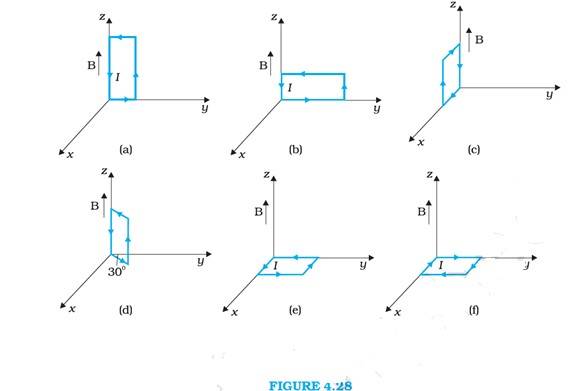
Contributor-Level 10
4.24 Magnetic field strength, B = 3000G = 3000 T = 0.3 T
Length of the rectangular loop, l = 10 cm
Width of the rectangular loop, b = 5 cm
Area of the loop, A = l = 10 = 50 = 50
Current in the loop, I = 12 A
Assume that the anti-clockwise direction of the current is positive and vice versa.
Torque, =
From the given figure, it can be observed that A is normal to the y-z plane and B is directed along z-axis.
= 12*( 50 = Nm
The Torque is Nm along the negative y-direction.
The force on the loop is zero because the angle between A & B is zero.
This case is similar to case (a). The answer is same as case (a)
Torque, = I
F
New question posted
a year agoNew answer posted
a year agoContributor-Level 10
4.23 Magnetic field strength, B = 1.5 T
Radius of the cylindrical region, r = 10 cm = 0.1 m
Current in the wire passing through the cylindrical region, I = 7 A
If the wire intersect the axis, then the length of the wire is the diameter of the cylindrical region, then l = 2r = 0.2 m
Angle between the magnetic field,
Magnetic force acting on the wire is given by the relation,
F = BIl = 1.5 = 2.1 N
Hence, a force of 2.1 N acts on the wire in a vertically downward direction.
If the wire is turned from N-S to NE-NW direction, new length of the wire can be given as
Angle between magnetic field and current = 45
Force on the wire,
F = BI =
New answer posted
a year agoContributor-Level 10
4.22 Current in both the wires, I = 300 A
Distance between the wires, r = 1.5 cm = 0.015 m
Length of the two wires, l = 70 cm = 0.7 m
Now, force between the two wires is given by the relation:
F = , where = Permeability of free space = 4 T m
Hence F = N/m = 1.2 N/m
Since the direction of the current in the wires is opposite, a repulsive force exists between them.
Taking an Exam? Selecting a College?
Get authentic answers from experts, students and alumni that you won't find anywhere else
Sign Up on ShikshaOn Shiksha, get access to
- 67k Colleges
- 1.2k Exams
- 718k Reviews
- 1850k Answers