

Chemistry
Get insights from 6.9k questions on Chemistry, answered by students, alumni, and experts. You may also ask and answer any question you like about Chemistry
Follow Ask QuestionQuestions
Discussions
Active Users
Followers
New answer posted
a year agoContributor-Level 9
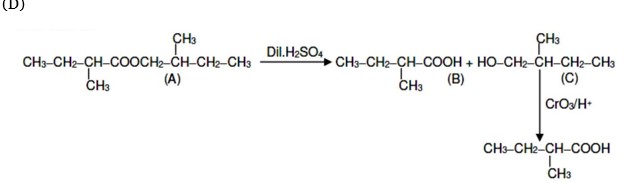
(B) contains eight carbon atoms whereas the molecular formula C? H? O? contains ten carbon atoms.
New answer posted
a year agoContributor-Level 9
The diameter of the dispersed particles is not much smaller than the wavelength of the light used. The intensity of scattered light depends on the difference between the refractive indice of the D.P and D.M., In lyophobic colloids, this difference is appreciable and therefore the tyndal effect is quite well defined but in lyophilic sols the difference is very small and the tyndal effect is very weak. So, to show Tyndall effect the refractive indices of the dispersed phase and dispersion medium differ greatly in magnitude.
New answer posted
a year agoContributor-Level 9
At room temperature water is liquid and has boiling point 373K due to hydrogen bonding. Where as H? S is gas and it has no hydrogen bonding. Hence boiling point of H? S is less than 300K [Boiling point of H? S is -60 °C ].
New answer posted
a year agoContributor-Level 9
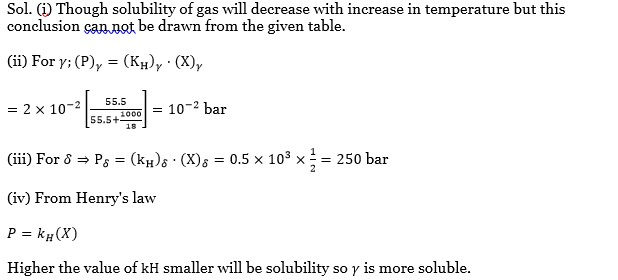
Novestrol (Anti Fertility Drugs)
Novestrol has phenolic functional group, alcoholic functional group and Terminal alkyne.

New answer posted
a year agoContributor-Level 9
Glycerol can be separated from spent-lye in soap industry by using reduce pressure distillation technique.

New answer posted
a year agoContributor-Level 9
Burning of fossil fuels (which contain sulphur and nitrogenous matter) such as coal and oil in power stations and furnaces produce sulphur dioxide and nitrogen oxides which causes acid rain.
Taking an Exam? Selecting a College?
Get authentic answers from experts, students and alumni that you won't find anywhere else
Sign Up on ShikshaOn Shiksha, get access to
- 67k Colleges
- 1.2k Exams
- 716k Reviews
- 1850k Answers