

Chemistry
Get insights from 6.9k questions on Chemistry, answered by students, alumni, and experts. You may also ask and answer any question you like about Chemistry
Follow Ask QuestionQuestions
Discussions
Active Users
Followers
New answer posted
a year agoContributor-Level 10
This is a short answer type question as classified in NCERT Exemplar
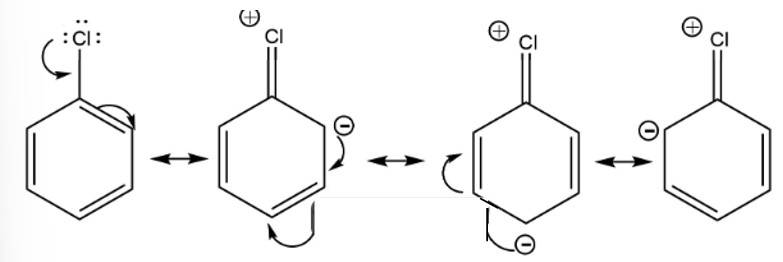
Due to the +R effect halogens are ortho and para directing groups.
New answer posted
a year agoContributor-Level 10
The electrons may be assigned to the following orbitals :
(i) 4d
(ii) 3d
(iii) 4p
(iv) 3d
(v) 3p
(vi) 4p.
The increasing order of energy is :
(v) < (ii) = (iv) < (vi) = (iii) < (i)
New answer posted
a year agoContributor-Level 10
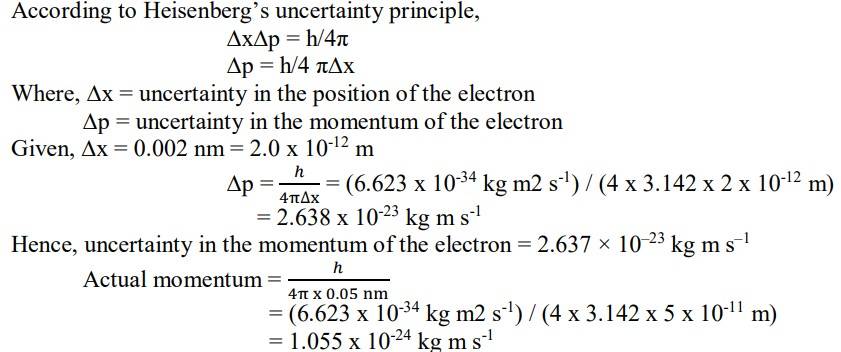
Since actual momentum is smaller than the uncertainty in measuring momentum, therefore, the momentum of electron cannot be defined
New answer posted
a year ago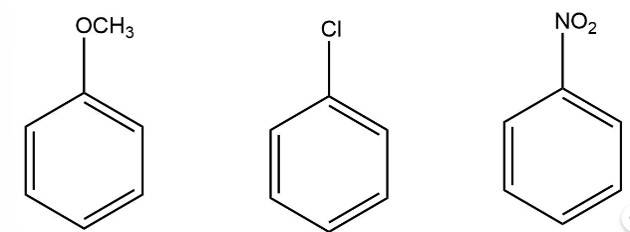
Contributor-Level 10
This is a short answer type question as classified in NCERT Exemplar
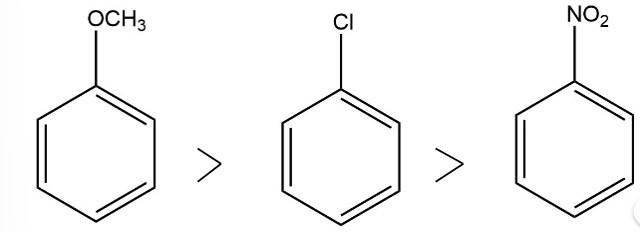
The electron donating group increases the reactivity in electrophilic substitution reaction whereas the electron withdrawing group decreases the reactivity in electrophilic substitution.
Thus, the order of reactivity
New answer posted
a year agoContributor-Level 10
ν = 4.37 x 10⁵ m s-1, m = 0.1 kg
As per de Brogile's equation,
λ= m/v = (6.626 x 10⁻³⁴ kg m2 s-1) / (0.1 kg) x (4.37 x 10⁵ m s-1)
=6.626/0.437 x 10-34-5 m
= 1.516 x 10-38 m
New question posted
a year agoNew answer posted
a year agoContributor-Level 10
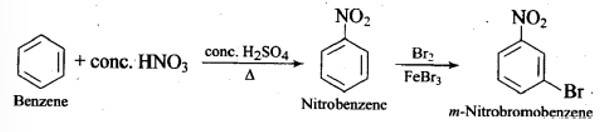
This is a short answer type question as classified in NCERT Exemplar
New answer posted
a year agoContributor-Level 10
ν = 2.19 x 10⁶ m s-1
As per de Brogile's equation,
λ= m/v = (6.626 x 10⁻³⁴ kg m2 s-1) / (9.1 x 10⁻³¹ kg) x (2.19 x 10⁶ m s-1)
6.626/91 * 2.19= x 10-34+25 m = 0.33243 x 10⁻⁹ m = 332.43 pm
New answer posted
a year agoContributor-Level 10
λ = 800 pm = 800 x 10-12 m
m = 1.675 x 10⁻²⁷ kg
As per de Brogile's equation,
ν =h/mλ = (6.626 x 10⁻³⁴ kg m2 s-1) / (1.675 x 10⁻²⁷ kg) x (800 x 10-12 m)
=6.626/1.675 * 8 x 10-34+27+10
= 0.494 x 10³ ms-1
= 494 ms-1
New answer posted
a year ago
Contributor-Level 10
This is a short answer type question as classified in NCERT Exemplar
The benzene here would undergo Friedel-Crafts alkylation reaction where carbocation is formed as an intermediate, thus secondary carbocation is formed as an intermediate due to its greater stability than that of the primary carbocation.
The final product obtained is

Taking an Exam? Selecting a College?
Get authentic answers from experts, students and alumni that you won't find anywhere else
Sign Up on ShikshaOn Shiksha, get access to
- 67k Colleges
- 1.2k Exams
- 717k Reviews
- 1850k Answers