

Class 11th
Get insights from 8k questions on Class 11th, answered by students, alumni, and experts. You may also ask and answer any question you like about Class 11th
Follow Ask QuestionQuestions
Discussions
Active Users
Followers
New answer posted
a year agoContributor-Level 10
68. The given series is
So, an =
So. Putting n = 1, 2, 3….n.
a1 =
a2 =
a3 =
So, adding. L.H.S and R.H.S. up ton terms
a1 + a2 + a3 + … + an =
Sn = 1 { equal terns cancelled out}
Sn =
Sn =
New answer posted
a year agoContributor-Level 10
67. The given series is 3 * 12 + 5 * 22 + 7 * 32 + ….
So,an = (nth term of A P 3, 5, 7, .) (nth term of A P 1, 2, 3, ….)2
a = 3, d = 5 -3 = 2a = 1, d = 2 -1 = 1.
= [3 + (n- 1) 2] [1 + (n- 1) 1]2
=[3 + 2n- 2] [1 + n- 1]2
(2n + 1)(n)2
= 2n3 + n2
So, = 5n2∑n3 + ∑n2
New answer posted
a year agoContributor-Level 10
66. Given series is 1* 2* 3 + 2* 3 *4 + 3* 4 *5 + … to n term
an = (nth term of A. P. 1, 2, 3, …) ´* (nth terms of A. P. 2, 3, 4) *
i e, a = 1, d = 2- 1 = 1i e, a = 2, d = 3- 2 = 1
(nth term of A. P. 3, 4, 5)
i e, a = 3, d = 3 -4 = 1.
= [1 + (n -1) 1] *[2 + (n -1):1]* [3 + (n- 1) 1]
= (1 + n -1)*(2 + n -1)*(3 + n -1)
= n (n + 1)(n + 2)
= n(n2 + 2n + n + 2)
=n3 + 2n2 + 2n.
Sn = ∑n3 + 3 ∑n2 + 2 ∑n
=
=
New answer posted
a year agoContributor-Level 10
65. Given series is 1*2+2 *3+3* 4+4* 5+…
So, an (nth term of A.P 1, 2, 3…) (nth term of A.P. 2, 3, 4, 5…)
i e, a = 2, d = 2 -1 = 1i e, a = 2, d = 3 - 2 = 1
= [1 + (n- 1) 1] [2 + (n -1) 1]
= [1 + n- 1] [2 + n -1]
= n (n -1)
= n2-n.
Sn (sum of n terms of the series) = ∑n2 + ∑n.
Sn = +
=
=
New answer posted
a year ago

Contributor-Level 10
4.32
(a) Let be the angle at which the projectile is fired w.r.t. the x-axis, since depends on t
Therefore tan since (Vy=Voy -gt and Vx = Vox)
(b) Since = sin2 /2g…….(1)
R = sin2 /g …….(2)
Dividing (1) by (2)
( /R) = [ sin2 /2g]/[ sin2 /g] = / 4
New answer posted
a year agoContributor-Level 10
64. Let a and b be the roots of quadratic equation
So, A.M = 8
a + b =16 ….I
G.M. =

ab = 25…. II
We know that is a quadratic equation
(sum of roots) + product of roots = 0
using I and II
Which is the reqd. quadratic equation
New answer posted
a year agoContributor-Level 10
4.31
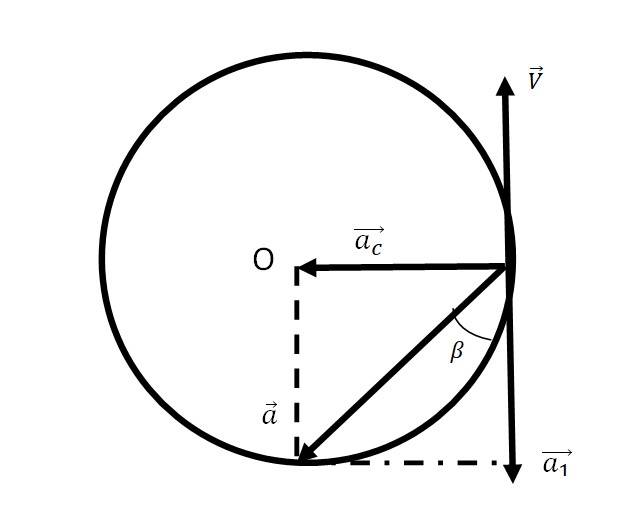
Speed of the cyclist = 27 km/h = 7.5 m/s
Radius of the road = 80m
The net acceleration is due to braking and the centripetal acceleration
Acceleration due to braking = 0.5 m/s2
Centripetal acceleration a = v2r = (7.5)2/80= 0.703 m/s2
The resultant acceleration is given by a = sqrt ( + ) = sqrt ( + ) = 0.86 m/s2
tan = AC / at = 0.7/0.5, = 54.5
New answer posted
a year agoContributor-Level 10
4.30
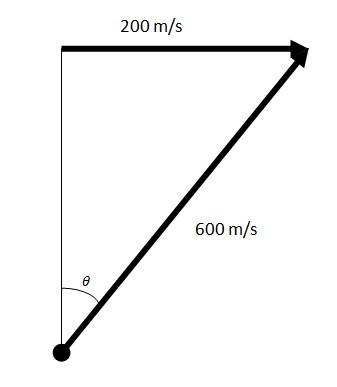
Speed of the fighter plane = 720 km/h = 200 m/s
The altitude of the plane = 1.5 km =1500 m
Velocity of the shell = 600 m/s
= 200/600
Let H be the minimum altitude for the plane to fly, without being hit
Using equation H = sin2 (90-
= (6002cos2 )/2g
= 360000 { ( 1 + cos2 )/2}/2 10
= 16000 m = 16 km
New answer posted
a year agoContributor-Level 10
63. Given,
Principal value, amount deposited, P= ?500
Interest Rate, R= 10
Using compound interest = simple interest +
Amount at the end of 1st year
=
= ?500* (1.1)
Amount at the end of 2nd year
=
=
= ?500 (1.1)2
Similarly,
Amount at the end of 3rd year = ?500 (1.1)3
So, the amount will form a G.P.
? 500 (1.1)? 500 (1.1)2?500 (1.1)3, ……….
After 10 years = ?500 (1.1)10
New answer posted
a year agoContributor-Level 10
4.29 The angle of projectile = 30
The bullet hits the ground at a distance of 3 km, Range R = 3 km
We know horizontal range for a projectile motion, R = sin2 / g
3 = sin60 / g
= 3/ sin60 = 3.464 …………… (1)
To hit a target at 5 km,
Max Range, = …………. (2)
On comparing equation (1) and (2), we get
= 3.464
Hence, the bullet will not hit the target even by adjusting its angle of projection.
Taking an Exam? Selecting a College?
Get authentic answers from experts, students and alumni that you won't find anywhere else
Sign Up on ShikshaOn Shiksha, get access to
- 67k Colleges
- 1.2k Exams
- 718k Reviews
- 1850k Answers