

Class 11th
Get insights from 8k questions on Class 11th, answered by students, alumni, and experts. You may also ask and answer any question you like about Class 11th
Follow Ask QuestionQuestions
Discussions
Active Users
Followers
New answer posted
a year agoContributor-Level 10
4.28
(a) We cannot associate the length of a wire bent into a loop with a vector.
(b) We can associate a plane area with a vector.
(c) We cannot associate the volume of a sphere with a vector.
New answer posted
a year agoContributor-Level 10
62. Since the numbers of bacteria doubles every hour. The number after every hour will be a G.P
So, a=30
r=2
At end of 2nd hour, a3 (or 3rd term) =
= 30*24
= 120
At end of 4th hour, a5 (r 4th term) =
= 30*24
= 30*16
= 480
Following the trend,
And at the end of nth hour, an+1=
= 30 *2n
New answer posted
a year agoContributor-Level 10
4.27 No in the both the cases.
A physical quantity which is having both direction and magnitude is not necessarily a vector. For instance, in spite of having direction and magnitude, current is a scalar quantity. The basic necessity for a physical quantity to fall in a vector category is that it ought to follow the “law of vector addition”.
As the rotation of a body about an axis does not follow the basic necessity to be a vector i.e. it does not follow the “law of vector addition”.
New answer posted
a year agoContributor-Level 10
4.26 Yes and No
A vector in space has no distinct location. The reason behind this is that a vector stays unchanged when it displaces in a way that its direction and magnitude do not change.
A vector changes with time. For instance, the velocity vector of a ball moving with a specific speed fluctuates with time.
Two equivalent vectors situated at different locations in space do not generate the same physical effect. For instance, two equivalent forces acting at different points on a body to rotate the body, but the combination will not generate the equivalent turning effect.



New answer posted
a year agoContributor-Level 10
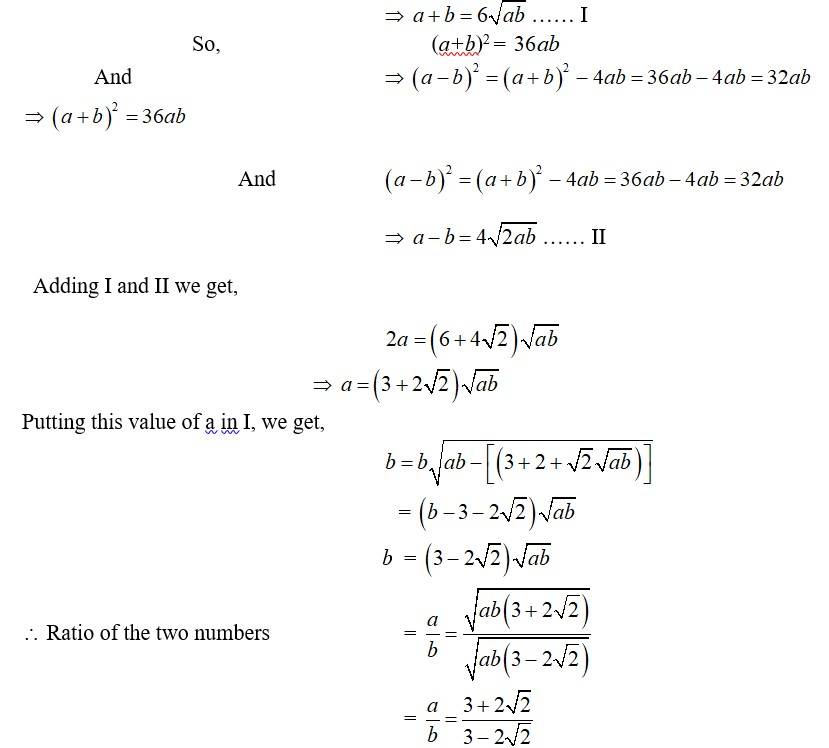
60. Let a and b be the two numbers and a>b so a-b = (+ ve)
So, sum of two numbers = 6. G.M of a and b
New answer posted
a year agoContributor-Level 10
58. Let G1 and G2 be the two numbers between 3 and 81 so that 3, G1, G2, 81 is in G.P.
So, a = 3
a4 = ar3 = 81 (when r = common ratio)
r3 = 27
r3 = 33
r = 3
So, G1 = ar = 33=9 and G2 = ar2 3´ (3)2 =27
New answer posted
a year agoContributor-Level 10
57. Let r be the common ratio of the G.P. then,
First term = a1 = a = a
So, L.H.S.=
=
=
=
=
R.H.S.=
=
=
= { }
=
L.H.S. = R.H.S.
New answer posted
a year agoContributor-Level 10
56. Let a and r be the first term and common difference of the G.P
Thus, Sum of the first on term,
Let Sn = sum of term from (n+1)th to (2n)th term
=
=
[ the above is a G.P. with first term arx and common ratio =
and number of term from (2n)th to (n+1)th = n
So,
=
=
Taking an Exam? Selecting a College?
Get authentic answers from experts, students and alumni that you won't find anywhere else
Sign Up on ShikshaOn Shiksha, get access to
- 67k Colleges
- 1.2k Exams
- 718k Reviews
- 1850k Answers