

Class 12th
Get insights from 12k questions on Class 12th, answered by students, alumni, and experts. You may also ask and answer any question you like about Class 12th
Follow Ask QuestionQuestions
Discussions
Active Users
Followers
New answer posted
a year agoContributor-Level 10
4. Given, f (x) = x n > n = positive.
At x = 2,
(x) = n.
f (x) = x n = n
∴ f (x) = f (x)
So f is continuous at x = n.

New answer posted
a year agoContributor-Level 10
Given,


Adding (2) and (3), we get
From (1) and (4), we have
Hence, proved.
New answer posted
a year ago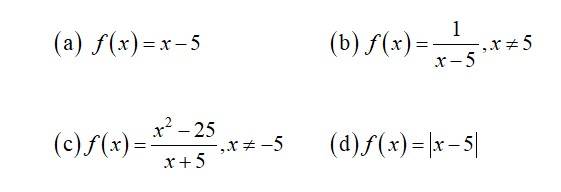
Contributor-Level 10
3. (a) Given, f (x) = x 5.
The given f x n is a polynernial f xn and as every pohyouraial f xn is continuous in its domain R we conclude that f (x) is continuous.
(b). Given, f(x) =
For any a {5},
and f(a) =
i e, f(x) = f(a).
Hence f is continuous in its domain.
(c) Given, f(x) =
For any a { 5}
= a 5
And f(a) =
= a 5
f(x) = f(a).
So, f is continuous in its domain.
(d) Given f (a) =
For x = c < 5.
f (c) = (c 5) = 5 c.
f(x) = (x 5) = (c 5) = 5 c.
∴ f(c) = f(x).
So f is continuous.
For x = c > 5.
f (c) = (x 5) = c 5
f(x) = (x 5) = c
New answer posted
a year agoContributor-Level 10
Given,
and
For,
, then either or or
For,
, then either or or
In case and are non- zero on both side.
But and cannot be both perpendicular and parallel simultaneously.
So, we can conclude that
or
New answer posted
a year ago
New answer posted
a year agoContributor-Level 10
Let as component
We know,
is a unit vector,
Given that,
marks angles with , with and with acute angle.
Now,
We know,

New answer posted
a year agoContributor-Level 10
Given,
A vector which is perpendicular to both and is given by

Say

Therefore, the unit vector is
Taking an Exam? Selecting a College?
Get authentic answers from experts, students and alumni that you won't find anywhere else
Sign Up on ShikshaOn Shiksha, get access to
- 67k Colleges
- 1.2k Exams
- 718k Reviews
- 1850k Answers