

Class 12th
Get insights from 12k questions on Class 12th, answered by students, alumni, and experts. You may also ask and answer any question you like about Class 12th
Follow Ask QuestionQuestions
Discussions
Active Users
Followers
New answer posted
a year agoContributor-Level 10
μ = sin (A + δm)/2) / sin (A/2)
Since, δm = A
μ = sin (A) / sin (A/2) = (2sin (A/2)cos (A/2) / sin (A/2)
μ = 2cos (A/2
New answer posted
a year agoContributor-Level 10
I = I? cosωt
Current is changing from its maximum value to rms value (I? /√2)
I? /√2 = I? cosωt
cosωt = 1/√2
ωt = π/4
2π * 50t = π/4
t = 1/400 s = 2.5 ms
New answer posted
a year ago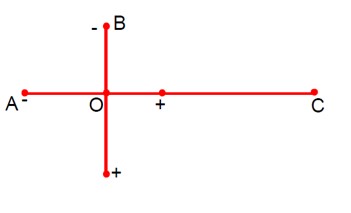
Contributor-Level 10
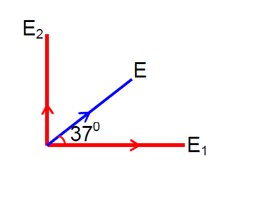
tan 37° = E? /E?
E? = k (2p? /r³) axial direction
E? = k (p? /r³) equatorial direction
tan 37° = (k p? /r³) / (k 2p? /r³) = p? / (2p? ) = 3/4
p? /p? = 2/3
New answer posted
a year agoContributor-Level 10
For electron,
λe = h/p ⇒ (KE)e = ½mv² = p²/ (2m) = (h²/λ²)/ (2m)
For photon,
λp = h/p ⇒ (K.E.)p = pc = hc/λ
KEe / KEp = (h²/ (2mλ²) / (hc/λ) = h/ (2mcλ)
But for electron p = mv = h/λ so h/λ = mv
KEe / KEp = mv / (2mc) = v/2c
New answer posted
a year ago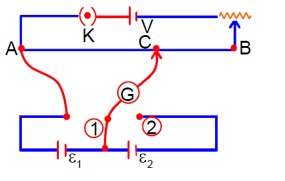
Contributor-Level 10
ε? = 250 * Potential Gradient
ε? + ε? = 400 * Potential Gradient
(ε? )/ (ε? + ε? ) = 250/400 = 5/8
By solving above
ε? /ε? = 5/3
New answer posted
a year ago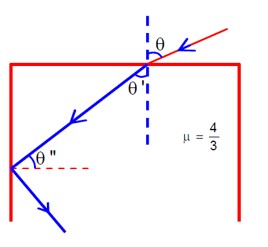
Contributor-Level 10
By shell's law
(sin θ)/ (sin θ') = 4/3 . (i)
For TIR on second surface
sin θ' > sin θc
(θ' + θ' = 90)
sin (90 - θ') > sin θc
cos θ' > sin θc
1 - sin²θ' > sin²θc (By equation (i) )
1 - (3/4 sin θ)² > sin²θc
[sin θc = 3/4]
1 - (9/16)sin²θ > (9/16)
1 - 9/16 > (9/16)sin²θ
7/16 > (9/16)sin²θ
sinθ < 7/3
New answer posted
a year agoContributor-Level 10
Yes, Institute of Hotel Management Studies, Kotdwar accept Class 12th marks. Candidates seeking admission to all programmes can enrol for admission with Class 12 marks. The college offers Certificate and Diploma courses. Institute of Hotel Management Studies, Kotdwar admissions are based on merit.
New answer posted
a year agoContributor-Level 9
λ = h/mv = h/√2mK
For same K:
λ ∝ 1/√m
λ? : λ? : λ? = 1/√m? : 1/√m? : 1/√4m?
As m? > m? ,
λ? > λ? > λ?
New answer posted
a year agoContributor-Level 9
μ? sin 30° = μ? sin θ
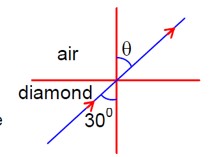
sinθ = 1.21 > 1
Refraction is not possible, total internal reflection
New answer posted
a year agoContributor-Level 9
3N? /4 = N? e?
⇒ e? = 4/3
t? = (1/λ) ln (4/3)
t? = ln2/λ
t? - t? = (1/λ)ln2 - (1/λ)ln (4/3)
= (1/λ)ln (2/ (4/3) = (1/λ)ln (3/2)
Taking an Exam? Selecting a College?
Get authentic answers from experts, students and alumni that you won't find anywhere else
Sign Up on ShikshaOn Shiksha, get access to
- 67k Colleges
- 1.2k Exams
- 717k Reviews
- 1850k Answers