

Class 12th
Get insights from 12k questions on Class 12th, answered by students, alumni, and experts. You may also ask and answer any question you like about Class 12th
Follow Ask QuestionQuestions
Discussions
Active Users
Followers
New answer posted
a year agoContributor-Level 10
A tristor is formed by doping a semi conductor water from one side by N-type dopant (high concentration while comparatively lower concentration on other side thus forming NPN tristor & vice-versa.
So, statement (I) is false & statement (II) is true.
New answer posted
a year agoContributor-Level 10
When a soft ferromagnetic substance is placed in external magnetic field, the size of domain lying in the opposite direction of external magnetic field increases while size of domain lying in the opposite direction of field decreases if field is weak. However, if field is strong then the domain rotate in the direction of external magnetic field due to strong torque.
New answer posted
a year agoContributor-Level 10
Zener break down occurs in p-n junction having p and n both : Heavily doped and have narrow depletion layer.
New answer posted
a year ago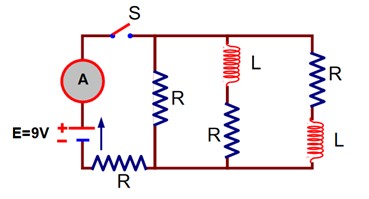
Contributor-Level 10
R =
L = 2 mH
E = 9V
Just after the switch 'S' is closed, the inductor acts as open circuit.
New answer posted
a year agoContributor-Level 10
ax2 + bx + c = 0
D = b2 – 4ac
D = 0
b2 – 4ac = 0
b2 = 4ac
(i) AC = 1, b = 2 (1, 2, 1) is one way
(ii) AC = 4, b = 4
(iii) AC = 9, b = 6, a = 3, c = 3 is one way
1 + 3 + 1 = 5 way
Required probability =
New answer posted
a year agoContributor-Level 10
a = 1, r = cos2 θ
Similarly, y =
Also,
(i) & (ii) ->xyz = xy + z -> (x + y) z = xy + z
New answer posted
a year agoContributor-Level 10
Let
A : Missile hit the target
B : Missile intercepted
P (B) =
Required Probability =
Taking an Exam? Selecting a College?
Get authentic answers from experts, students and alumni that you won't find anywhere else
Sign Up on ShikshaOn Shiksha, get access to
- 67k Colleges
- 1.2k Exams
- 717k Reviews
- 1850k Answers