Class 12th
Get insights from 12k questions on Class 12th, answered by students, alumni, and experts. You may also ask and answer any question you like about Class 12th
Follow Ask QuestionQuestions
Discussions
Active Users
Followers
New answer posted
3 months agoContributor-Level 10
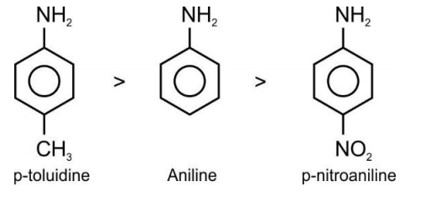
Order of reactivity towards electrophile
Strength of +M/+R : –OH > –CH3 > –Cl
In case of halogens, their –I effect dominates over
+M hence –Cl is deactivating and is lesser reactive than for incoming electrophile.
New answer posted
3 months agoContributor-Level 10
⇒ (y, x) ∈ R V (x, y) ∈ R
(x, y) ∈ R ⇒ 2x = 3y and (y, x) ∈ R ⇒ 3x = 2y
Which holds only for (0, 0)
Which does not belongs to R.
∴ Value of n = 0
New answer posted
3 months agoContributor-Level 10

Take
x = 2λ + 1, y = 3λ + 2, z = 4λ + 3
= (α − 2)
Now,
(α − 2) ⋅ 2 + (β − 3) ⋅3 + (γ − 4) ⋅ 4 = 0
2α − 4 + 3β − 9 + 4γ −16 = 0
⇒ 2α + 3β + 4γ = 29
New answer posted
3 months agoContributor-Level 10
(3x2 − 3)
= ⋅ 3(x −1)(x +1)
For x ∈ (−∞, −1], f '(x) ≥ 0
∴ f(x) is increasing function
∴ a = e–∞ = 0 = f (−∞)
b = e−1+3+1 = e3 = f (−1)
∴ P(4, e3 + 2)

Taking an Exam? Selecting a College?
Get authentic answers from experts, students and alumni that you won't find anywhere else
Sign Up on ShikshaOn Shiksha, get access to
- 66k Colleges
- 1.2k Exams
- 681k Reviews
- 1800k Answers