Complex Numbers and Quadratic Equations
Get insights from 193 questions on Complex Numbers and Quadratic Equations, answered by students, alumni, and experts. You may also ask and answer any question you like about Complex Numbers and Quadratic Equations
- 193
Questions
- 0
Discussions
- 0
Active Users
- 0
Followers
Have a question about Complex Numbers and Quadratic Equations? Ask our experts
Keep it short & simple. Type complete word. Avoid abusive language.

23. x2 – x + 2 = 0
Comparing the given equation with ax2 + bx + c = 0
We have, a = 1, b = –1 andc = 2
Hence, discriminant of the equation is
b2 – 4ac = (-1)2 – 4 * 1 * 2 = 1 – 8 = –7
Therefore, the solution of the quadratic equation is

 Upvote

21. –x2 + x – 2 = 0
Comparing the given equation with ax2 + bx + c = 0
We have, a = –1, b = 1 and c = –2
Hence, discriminant of the equation is
b2 – 4ac = 12 – 4 * (-1)* (-2) = 1 – 8 = –7
Therefore, the solution of the quadratic equation is

Upvote 20. x2 + 3x + 9 = 0
Comparing the given equation with ax2 + bx + c = 0
We have, a = 1, b = 3 and c = 9
Hence, discriminant of the equation is
b2 – 4ac = 32 – 4 * 1* 9 = 9 – 36 = –27
Therefore, the solution of the quadratic equation is

Upvote Class 11 Complex Numbers Ex 5.3 Solutions
18. x2+ 3 = 0
Class 11 Complex Numbers Ex 5.3 Solutions
18. x2+ 3 = 0
18. x2 + 3 = 0
=>x2 = –3
=>x =
=>x= ± √3 [since, √-1 = i]
=>x = 0 ± √3
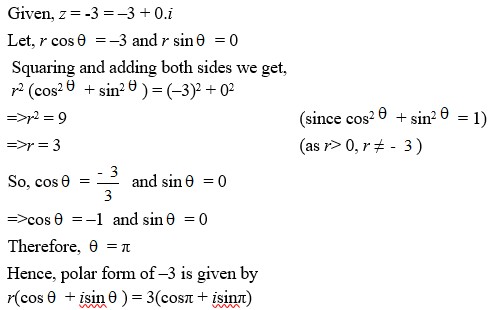
Upvote Convert the complex number given in Exercise 3 in the polar form:
17. –3
Convert the complex number given in Exercise 3 in the polar form:
17. –3