
Electrostatics
Get insights from 79 questions on Electrostatics, answered by students, alumni, and experts. You may also ask and answer any question you like about Electrostatics
- 79
Questions
- 0
Discussions
- 0
Active Users
- 0
Followers
Have a question about Electrostatics? Ask our experts
Keep it short & simple. Type complete word. Avoid abusive language.
For a region of constant electric potential, which of the following statements is incorrect?
For a region of constant electric potential, which of the following statements is incorrect?
For a region of constant electric potential
(1) The electric field may be uniform
(2) The electric field may be zero
(3) There can be no charge inside the region
 Upvote

Five metallic plates each of area A and separated from adjacent plate by a distance d as shown in figure. The capacitance of the system across A and B is:
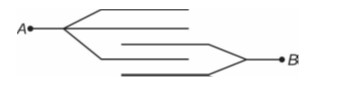
Five metallic plates each of area A and separated from adjacent plate by a distance d as shown in figure. The capacitance of the system across A and B is:
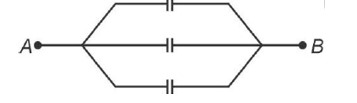
C = 3A? 0/d
Upvote 27 similar drops of mercury are maintained at 10V each. All these spherical drops combine into a single big drop. The potential energy of the bigger drop is……… times that of a smaller drop.
27 similar drops of mercury are maintained at 10V each. All these spherical drops combine into a single big drop. The potential energy of the bigger drop is……… times that of a smaller drop.
With the help of conservation of volume, we can write
With the help of conservation of charge, we can write
Q = 27 q.(2)
Potential energy of single drop = U1 =
Potential energy of bigg
Upvote 512 identical drops of mercury are charged to a potential of 2V each. The drops are joined to form a single drop. The potential of this drop is ……………. V.
512 identical drops of mercury are charged to a potential of 2V each. The drops are joined to form a single drop. The potential of this drop is ……………. V.
Let the charge of on each drop be q and radius of each drop be r.
When all drops are joined, radius,
Potential of the new drop,
Upvote If the electric potential at any point (x, y, z)m in space is given by V = 3x2 volt. The electric field at the point (1, 0, 3)m will be:
If the electric potential at any point (x, y, z)m in space is given by V = 3x2 volt. The electric field at the point (1, 0, 3)m will be:
According to relation between field and potential, we can write
Upvote A capacitor is discharging through a resistor R. Consider in time t1 the energy stored in the capacitor reduces to half of its initial value and in time t2, the charge stored in the capacitor reduces to half of its initial value and in time t2 the charge stored reduces to one eight of its initial value. The ratio t1/t2 will be
A capacitor is discharging through a resistor R. Consider in time t1 the energy stored in the capacitor reduces to half of its initial value and in time t2, the charge stored in the capacitor reduces to half of its initial value and in time t2 the charge stored reduces to one eight of its initial value. The ratio t1/t2 will be
According to Law of discharging of capacitor, we can write
Upvote An electron moves in the field produced by a charged sphere of radius 10cm along the radius connecting the points separated by 12 and 15 cm from the centre of the sphere. The velocity of the electron changes thereby from 2 × 10⁵ to 2 × 10⁶ m/s. Determine the surface charge (in nC/m2) density of the sphere. (Mass of electron = 9.1 × 10⁻³¹kg)
An electron moves in the field produced by a charged sphere of radius 10cm along the radius connecting the points separated by 12 and 15 cm from the centre of the sphere. The velocity of the electron changes thereby from 2 × 10⁵ to 2 × 10⁶ m/s. Determine the surface charge (in nC/m2) density of the sphere. (Mass of electron = 9.1 × 10⁻³¹kg)