

Physics Current Electricity
Get insights from 213 questions on Physics Current Electricity, answered by students, alumni, and experts. You may also ask and answer any question you like about Physics Current Electricity
Follow Ask QuestionQuestions
Discussions
Active Users
Followers
New answer posted
a year ago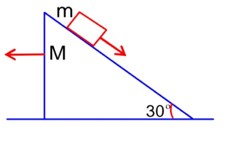
Contributor-Level 10
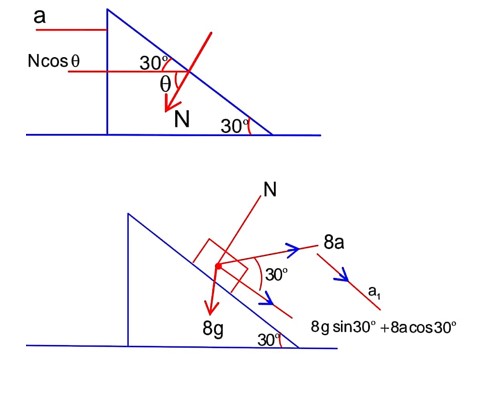
Suppose acceleration of wedge is a and acceleration of block w. r.t. wedge is a1 then N cos60° = Ma = 16 a -> N = 32 a
For block w.r.t. wedge
N + 8a sin 30° = 8g cos 30°
N = 8g cos 30° - 8a sin 30°
->32a = 8g cos 30° - 8a sin 30°
->a =
Now for 8 kg,
New answer posted
a year agoContributor-Level 10
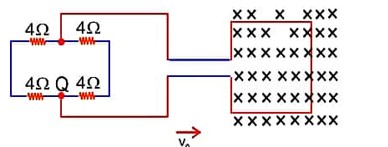
In first condition R1 = 36
In second condition R2 = 18
So
x = 4
New answer posted
a year ago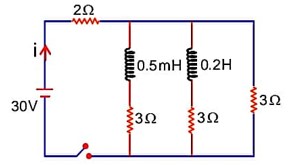
Contributor-Level 10
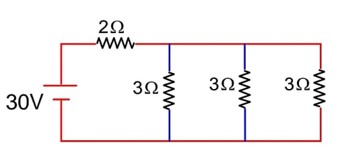
In given circuit inductor behave as a simple wire so resultant circuit will be
Ref = 2 + 1 = 3
V = IR
New answer posted
a year agoContributor-Level 10
Using Heat equation : H = i2Rt
=>192 = (4)2 R (1)
H = (8)2 R (5)
=>H = 3840 J
New answer posted
a year agoContributor-Level 10
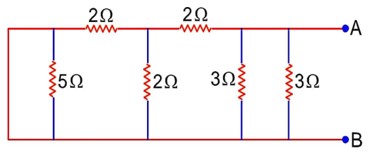
Energy required to melt
Q =
->3.53 * 104 J
Heat produce in wire
H = l2RT
New answer posted
a year agoContributor-Level 10
The basic unit of energy is a Joule (J), which is equal to one watt of power expended for one second. In the day-to-day scenarios such as household electricity consumption, joule is too small a unit to be convenient. For billing and metering purpose, it is measured in kilowatt-hours (kWh). Electrical energy is measured in kilowatt-hours (kWh) as the commercial unit. 1kWh = 1000 W * 3600 s
For calculating the units consumed, we will be using the following formula
Units = [Power (W) x Time (h)]/1000
Taking an Exam? Selecting a College?
Get authentic answers from experts, students and alumni that you won't find anywhere else
Sign Up on ShikshaOn Shiksha, get access to
- 67k Colleges
- 1.2k Exams
- 716k Reviews
- 1850k Answers