
Physics Current Electricity
Get insights from 213 questions on Physics Current Electricity, answered by students, alumni, and experts. You may also ask and answer any question you like about Physics Current Electricity
- 213
Questions
- 0
Discussions
- 0
Active Users
- 2
Followers
Have a question about Physics Current Electricity? Ask our experts
Keep it short & simple. Type complete word. Avoid abusive language.
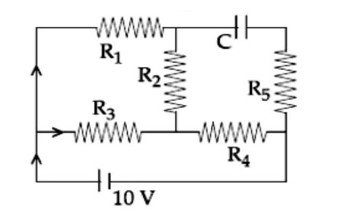
An ideal cell of emf 10 V is connected in circuit shown in figure. Each resistance is 2Ω. The potential difference (in V) across the capacitor when it is fully charged is
<!-- [if !supportLineBreakNewLine]-->
<!--[endif]-->
An ideal cell of emf 10 V is connected in circuit shown in figure. Each resistance is 2Ω. The potential difference (in V) across the capacitor when it is fully charged is
<!-- [if !supportLineBreakNewLine]-->
<!--[endif]-->
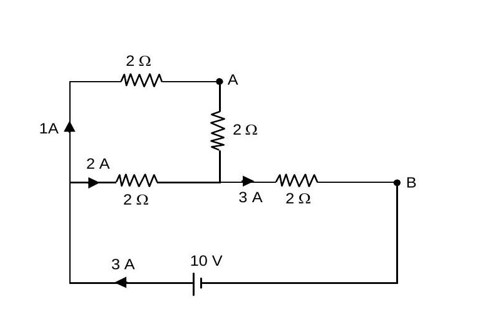
V_AB = 2Ω (1A) + 2Ω (3A) = 8V.
 Upvote

A potentiometer wire PQ of 1 m length is connected to a standard cell E₁. Another cell E₂ of emf 1.02 V is connected with a resistance 'r' and switch S (as shown in figure). With switch S open, the null position is obtained at a distance of 49 cm from Q. The potential gradient in the potentiometer wire is:
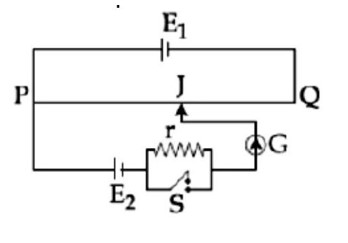
A potentiometer wire PQ of 1 m length is connected to a standard cell E₁. Another cell E₂ of emf 1.02 V is connected with a resistance 'r' and switch S (as shown in figure). With switch S open, the null position is obtained at a distance of 49 cm from Q. The potential gradient in the potentiometer wire is:
V_PQ * (49/100). 1.02 = V_PQ * 0.49. V_PQ ≈ 2.08V.
Potential gradient = 2.08V/100cm = 0.0208 V/cm.
Upvote A wire carrying current I is bent in the shape ABCDEFA as shown, where rectangles ABCDA and ADEFA are perpendicular to each other. If the sides of the rectangles are of lengths a and b, then the magnitude and direction of magnetic moment of the loop ABCDEFA is:
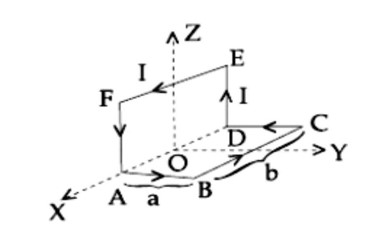
A wire carrying current I is bent in the shape ABCDEFA as shown, where rectangles ABCDA and ADEFA are perpendicular to each other. If the sides of the rectangles are of lengths a and b, then the magnitude and direction of magnetic moment of the loop ABCDEFA is:
m = I (abk + abj)
|m| = Iab√2
Direction ⇒ (j+k)/√2
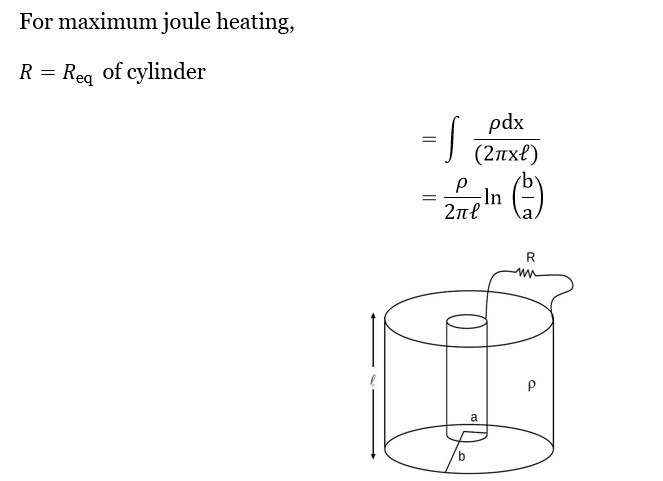
Upvote Model a torch battery of length l to be made up of a thin cylindrical bar of radius 'a' and a concentric thin cylindrical shell of radius 'b' filled in between with an electrolyte of resistivity ρ (see figure). If the battery is connected to a resistance of value R, the maximum joule heating in R will take place for:
<!-- [if !supportLineBreakNewLine]-->
<!--[endif]-->
Model a torch battery of length l to be made up of a thin cylindrical bar of radius 'a' and a concentric thin cylindrical shell of radius 'b' filled in between with an electrolyte of resistivity ρ (see figure). If the battery is connected to a resistance of value R, the maximum joule heating in R will take place for:
<!-- [if !supportLineBreakNewLine]-->
<!--[endif]-->
Consider four conducting materials copper, tungsten, mercury and aluminum with resistivity ρc, ρt, ρm and ρa respectively. Then
<!-- [if !supportLineBreakNewLine]-->
<!--[endif]-->
Consider four conducting materials copper, tungsten, mercury and aluminum with resistivity ρc, ρt, ρm and ρa respectively. Then
<!-- [if !supportLineBreakNewLine]-->
<!--[endif]-->
ρ? = 98 × 10?
ρ? = 2.65 × 10?
ρc = 1.724 × 10?
ρT = 5.65 × 10?
Upvote In the circuit, given in the figure currents in different branches and value of one resistor are shown. Then potential at point B with respect to the point A is:
In the circuit, given in the figure currents in different branches and value of one resistor are shown. Then potential at point B with respect to the point A is:
Let us assume the potential at A = V_A = 0.
Now at junction C, according to KCL
i? + i? = i?
1 A + i? = 2 A
i? = 2 A
Now analyse potential along ACDB
V_A + 1 + i? (2) - 2 = V_B
0 + 1 + 2 (1) - 2 = V_B
V_B = 3 - 2
V_B = 1amp.
Upvote A galvanometer is used in laboratory for detecting the null point in electrical experiments. If, on passing a current of 6 mA it produces a deflection of 2°, its figure of merit is close to:
<!-- [if !supportLineBreakNewLine]-->
<!--[endif]-->
A galvanometer is used in laboratory for detecting the null point in electrical experiments. If, on passing a current of 6 mA it produces a deflection of 2°, its figure of merit is close to:
<!-- [if !supportLineBreakNewLine]-->
<!--[endif]-->
Figure of Merit = C = i/θ
= C = (6 × 10? ³)/2 = 3 × 10? ³ Am²
Upvote