

Physics
Get insights from 5.6k questions on Physics, answered by students, alumni, and experts. You may also ask and answer any question you like about Physics
Follow Ask QuestionQuestions
Discussions
Active Users
Followers
New answer posted
a year agoContributor-Level 10
This is a Long Answer type Questions as classified in NCERT Exemplar
Explanation- as angle is 45
On smooth inclined plane acceleration will be a = gsin

So acceleration will become a= g/
Using equation of motion s =ut +1/2at2
S=
On rough inclined plane a = g (sin )
= g (sin )=
So s=ut +1/2at2
S= 0+ 2
Comparing two above distance
2=
So after solving we get
New answer posted
a year agoContributor-Level 10
This is a Long Answer type Questions as classified in NCERT Exemplar
Explanation – as body moving with uniform acceleration a=0
The sum of forces is zero F1+F2+F3=0
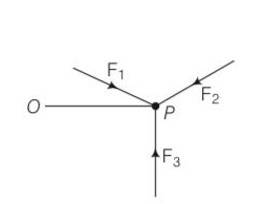
a)let F1, F2, F3 be the three forces passing through the point . let F1and F2 be in the plane A
so F3 =- (F1+F2) so F3 is also in plane A.
b)consider the torque of the forces about P . since all the forces pass through P the torque is zero
torque = OP (F1+F2+F3)
since F1+F2+F3=0 so torque =0
New answer posted
a year agoContributor-Level 10
This is a Short Answer type Questions as classified in NCERT Exemplar
Explanation -initial speed of coin u= 20m/s
Acceleration of elevator =2m/s2 acceleration due to gravity = 10m/s2
Effective acceleration =g+a=12m/s2
We know that v=u +at
0= 20+ (-12)t
So t= 20/12=5/3 s
Time of ascent = time of descent
Total time coin fall back into hand = (5/3+5/3)=10/3s=3.33s
New answer posted
a year agoContributor-Level 10
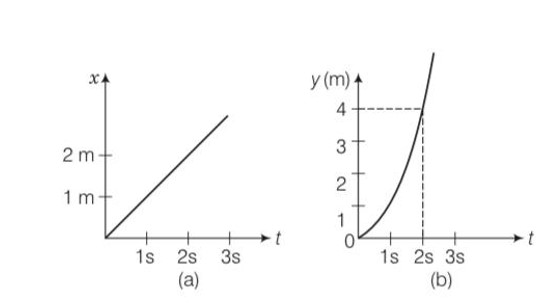
Explanation- from the diagram x= t=dx/dt=1m/s
So ax= 0
From the diagram y =t2
dy/dt=2t or ay=d2y/dt2=2m/s2
Iy= may=500 (10-3) (2) =1N
Fx=max=0
F= = 1N
New answer posted
a year agoContributor-Level 10
This is a Short Answer type Questions as classified in NCERT Exemplar
Explanation- mass of gun =100kg
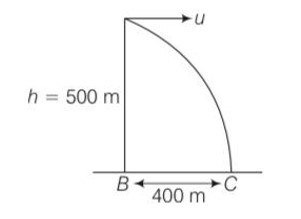
Mass of ball =1kg and height of cliff = 500m
So horizontal distance travelled by the ball is x = 400m
So h =1/2gt2
500= 2 so t= 10s
X=ut then u= 400/10=40m/s
According to principle of conservation pf momentum
Mv=mu
V= 40/100= 0.4m/s
New answer posted
a year agoContributor-Level 10
This is a Short Answer type Questions as classified in NCERT Exemplar
Explanation-given mass of the block =M
Coefficient of friction between block and the wall =
In equilibrium condition vertical and horizontal component balance each other
So f=mg
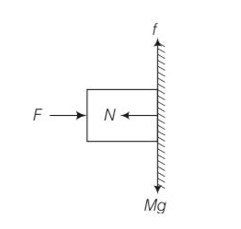
And F=N but the force of friction f=
F= Mg/

New answer posted
a year ago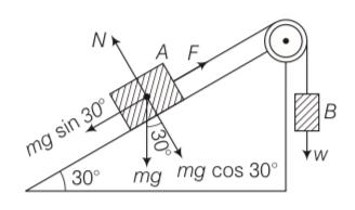
Contributor-Level 10
This is a Short Answer type Questions as classified in NCERT Exemplar
Explanation- in equilibrium, The force mgsin acting on the block A is parallel to the plane should be balanced by the tension in the string
mgsin
and for block B, w=T=F
from these two above equation
w=mgsin = 100sin30= 100 (1/2)=50N
New answer posted
a year ago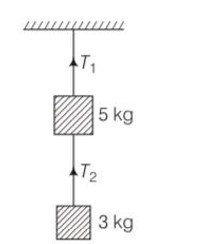
Contributor-Level 10
This is a Short Answer type Questions as classified in NCERT Exemplar
Explanation- m1= 5kg, m2= 3kg
And g= 9.8m/s2 and a= 2m/s2
For the upper block T1-T2-5g=5a
T1-T2= 5 (g+a)
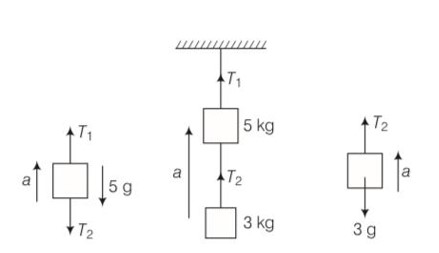
For the lower block T2-3g =3a
T2=3 (g+a)=3 (9.8+2)=35.4N
T1=T2+5 (g+a)=94.4N
New answer posted
a year agoContributor-Level 10
This is a Short Answer type Questions as classified in NCERT Exemplar
Explanation – when the lower thread CD is pulled with a * the thread Cd itself break because the thread CD is not transmitted to the thread Ab instantly.
New answer posted
a year ago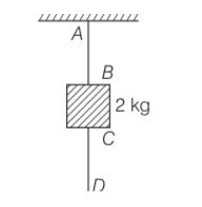
Contributor-Level 10
This is a Short Answer type Questions as classified in NCERT Exemplar
Explanation- The thread AB will break earlier than the thread CD. This is because force acting on thread CD= applied force and force acting on thread AB = applied force +weight of 2kg mass. Hence force acting on thread Ab is larger than the force acting on thread CD
Taking an Exam? Selecting a College?
Get authentic answers from experts, students and alumni that you won't find anywhere else
Sign Up on ShikshaOn Shiksha, get access to
- 67k Colleges
- 1.2k Exams
- 718k Reviews
- 1850k Answers