

Physics
Get insights from 5.6k questions on Physics, answered by students, alumni, and experts. You may also ask and answer any question you like about Physics
Follow Ask QuestionQuestions
Discussions
Active Users
Followers
New answer posted
a year agoContributor-Level 10
This is a Short Answer type Questions as classified in NCERT Exemplar
Explanation- while going up a mountain the force of friction acting on a vehicle of mass m is f=
= To avoid skidding force of friction should be large and therefore cos should be large and should be small. That is why mountain roads generally made winding upwards rather than going straight up.
New answer posted
a year agoContributor-Level 10
This is a Short Answer type Questions as classified in NCERT Exemplar
Explanation- mass of the objects =0.5kg
Speed of the objects =25m/s
a) impulse imparted = change in momentum = mv-mu
= m (v-u)= 0.5 (25-0)=12.5N-s
b) velocity of the object after rebounding= 25/2=-12.5m/s
change in momentum = m (v-u)= 0.5 (-12.5-25)= -18.75N-s
New answer posted
a year agoContributor-Level 10
This is a Short Answer type Questions as classified in NCERT Exemplar
Explanation-when she falls on cemented floor the time is very less so force is very large which increase the pain but F =change in momentum =constant . while in muddy ground the time is very large as compared to cemented floor so less will be applied . so she feel less pain.
New answer posted
a year agoContributor-Level 10
This is a Short Answer type Questions as classified in NCERT Exemplar
Explanation- porcelain objects are wrapped in paper while transporting because they are very fragile can easily break. while we wrapped them in paper to increase the time so the damage to them is as less as possible.
New answer posted
a year agoContributor-Level 10
This is a Short Answer type Questions as classified in NCERT Exemplar
Explanation -the frictional force shown on vertical axis and the applied force shown on horizontal axis. The portion OA of graph represents static friction which is a self-adjusting .in this f=F.
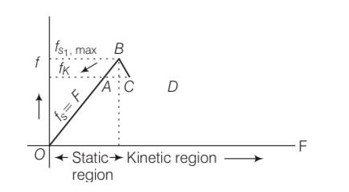
Whereas the point B represents force of limiting friction . Cd|OX represents kinetic friction. The force of kinetic friction does not change by applying force.
New answer posted
a year agoContributor-Level 10
This is a Short Answer type Questions as classified in NCERT Exemplar
Explantion - given mass of the body = 2kg
Velocity of the body = 2t? +t2?
Velocity of body at t=2s
V= 2 ? +22? = 4? +4?
Momentum of body =mv = 2 (4? +4? )= 8? +8? kgm/s
Acceleration a= dv/dt
= d/dt (2t? +t2? )= 2? +2t?
At t=2s, a= (2i+2 (2)j)= 2? +4?
Force acting on the body F=ma
=2 (2? +4? )
= 4? +8? N
New answer posted
a year agoContributor-Level 10
This is a Short Answer type Questions as classified in NCERT Exemplar
Explanation- when a person driving car suddenly applies brakes the lower comes to rest but the upper part of the body will remain in motion. so if the driver not wearing seat belt will falls forward and his head hit against the steering wheel.
New answer posted
a year ago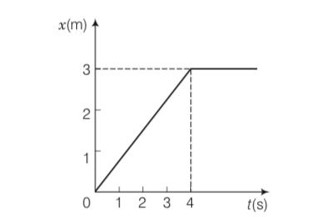
Contributor-Level 10
This is a Short Answer type Questions as classified in NCERT Exemplar
Explanation- mass of body =2kg
From the above graph the body at x=0 when t=0 so body at rest.
So impulse is also zero.
From t=0s to t=4s graph becomes straight line which shows body is at uniform velocity
Beyond 4s graph is parallel to time axis, body is at rest
So tan =3/4
Impulse at t=4s= change in momentum= mv-mu
=m (v-u)
= 2 (0-3/4)= -3/2kgm/s
New answer posted
a year agoContributor-Level 10
This is a Short Answer type Questions as classified in NCERT Exemplar
Explanation – w'=R=m (g-a)
Mass of person =50kg
Descending acceleration= 9m/s2
Acceleration due to gravity g= 10m/s2
Apparent weight of person R= m (g-a)
= 50 (10-9)=50N
Reading in weighing scale = 50/10 =5kg
New answer posted
a year agoContributor-Level 10
This is a Short Answer type Questions as classified in NCERT Exemplar
explanation-total mass of bicycle and stone =m1=50+0.5= 50.5kg
Velocity of bicycle u1= 5m/s mass of stone m2= 0.5kg
Velocity of stone u2= 15m/s mass of girl and bicycle m= 50kg
Also the speed of bicycle change when stone is thrown
According to conservation of linear momentum
m1u1=m2u2+mv
50.5 (5)= 0.5 (15)+50 (v)
V= 4.9m/s
Change in speed 5-4.9= 0.1m/s
Taking an Exam? Selecting a College?
Get authentic answers from experts, students and alumni that you won't find anywhere else
Sign Up on ShikshaOn Shiksha, get access to
- 67k Colleges
- 1.2k Exams
- 718k Reviews
- 1850k Answers