
Simple Pendulum
Get insights from 10 questions on Simple Pendulum, answered by students, alumni, and experts. You may also ask and answer any question you like about Simple Pendulum
- 10
Questions
- 0
Discussions
- 0
Active Users
- 0
Followers
Have a question about Simple Pendulum? Ask our experts
Keep it short & simple. Type complete word. Avoid abusive language.

The motion of a simple pendulum executing S.H.M. is represented by the following equation. where time is measured in second.
The length of pendulum is
The motion of a simple pendulum executing S.H.M. is represented by the following equation. where time is measured in second.
The length of pendulum is
According to question, we can write
 Upvote

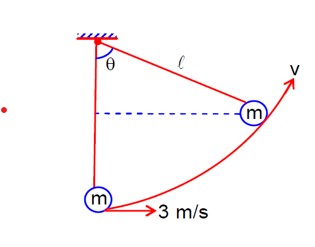
A pendulum bob has a speed of 3 m/s at its lowest position. The pendulum is 50 cm long. The speed of the bob, when the length makes an angle of 60° to the vertical will be _______ m/s. (g = 10 m/s²)
A pendulum bob has a speed of 3 m/s at its lowest position. The pendulum is 50 cm long. The speed of the bob, when the length makes an angle of 60° to the vertical will be _______ m/s. (g = 10 m/s²)
(1/2)mu² = (1/2)mv² + mgl (1-cosθ)
⇒ v² = u² - 2gl (1-cosθ)
⇒ v² = 3² - 2×10×0.5× (1 - 1/2)
⇒ v² = 9 - 5 = 4
v = 2m/s
Upvote Given below are two statements:
Statement I : A second’s pendulum has a time period of 1 second.
Statement II : It takes precisely one second to move between the two extreme positions.
In the light of the above statements, choose the correct answer from the options given below:
Given below are two statements:
Statement I : A second’s pendulum has a time period of 1 second.
Statement II : It takes precisely one second to move between the two extreme positions.
In the light of the above statements, choose the correct answer from the options given below:
Time period of second pendulum is 2 seconds. &nbs
Upvote Is a simple pendulum the same as a simple harmonic motion?
Is a simple pendulum the same as a simple harmonic motion?
A simple pendulum shows simple harmonic motion only for small angular displacements. Otherwise, its motion is oscillatory but not purely SHM.
Upvote What are the forces acting on a swinging pendulum?
What are the forces acting on a swinging pendulum?
Tension in the string and gravitational force are common forces. These forces are resolved into tangential and radial components.
Upvote What is the small-angle approximation for a simple pendulum?
What is the small-angle approximation for a simple pendulum?
For small displacements, sinθ≈θ (in radians), the small-angle approximation simplifies pendulum motion equations and makes it to approximate simple harmonic motion.
Upvote