Three Dimensional Geometry
Get insights from 211 questions on Three Dimensional Geometry, answered by students, alumni, and experts. You may also ask and answer any question you like about Three Dimensional Geometry
- 211
Questions
- 0
Discussions
- 0
Active Users
- 0
Followers
Have a question about Three Dimensional Geometry? Ask our experts
Keep it short & simple. Type complete word. Avoid abusive language.
Total number of common point = 1 + 5 + 7 + 5 + 5 + 3 + 1 = 27
 Upvote

Let <!-- [if gte mso 9]><xml>
Let <!-- [if gte mso 9]><xml>
Let the lines
L1 : <!-- [if gte mso 9]><xml>
L2 : <!-- [if gte mso 9]><xml>
intersects at the point. S. If a plane ax + by – z + d = 0 passes through S and is parallel to both lines L1 and L2, then the value of a + b + d is equal to…………
Let the lines
L1 : <!-- [if gte mso 9]><xml>
L2 : <!-- [if gte mso 9]><xml>
intersects at the point. S. If a plane ax + by – z + d = 0 passes through S and is parallel to both lines L1 and L2, then the value of a + b + d is equal to…………
7x – 2y – z + d = 0
(2, 4, 6) Þ d = -14 + 8 + 6
d = 0
7x – 2y – z = 0
7 – 2 = 5
Upvote Let Q be the mirror image of the point P(1, 0, 1) with respect to the plane S : x + y + z = 5. If a line L passing through (1, -1, -1) parallel to the line PQ meets the plane S at R, then QR2 is equal to:
Let Q be the mirror image of the point P(1, 0, 1) with respect to the plane S : x + y + z = 5. If a line L passing through (1, -1, -1) parallel to the line PQ meets the plane S at R, then QR2 is equal to:
x + y + z = 5
M (2, 1, 2)
Q (3, 2, 3)
R (3, 1, 1), QR2 = 1 + 4 = 5
Upvote <!-- [if gte mso 9]><xml>
<!-- [if gte mso 9]><xml>
Let a line having direction ratios 1, -4, 2 intersect the lines <!-- [if gte mso 9]><xml>
Let a line having direction ratios 1, -4, 2 intersect the lines <!-- [if gte mso 9]><xml>
and
AB2 = 84
f(-1) = 1
f(1) = 3
Hence f(x) will be discontinuous at x = 1 and also 4x2 – 1 = 0 , 1 , 2
Upvote Let the points on the plane P be equidistance from the points (–4, 2, 1) and (2, –2, 3). Then the acute angle between the plane P and the plane 2x + y + 3z = 1 is
Let the points on the plane P be equidistance from the points (–4, 2, 1) and (2, –2, 3). Then the acute angle between the plane P and the plane 2x + y + 3z = 1 is
Let P (x, y, z) be any point on plane P1 then
Upvote If the shortest distance between the lines and then the sum of all possible values of is
If the shortest distance between the lines and then the sum of all possible values of is
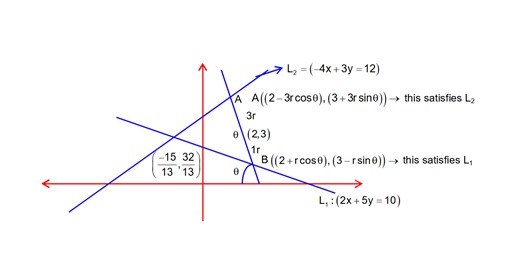
Let a triangle be bounded by the lines L1 : 2x + 5y = 10; L2 : -4x + 3y = 12 and the line L3, which passes through the point P(2, 3), intersects L2 at A and L1 at B. If the point P divides the line-segment AB, internally in the nation 1 :3, then the area of the triangle is equal to:
Let a triangle be bounded by the lines L1 : 2x + 5y = 10; L2 : -4x + 3y = 12 and the line L3, which passes through the point P(2, 3), intersects L2 at A and L1 at B. If the point P divides the line-segment AB, internally in the nation 1 :3, then the area of the triangle is equal to: