
Three Dimensional Geometry
Get insights from 211 questions on Three Dimensional Geometry, answered by students, alumni, and experts. You may also ask and answer any question you like about Three Dimensional Geometry
- 211
Questions
- 0
Discussions
- 0
Active Users
- 0
Followers
Have a question about Three Dimensional Geometry? Ask our experts
Keep it short & simple. Type complete word. Avoid abusive language.
If <!-- [if gte mso 9]><xml>
Then the value of 'α' is equal to
If <!-- [if gte mso 9]><xml>
Then the value of 'α' is equal to
.(1)
Let
Let
Put l1 and l2 in (1)
α = 3
 Upvote

If , <!--[endif]--><!-- [if gte mso 9]><xml>
If , <!--[endif]--><!-- [if gte mso 9]><xml>
Given , ,
Dot product with on both sides
. (1)
Dot product with on both sides
. (2)
Upvote If the foot of perpendicular from (1, 2, 3) to the line is (a, b, g) then find a + b + g
If the foot of perpendicular from (1, 2, 3) to the line is (a, b, g) then find a + b + g
(a – 1) × 2 + (b – 2) × 5 + (g – 3) × 1 = 0
2a + 5b + g – 15 = 0
Also, P lie on line
a + 1 = 2λ
b – 2 = 5λ
g – 4 = λ
2 (2λ – 1) + 5 (5λ + 2) + λ + 4 – 15 = 0
4λ + 25λ + λ – 2 + 10 + 4 – 15 = 0
30λ – 3 = 0
a + b + g = (2λ – 1) + (5λ + 2) + (λ + 4)
Upvote If (α, β, γ) is mirror image of the point (2, 3, 4) with respect to the line <!-- [if gte mso 9]><xml>
If (α, β, γ) is mirror image of the point (2, 3, 4) with respect to the line <!-- [if gte mso 9]><xml>
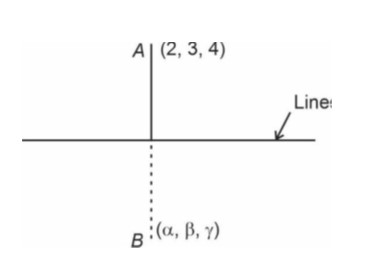
Take
x = 2λ + 1, y = 3λ + 2, z = 4λ + 3
= (α − 2)
Now,
(α − 2) ⋅ 2 + (β − 3) ⋅3 + (γ − 4) ⋅ 4 = 0
2α − 4 + 3β − 9 + 4γ −16 = 0
⇒ 2α + 3β + 4γ = 29
Upvote Let be an integer. IF the shortest distance between the lines and , then the value of
Let be an integer. IF the shortest distance between the lines and , then the value of
The equation of the line through the point (0, 1, 2) perpendicular to the line
The equation of the line through the point (0, 1, 2) perpendicular to the line
For ‘B’, x = 2r + 1, y = 3r – 1, z = -2r + 1
As AB is perpendicular to the line,
direction ratios of AB
(2r + 1, 3r – 2, -2r – 1)
Equation of AB
Upvote Let a, b R. If the mirror image of the point P (a, 6, 9) with respect to the line
is equal to:
Let a, b R. If the mirror image of the point P (a, 6, 9) with respect to the line
is equal to:
a + 20 = 6 + 14r . (i)
b = 2 + 10r. (ii)
a = 18r – 2 . (iii)
Solving (i) and (iii) we get
20 + 18r – 2 = 6 + 14r
r = 3
a = 14 + 14 (-3) = -56 and b = -2 30 = 32
Upvote Let L be a line obtained from the intersection of two plane x + 2y + z = 6 and y + 2z = 4. If points <!-- [if gte mso 9]><xml>
Let L be a line obtained from the intersection of two plane x + 2y + z = 6 and y + 2z = 4. If points <!-- [if gte mso 9]><xml>
For line of intersection of two planes
put z = then
->
Now
Upvote If the mirror image of the point (1,3,5) with respect to the plane 4x – 5y + 2z = 8 is (a, b, <!-- [if gte mso 9]><xml>
If the mirror image of the point (1,3,5) with respect to the plane 4x – 5y + 2z = 8 is (a, b, <!-- [if gte mso 9]><xml>
Now equation of line OA be
direction cosines of plane are 4, -5, 2
Equation of any point on OA be
Since O lies on given plane so
So, O (9/5,2,27/5). Hence by mid-point
Upvote