

Chemistry
Get insights from 6.9k questions on Chemistry, answered by students, alumni, and experts. You may also ask and answer any question you like about Chemistry
Follow Ask QuestionQuestions
Discussions
Active Users
Followers
New answer posted
a year agoContributor-Level 10
This is a matching answer type question as classified in NCERT Exemplar
(i) → (d); (ii) → (a); (iii) → (e) : (iv) → (c) : (v) → (b)
New answer posted
a year agoContributor-Level 10
This is a multiple choice answer as classified in NCERT Exemplar
(ii) & (iii)

New answer posted
a year ago
Contributor-Level 10
This is a multiple choice answer as classified in NCERT Exemplar
(i) & (iii)
The structures that follow the (4n+2) Huckle rule of aromaticity is considered to be aromatic
New answer posted
a year agoContributor-Level 10
This is a multiple choice answer as classified in NCERT Exemplar
(i) & (iii)
The +I effect of the -OCH3 group stabilizes the carbocation.
The two resonating structure of CH2=CH-CH2⊕↔⊕CH2-CH=CH2 makes it more stable
New answer posted
a year agoContributor-Level 10
This is a multiple choice answer as classified in NCERT Exemplar
(i) & (iii) The nitro group strongly deactivate the ring due to the -R effect and -I effect
New answer posted
a year agoContributor-Level 10
This is a multiple choice answer as classified in NCERT Exemplar
(i) & (iii)
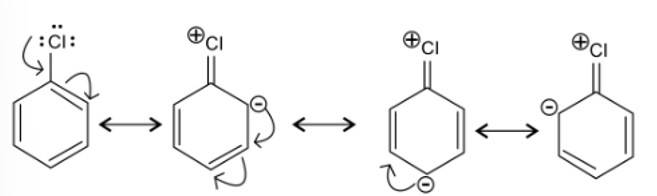
The halogens atom weakly deactivate the ring due to the -I effect and directs the incoming group to the ortho and para position due to the +R effect.
New answer posted
a year ago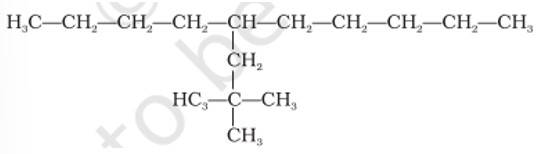
Contributor-Level 10
This is a multiple choice answer as classified in NCERT Exemplar
(i) & (iv) The longest carbon chain is of 10 carbon atom
New answer posted
a year ago
Contributor-Level 10
This is a multiple choice answer as classified in NCERT Exemplar
(iii) & (iv) The longest carbon chain is of 10 carbon atom
New answer posted
a year ago
Contributor-Level 10
This is a multiple choice answer as classified in NCERT Exemplar
(iii) & (iv) When only the alkyl group is attached to the C atom of the C=C bond then only it would lead to giving only ketone on ozonolysis.
New answer posted
a year ago HCHO + H2O
 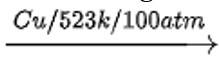 2CH3OH
Contributor-Level 10
This is a multiple choice answer as classified in NCERT Exemplar
(iii) & (iv) Methane is a controlled oxidation reaction that leads to giving formaldehyde and methanol.
Taking an Exam? Selecting a College?
Get authentic answers from experts, students and alumni that you won't find anywhere else
Sign Up on ShikshaOn Shiksha, get access to
- 67k Colleges
- 1.2k Exams
- 717k Reviews
- 1850k Answers