

Chemistry
Get insights from 6.9k questions on Chemistry, answered by students, alumni, and experts. You may also ask and answer any question you like about Chemistry
Follow Ask QuestionQuestions
Discussions
Active Users
Followers
New answer posted
a year agoContributor-Level 10
1.26 Quartzis crystalline solid with long range order and glass is amorphous solid (or pseudo solid or super cooled liquid) with short range order and has a tendency to flow. When quartzis heated, it can be converted into glass.
New answer posted
a year agoContributor-Level 10
1.25 Amorphous solids have short-range order with irregular shapes of constituent particles. They have isotropic nature and melt over a range of temperatures. They do not have a definite enthalpy of fusion. Examples of amorphous solids are glass, rubber, plastic, etc.
New answer posted
a year agoContributor-Level 10
3.28. The elements of Group I have only one electron in their respective valence shells and thus have a strong tendency to lose this electron. The tendency to lose electrons in turn, depends upon the ionization enthalpy. Since the ionization enthalpy decreases down the group therefore, the reactivity of group 1 elements increases in the order Li < Na < K < Rb < Cs. In contrast, the elements of group 17 have seven electrons in their respective valence shells and thus have strong tendency to accept one more electron to make stable configuration. So for group 17, the electron gain enthalpy and electronegativity decreases down the group and thus the reactivity also decreases.
New answer posted
a year agoContributor-Level 10
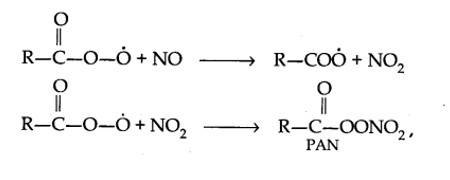
Harmful effects of photochemical smog: Photochemical smog causes serious health problems. Both ozone and PAN (peroxyacetyl nitrate) act as powerful eye irritants. Ozone and nitric oxide irritate the nose and throat and their high concentration causes headache, chest pain, dryness of the throat, cough and difficulty in breathing. Photochemical smog leads to cracking of rubber and extensive damage to plant life. It also causes corrosion of metals, stones, building materials, rubber and painted surfaces.
Control:
- Control of primary precursors of photochemical smog, such as NO2 and hydrocarbons, the secondary precursors such as ozone and PAN

New answer posted
a year agoContributor-Level 10
3.27. (a) Element belonging to nitrogen family (group 15) e.g., nitrogen.
(b) Element belonging to alkaline earth family (group 2) e.g., magnesium.
(c) Element belonging to oxygen family (group 16) e.g., oxygen.
New answer posted
a year agoContributor-Level 10
The word smog is a combination of smoke and fog. It is a type of air pollution that occurs in many cities throughout the world. Classical smog occurs in a cool, humid climate. It is also called reducing smog. Whereas photochemical smog (photo means light) occurs in warm and dry sunny climates. It has a high concentration of oxidising agents and therefore, it is also called oxidising smog.
New answer posted
a year agoContributor-Level 10
1.24 Ferromagnetic substances would make better permanent magnets because when the ferromagnetic substance is placed in a magnetic field, all domains get oriented in the direction of magnetic field and strong a magnetic effect is produced.
New answer posted
a year agoContributor-Level 10
This is mainly due to the large number of industries and power plants in the nearby areas. Acid rain has vapours of sulphuric acid dissolved in it. When it comes in contact with various statues or monuments, the acid reacts chemically with marble (calcium carbonate).
CaCO3 + H2SO4 à CaSO4 + H2O + CO2
As a result, the monument is being slowly disfigured, and the marble is getting discoloured and lustreless.
New answer posted
a year agoContributor-Level 10
3.26.
Metals | Non-metals |
1. They have strong tendency to lose electrons to form cations. | 1. They have strong tendency to accept electrons to form anions. |
2. Metals are strong reducing agents. | 2. They are strong oxidising agents. |
3. Metals have low ionization enthalpies. | 3. Non-metals have high ionization enthalpies. |
4. They form basic oxides and ionic compounds. | 4. They form acidic oxides and covalent compounds. |
Taking an Exam? Selecting a College?
Get authentic answers from experts, students and alumni that you won't find anywhere else
Sign Up on ShikshaOn Shiksha, get access to
- 67k Colleges
- 1.2k Exams
- 718k Reviews
- 1850k Answers