

Class 11
Get insights from 2.7k questions on Class 11, answered by students, alumni, and experts. You may also ask and answer any question you like about Class 11
Follow Ask QuestionQuestions
Discussions
Active Users
Followers
New answer posted
a year agoBeginner-Level 5
Students are eager to know the weightage of Class 11 Physics Thermal properties of matter in annual school level examinations. The thermal properties of matter chapter is part of Thermodynamics unit in class 11 Physics. In the CBSE Class 11 Physics examination, this chapter generally carries around 3 to 5 marks. NCERT Solutions for Class 11th Physics Ch 10 Thermal Properties of matter is available on your pages, Students can access the NCERT Solutions alongwith free PDF on our website.
New answer posted
a year agoContributor-Level 10
NCERT Class 11 Physics Mechanical Properties of Fluids includes several important subtopics that explore the behavior of liquids and gases under pressure, their motion, and related physical properties. Major areas covered are pressure in fluids, Pascal's law, buoyancy and Archimedes' principle, surface tension, viscosity, fluid flow, the equation of continuity, and Bernoulli's theorem. These concepts are not only important from an academic point of view but are also directly applicable in real-world phenomena such as hydraulic machines, capillary action, blood flow in arteries, airplane lift, and more. Students can check the NCERT Solu
New answer posted
a year agoBeginner-Level 5
Mechanical Properties of Fluids holds significant importance in both school-level examinations and competitive exams like NEET and JEE.
- In the CBSE Class 11 Physics annual examination, this chapter typically carries a weightage of 3 to 5 marks.
- In NEET, 1 to 2 questions are usually asked from this chapter, focusing on fluid pressure, Bernoulli's principle, and surface tension.
- JEE Main occasionally includes a conceptual or numerical question based on fluid dynamics or viscosity.
Students must focus on understanding Class 11 Physics Mechanical Properties of Fluid thoroughly helps students build a strong conceptual base for advanced physics
New answer posted
a year agoBeginner-Level 5
The Class 11 Physics Mechanical Properties of Fluids is a foundational topic that introduces students to the behavior of fluids under various forces. It holds significant importance in both school-level examinations and competitive exams like NEET and JEE. In the CBSE Class 11 Physics annual examination, this chapter typically carries a weightage of 3 to 5 marks. Question generally asked are realted to fluid pressure, Bernoulli's principle, and surface tension. We have provided NCERT Solutions for Class 11 Physics Mechanical Properties of Fluids, Students can take help of the provided solutions for revising concepts, studying and
New answer posted
a year agoContributor-Level 10
The University of Bihar and Uttar Pradesh offer undergraduate courses, but specific Class 11th PCM programs are unclear.
Some Bihar universities offer Science courses:
- Patna University:B.Sc courses in Mathematics, Chemistry, Physics
- Magadh University:B.Sc courses in Mathematics, Chemistry, Physics
- Veer Kunwar Singh University:B.Sc courses in Mathematics, Chemistry, Physics
For more information, visit the universities' websites or contact their admissions departments.
New answer posted
a year agoContributor-Level 10
Poisson's Ratio (? ) is used when a material is subjected to axial stress. It is the ratio of lateral strain to longitudinal strain. Mathematically, it is:
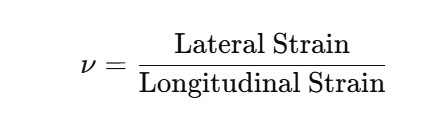
Derivation of the Poisson Ratio includes when a material is stretched, its width decreases (called lateral strain) and its length increases which is called longitudinal strain.
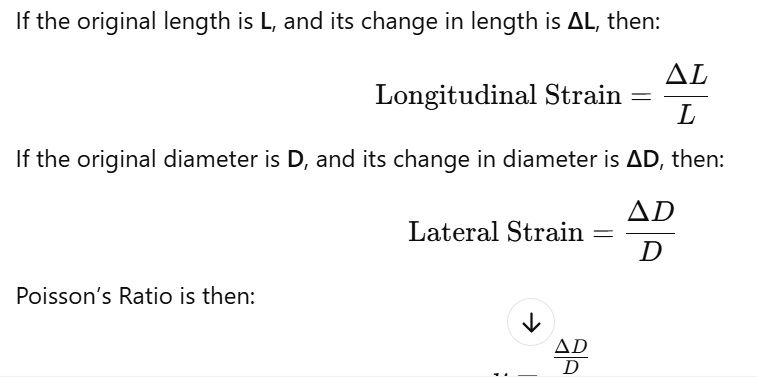
Poisson's Ratio (? ) is a dimensionless quantity and it is normally between a range of 0 to 0.5 for most materials. It is used in engineering applications including for bridge and building design. It is used in analyzing the structural deformations. Materials like rubber which has a high Poisson's ratio when s
New answer posted
a year agoContributor-Level 10
Maharashtra SSC 11th PYQ Resources
Official Website
- Maharashtra State Board Website: Access previous year's question papers for Class 11.
Educational Platforms
- shiksha.com: Question papers with solutions for Physics, Maths, Chemistry, and Biology.
- Target Publications: Maharashtra Board question papers for Class 11.
New answer posted
a year agoContributor-Level 10
The modulus of elasticity refers to the material's capacity to withstand or resist deformation when stress is applied. There are three types of the modulus of elasticity including:
Young's Modulus (E): It is used to measure a solid's elasticity when longitudinal stress (tensile or compressive) is applied to it. Mathematically, it is represented by the following formula;
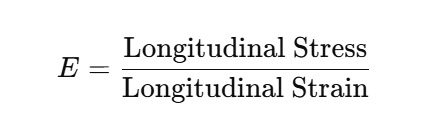
SI Unit is N/m² (Pascal, Pa).
Bulk Modulus (K): It is used to measure the ability of the material to resist volume change when uniform pressure is applied to it. Mathematically, it is:
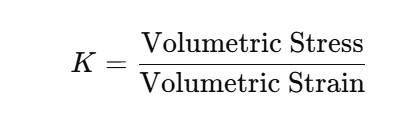
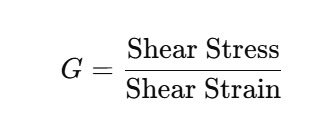
Shear Modulus (G) or Modulus of Rigidity: It is used when a shear
New answer posted
a year agoContributor-Level 10
Hooke's Law states that within the elastic limit, the stress applied to a material is directly proportional to the strain produced. Mathematically,

E stands for the modulus of elasticity also called Young's modulus in case of linear deformation.
The Hooke's Law defines the elastic behaviour of materials, determines its elastic limit and helps in material selection for construction and manufacturing. It is used to design springs and elastic components in machines. Hook's law is applicable for the solids within their elastic limit.
Hooke's law for a spring and other elastic material is shown as:
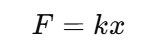
F is the force applied on the mat
Taking an Exam? Selecting a College?
Get authentic answers from experts, students and alumni that you won't find anywhere else
Sign Up on ShikshaOn Shiksha, get access to
- 67k Colleges
- 1.2k Exams
- 716k Reviews
- 1850k Answers