

Class 11th
Get insights from 8k questions on Class 11th, answered by students, alumni, and experts. You may also ask and answer any question you like about Class 11th
Follow Ask QuestionQuestions
Discussions
Active Users
Followers
New answer posted
a year agoContributor-Level 10
45. Given, n (X) = 40
n (Y Y) = 60.
n (X Y) = 10.
n (Y) =?
Using, n (X Y) = n (X) + n (Y) n (X Y)
60 = 40 + n (y) 10.
n (Y) = 60 - 40 + 10
n (Y) = 30.
New answer posted
a year agoContributor-Level 10
44. Given, n (S) = 21
n (T) = 32
n (S T) = 11.
Using, n (S T) = n (S) + n (T) n (S T)
= 21 + 32 11
= 42.
New answer posted
a year agoContributor-Level 10
43. Let H and E be set if people who speak Hindi and English respectively. there,
n (H) = 250, people speak Hindi n (E) = 200, people speak English
n (H E) = 400, people speaks either Hindi or English
So, n (H E) = n (H) + n (E) n (H E)
= 250 + 200 400
= 50
So, 50 people can speak both Hindi and English.
New answer posted
a year agoContributor-Level 10
42. Given, n (X Y) = 18.
n (X) = 8.n (Y) = 15.n (X Y) =?
Using n (X Y) = n (X) + n (Y) n (X Y)
= 8 + 15 18.
= 5.
New answer posted
a year agoContributor-Level 10
41. Given, n (X)= 17
n (Y) = 23
n (X Y)= 38.
So, n (X Y) = n (X) + n (Y) n (X Y)
n (X Y) = n (X) + n (Y) n (X Y)
= 17 + 23 38.
= 2
New answer posted
a year agoContributor-Level 10
40. (i) A A = U
(ii) ∩ A = U ∩ A = A.
(iii) A ∩ A = .
(iv) U ∩ A = ∩ A = .
New answer posted
a year agoContributor-Level 10
39. A = U – A
= Set of all triangle in a plane - Set of all triangle with at least the angle different from 60°.
= Set of all triangle with each angle 60°.
A? = set of all equilateral triangle.
New answer posted
a year agoContributor-Level 10
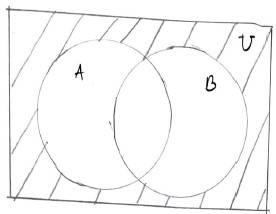
38. (i) (A B) = U – (A B)
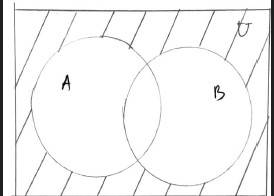
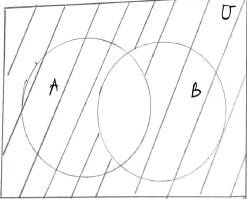
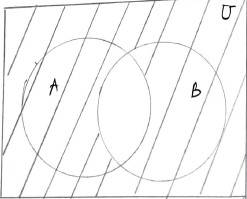
(ii) A ∩ B = (AU B) = U – (AU B)
New answer posted
a year agoContributor-Level 10
37. (i) L.H.S = (A B) = U – (A B)
= {1,2,3,4,5,6,7,8,9} – [ {2,4,6,8) {2,3,5,7}]
= {1,2,3,4,5,6,7,8,9} – {2,3,4,5,6,7,8}
= {1,9}
R.H.S. = A ∩ B = [U – A] ∩ [U B]
= ∩
= {1,3,5,7,9} ∩ {1,4,6,8,9}
= {1,9}
? L.H.S. = R.H.S.
(A B) = A ∩ B.
(ii) L.H.S. = (A ∩ B) = U – (A ∩ B)
= {1,2,3,4,5,6,7,8,9} – [ {2,4,6,8} ∩ {2,3,5,7}]
= {1,2,3,4,5,6,7,8,9} – {2}
= {1,3,4,5,6,7,8,9}
R.H.S. = A B
= [U – A] [U – B]
= [ {1,2,3,4,5,6,7,8,9} – {2,4,6,8}] [ {1,2,3,4,5,6,7,8,9} – {2,3,5,7}]
= {1,3,5,7,9} {1,4,6,8,9}
= {1,3,4,5,6,7,8,9}
? L.H.S. = R.H.S.
(A ∩ B) = A B.
New answer posted
a year agoContributor-Level 10
3. (i) {x : x is an odd natural number}
(ii) {x : x is an even natural number}
(iii) {x : x is not a multiple of 3}
(iv) {x : x is a positive composite number and x = 1}
(v) {x : x is a natural number not divisible by 3 and 5}.
(vi) {x : x is not a perfect square}
(vii) {x : x is not a perfect cube}
(viii) We have, x + 5 = 8.
x = 8 – 5 = 3
x = 3
? {x : x ≠ 3, x? N}
(ix )We have,
2x + 5 = 9
2x = 9 – 5
2x = 4
x = 2
? {x : x? N and x ≠ 2}
(x) {x : x < 7} = {1,2,3,4,5,6}
(xi) We have,
2x + 1 >10
2x >10 – 1
x >
? = {1,2,3,4}
Taking an Exam? Selecting a College?
Get authentic answers from experts, students and alumni that you won't find anywhere else
Sign Up on ShikshaOn Shiksha, get access to
- 67k Colleges
- 1.2k Exams
- 718k Reviews
- 1850k Answers