

Class 11th
Get insights from 8k questions on Class 11th, answered by students, alumni, and experts. You may also ask and answer any question you like about Class 11th
Follow Ask QuestionQuestions
Discussions
Active Users
Followers
New answer posted
a year agoContributor-Level 10
64. Let A, B and C be the set of people who like product A, B and C respectively.
Then,
Number of people who like product A, n (A) = 21
Number of people who like product B, n (B) = 26
Number of people who like product C, n (C) = 29.
Number of people likes both product A and B, n (AB) = 14
Number of people likes both product A and C, n (AC) = 12
Number of people likes both product B and C, n (BC) = 14.
No. of people who likes all product, n (ABC) = 8
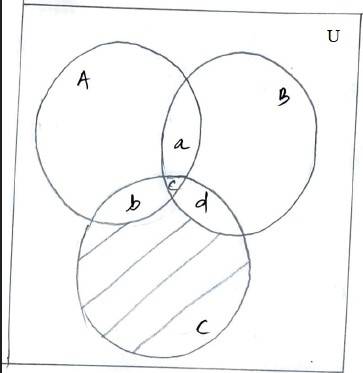
a→n (AB)
b→n (AC)
d→n (BC)
c→n (ABC)
From the above venn diagram we can see that,
Number of people who likes product C only
= n (C) - b - d + c
= n (C) - n (AC) - n (BC) + n (ABC)
= 29 - 12 - 14 +
New answer posted
a year agoContributor-Level 10
63. Let H, T and I be of people who reads newspaper H, T and I respectively.
Then,
number of people who reads newspaper H, n (H) = 25.
number of people who T, n (T) = 26.
number of people who I, n (I) = 26
number of people who both H and T, n (HI) = 9
number of people who both H and T, n (H T) = 11
number of people who both T and I, n (TI) = 8
number of people who reads all newspaper, n (HTI) = 3.
Total no. of people surveyed = 60
The given sets can be represented by venn diagram
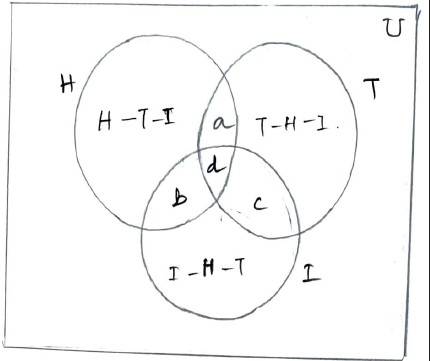
(i) The number of people who reads at least one of the newspaper.
in (H∪TI) = n (H) + n (T) + n (I) n (HT) n (HI) n (TI) + n (HTI)
= 25 + 26 + 26 11 9 8 + 3
= 80 2
New answer posted
a year agoContributor-Level 10
62. Let H and E be set of students who known Hindi and English respectively.
Then, number of students who know Hindi = n (H) = 100
Number of students who know English = n (E) = 50
Number of students who know both English & Hindi = 25 = n (HE)
As each of students knows either Hindi or English,
Total number of students in the group,
n (HE) = n (H) + n (E) - n (HE)
= 100 + 25
= 125,
New answer posted
a year agoContributor-Level 10
61. Let T and C be sets of students taking tea and coffee.
Then, n (T) = 150, number of students taking tea
n (C) = 225, number of students taking coffee
n (TC) = 100, number of students taking both tea and coffee.
So, Number of students taking either tea or coffee is.
n (TC) = n (T) + n (C) n (TC)
= 150 + 225 100
= 275
Number of students taking neither tea coffee
= Total number of students No of students taking either tea or coffee
= 600 275
= 325.
New answer posted
a year agoContributor-Level 10
60. Let A = {x, y}
B = {y, z}
C = {x, z}
So, AB = {x, y} {y, z} = {y}≠
BC = {y, z} {x, z} = {z}≠
AC = {x, y} {x, z} = {x}≠
But ABC = (AB) C
= {y} (x, z}
=
New answer posted
a year agoContributor-Level 10
59. Let A, B and x be sets such that,
Ax = Bx = and Ax = Bx.
We know that,
A = A (Ax)
= A (Bx) [? Ax = Bx]
= (AB) (Ax) [by distributive law]
= (AB) ∪? [? A∩x =? ]
=> A = A∩ B [? A ∪? = A]
And B = (Bx)
= B (Ax) [? Bx = Ax]
= (BA) (Bx) [By distributive law]
= (BA) ∪ [? Bx =? ]
B = BA [? A = A]
So, A = B = AB.
New answer posted
a year agoContributor-Level 10
58. Let A = {a}, B = {a, b}, C = {a, c}
So, AB = {a} {a, b} = {a}
AC = {a} {a, c} = {a}
i.e., AB = AC = {a}
But B ≠C. as bB but vice-versa
New answer posted
a year agoContributor-Level 10
57. (i) We know that,
A A
(A B) A
[A (A B)] (A)
[A (A B)] A
and also
A [A (A B)]
So, A (A B) = A.
(ii) A (A B) = (A A) (A B) [By distributive law]
= A (A B)
= A as (A B) A
New answer posted
a year agoContributor-Level 10
56. Here,
(AB) (A - B) = (AB) (A B') as (A - B) = A B'
= A (B B') [ by converse of distributive law]
= A U [ B B' = U, sample space set or universal set]
= A
And (A (B - A) = A (B A') [as B - A = B A']
= (AB) (AA')
= (AB) U [ AA' = U, universal set]
= A B.
Taking an Exam? Selecting a College?
Get authentic answers from experts, students and alumni that you won't find anywhere else
Sign Up on ShikshaOn Shiksha, get access to
- 67k Colleges
- 1.2k Exams
- 718k Reviews
- 1850k Answers