Class 11th

Get insights from 8k questions on Class 11th, answered by students, alumni, and experts. You may also ask and answer any question you like about Class 11th

Follow Ask Question
8k

Questions

0

Discussions

4

Active Users

0

Followers

New answer posted

6 months ago

0 Follower 4 Views

R
Raj Pandey

Contributor-Level 9

Pressure * time = F t A = [ M L T 2 ] [ T ] [ L 2 ] = [ M L 1 T 1 ]  

 Coefficient of viscosity, η = [ M L 1 T 1 ]  

  F v i s c o u s = η A Δ v Δ y  

New answer posted

6 months ago

0 Follower 3 Views

A
alok kumar singh

Contributor-Level 10

According to Newton's law of motion, we can write

ma = mg – N = mg -  m g 4 = 3 m g 4                              
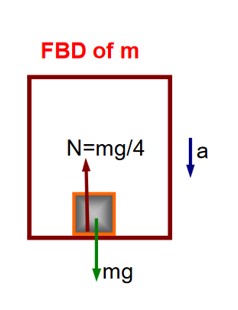
a = 3 g 4


New answer posted

6 months ago

0 Follower 10 Views

A
alok kumar singh

Contributor-Level 10

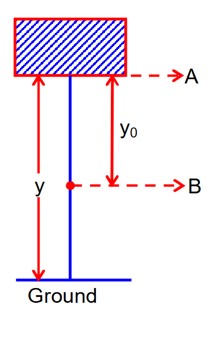
According to conservation of energy, we can write

Gain in kinetic energy = Loss in potential energy

 Kf – Kin = Uin - Uf

K - = mgy – mg (y – y0) = mgy0

New answer posted

6 months ago

0 Follower 7 Views

A
alok kumar singh

Contributor-Level 10

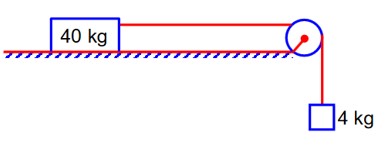
According to Newton's laws of motion, we can write

4a = 4g – T . (1), and

40a = T - fk = T μ - (40g) ……………… (2)

Adding equations (1) and (2), we can write

44a = 40 – 0.02 * (400) = 32
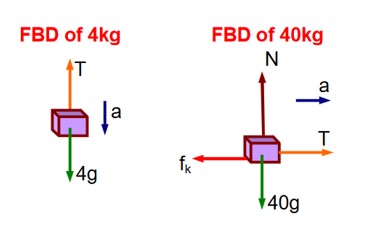
a = 3 2 4 4 = 8 1 1 m / s 2


New answer posted

6 months ago

0 Follower 2 Views

A
alok kumar singh

Contributor-Level 10

 According to question, we can write

Total moles of gas = n = nOxygen + nOxygen = 1 6 2 + 1 2 8 3 2 = 1 2 m o l e s  

Volume of gas = 12 * 22.4 litre = 268.8 litre = 2.688 * 105 cm3 ? 2 7 * 1 0 4 c m 3  

New answer posted

6 months ago

0 Follower 27 Views

R
Raj Pandey

Contributor-Level 9

Slope of AH = a + 2 1 slope of BC = 1 p p = a + 2 C ( 1 8 p 3 0 p + 1 , 1 5 p 3 3 p + 1 )  

slope of HC =  1 6 p p 2 3 1 1 6 p 3 2  

slope of BC * slope of HC = -1 Þ p = 3 or 5

hence p = 3 is only possible value.

New answer posted

6 months ago

0 Follower 4 Views

A
alok kumar singh

Contributor-Level 10

According to question, we can write

ω = π = g l l = g π 2 = 9 . 8 ( 3 . 1 4 ) 2 = 0 . 9 9 3 9 5 = 9 9 . 4 c m

New answer posted

6 months ago

0 Follower 20 Views

R
Raj Pandey

Contributor-Level 9

Coefficient of x in ( 1 + x ) p ( 1 x ) q = p C 0 q C 1 + p C 1 q C 0 = 3 p q = 3  

              Coefficient of x2 in ( 1 + x ) p ( 1 x ) q = p C 0 q C 2 p C 1 q C 1 p C 2 q C 0 = 5  

q ( q 1 ) 2 p q + p ( p 1 ) 2 = 5 q ( q 1 ) 2 ( q 3 ) q + ( q 3 ) ( q 4 ) 2 = 5 q = 1 1 , p = 8  

              Coefficient of x3 in ( 1 + x ) 8 ( 1 x ) 1 1 = 1 1 C 3 + 8 C 1 1 1 C 2 8 C 2 1 1 C 1 + 8 C 3 = 2 3  

New answer posted

6 months ago

0 Follower 22 Views

R
Raj Pandey

Contributor-Level 9

x 8 x 7 x 6 + x 5 + 3 x 4 4 x 3 2 x 2 + 4 x 1 = 0  

x 7 ( x 1 ) x 5 ( x 1 ) + 3 x 3 ( x 1 ) x ( x 2 1 ) + 2 x ( 1 x ) + ( x 1 ) = 0  

( x 1 ) ( x 2 1 ) ( x 5 + 3 x 1 ) = 0 x = ± 1  are roots of above equation and x5 + 3x – 1 is a monotonic term hence vanishes at exactly one value of x other then 1 or -1.

 3 real roots.

New answer posted

6 months ago

0 Follower 3 Views

A
alok kumar singh

Contributor-Level 10

Kindly go through the solution 

Get authentic answers from experts, students and alumni that you won't find anywhere else

Sign Up on Shiksha

On Shiksha, get access to

  • 66k Colleges
  • 1.2k Exams
  • 687k Reviews
  • 1800k Answers

Share Your College Life Experience

×

This website uses Cookies and related technologies for the site to function correctly and securely, improve & personalise your browsing experience, analyse traffic, and support our marketing efforts and serve the Core Purpose. By continuing to browse the site, you agree to Privacy Policy and Cookie Policy.