

Class 12th
Get insights from 12k questions on Class 12th, answered by students, alumni, and experts. You may also ask and answer any question you like about Class 12th
Follow Ask QuestionQuestions
Discussions
Active Users
Followers
New answer posted
a year agoContributor-Level 10
1.32 (a) Let the equilibrium of the test charge be stable. If a test charge is in equilibrium and displaced from its position in any direction, then it experiences a restoring force towards a null point, where the electric field is zero. All the field lines near the null point are directed inwards towards the null point. There is a net inward flux of electric field through a closed surface around the null point. According to Gauss's law, the flux of electric field through a surface, which is not enclosing any charge, is zero. Hence, the equilibrium of the test charge can be stable.
(b) Two charges of same magnitude and same sign a
New answer posted
a year agoContributor-Level 10
8.12 Power rating of the bulb, P = 100 W
Power of visible radiation, = 5% of 100 W = 5 W
Distance from the bulb, d = 1 m
Intensity of radiation at that point is given as:
I = = = 0.398 W/
Distance from the bulb, d = 10 m
Intensity of radiation at that point is given as:
I = = = 3.978 W/
New answer posted
a year agoContributor-Level 10
1.31 A proton has 3 quarks. Let there be n 'up quarks', then number of 'down quarks' = 3-n
Charge due to n 'up quarks' = e) n
Charge due to (3-n) 'down quarks' =
Total charge on a proton = +e = e) n + ( -
e = +-e
2e =
n = 2
Number of 'up quark' = 2 and number of 'down quark' = 1. Therefore a proton can be represented as 'uud'.
A neutron has 3 quarks. Let there be n 'up quark' in a neutron and (3-n) 'down quark'
Charge due to n 'up quark' = + e)n
Charge due to (3-n) 'down quark' =
- (
Since total charge of a neutron is zero, we get
+ e)n -( = 0
e)n = (
en = e or n = 1
Hence number of 'up quark' in neu
New answer posted
a year agoContributor-Level 10
8.10 Frequency of the electromagnetic wave, = 2.0 Hz
Electric field amplitude, = 48 V/m
Speed of light, c = 3 m/s
Wavelength of a wave is given by,
= = 0.015 m
Magnetic field strength is given by
= = 1.6 T
Energy density of the electric field is given as,
= and energy density of magnetic field is given by,
=
= Permittivity of free space
Permeability of free space
We have the relation connecting E and B as:
E = cB, where c =
Hence E =
=
or =
New answer posted
a year agoContributor-Level 10
8.9 Energy of a photon is given as:
E = h = , where
h = Planck's constant = 6.6 Js
c = Speed of light = 3 m/s
= wavelength of radiation
Hence, E = J = J = eV = eV
The following table lists the photon energies for different parts of an electromagnetic spectrum for different

New answer posted
a year agoContributor-Level 10
1.30
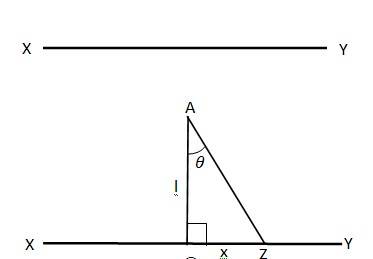
Take a long thin wire XY of uniform linear charge density . Consider a point A at a perpendicular distance l from the midpoint O of the wire. Let E be the electric field at point A due to the wire XY. Consider a small length element dx on the wire section with OZ = x. Let q be the charge on this piece.
Q =
Electric field due to the piece,
dE = = = since AZ =
The electric field is resolved into two rectangular components. dE is the perpendicular component and dE When the whole wire is considered, the component dE is cancelled. Only the perpendicular component dE affects point A.
Hence
New answer posted
a year agoContributor-Level 10
8.8 Electric field amplitude, = 120 N/C
Frequency of source, = 50 MHz = 50 Hz
Speed of light, c = 3 m/s
Magnitude of magnetic field strength is given as
= = 4 T = 400 T = 400 nT
= 2 = 2 50
= 3.14 rad/s
Propagation constant is given as
k = = = 1.05 rad/m
Wavelength of wave is given as
= = 6.0 m
Suppose the wave is propagating in the positive x direction. Then, the electric field vector will be in the positive y direction and the magnetic field vector will be in the positi
New answer posted
a year agoContributor-Level 10
8.7 The amplitude of magnetic field of the electromagnetic wave in a vacuum,
= 510 nT = 510 T
Speed of the light in vacuum, c = 3 m/s
Amplitude of electric field of the electromagnetic wave is given by the relation,
E = c = 3 510 N/C = 153 N/C
Hence, the electric field part of the wave is 153 N/C.
New answer posted
a year agoContributor-Level 10
8.6 The frequency of an electromagnetic wave produced by the oscillator is the same as that of a charged particle oscillating about its mean position, i.e. Hz.
New answer posted
a year agoContributor-Level 10
1.29 Let us consider a conductor with a cavity or a hole. Electric field inside the cavity is zero. Let E be the electric field outside the conductor, q is the electric charge, is the charge density and is the permittivity of free space.
Charge q =
According to Gauss's law, flux = E.ds = =
Hence, E =
Therefore, the electric field just outside the conductor is . This field is a superposition of field due to the cavity E' and the field due to the rest of the charged conductor E'. These fields are equal and opposite inside the conductor and equal in magnitude and direction outside the conductor.
So E' + E' = E
E'&n
Taking an Exam? Selecting a College?
Get authentic answers from experts, students and alumni that you won't find anywhere else
Sign Up on ShikshaOn Shiksha, get access to
- 67k Colleges
- 1.2k Exams
- 718k Reviews
- 1850k Answers