

Class 12th
Get insights from 12k questions on Class 12th, answered by students, alumni, and experts. You may also ask and answer any question you like about Class 12th
Follow Ask QuestionQuestions
Discussions
Active Users
Followers
New answer posted
a year ago
Contributor-Level 10
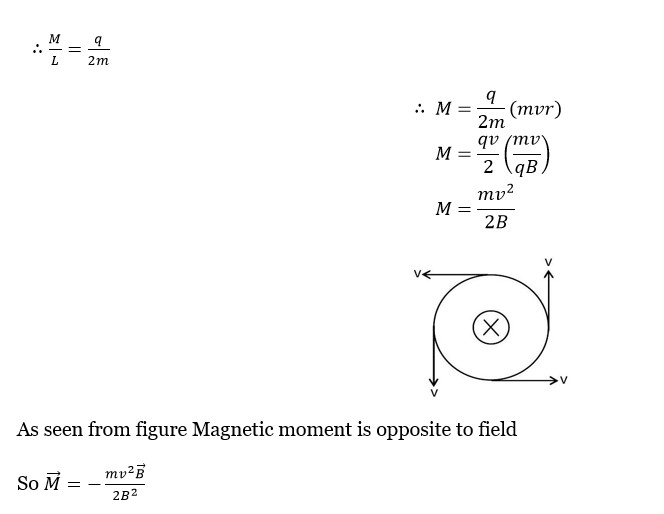
Sol. eVslop = hc/λ - φ
Slope of curve
tan θ = hc/e = constant
as intensity of incident radiation is increased, there will be no effect on graph
New answer posted
a year agoContributor-Level 10
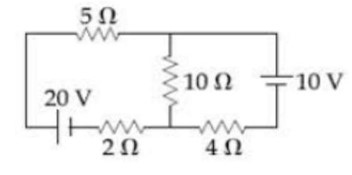
Q? = CV?
U? = ½CV? ²
q? = (q? C)/ (C + C/2) = 2q? /3
q? = (q? (C/2)/ (C + C/2) = q? /3; Uf = q? ²/2C + q? ²/2 (C/2)
= (4q? ²/9x2C) + (q? ²/9C)
= (6q? ²/18C) = q? ²/3C = CV? ²/3
Energy loss in the process = U? – Uf
= ½CV? ² - CV? ²/3
= CV? ²/6
New answer posted
a year agoContributor-Level 10
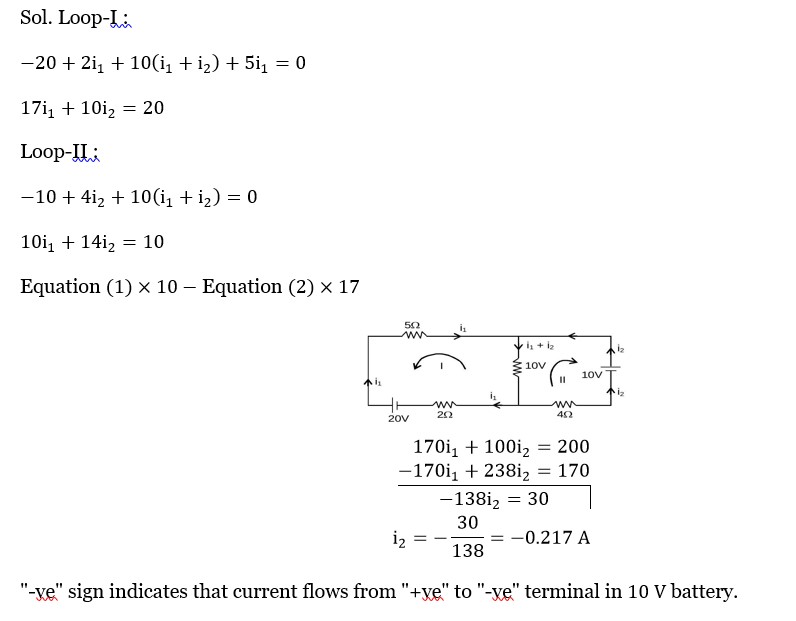
In Rutherford's model, electrostatic force provides the centripetal force:
∈
Kinetic Energy (K):
Potential Energy (U):
Total Energy (E):
Note that, E is the Epsilon symbol.
New answer posted
a year agoContributor-Level 10
Since, lim (x→0) f (x)/x exist ⇒ f (0) = 0
Now, f' (x) = lim (h→0) (f (x+h)-f (x)/h = lim (h→0) (f (h)+xh²+x²h)/h (take y = h)
= lim (h→0) f (h)/h + lim (h→0) (xh) + x²
⇒ f' (x) = 1 + 0 + x²
⇒ f' (3) = 10
New answer posted
a year agoContributor-Level 10
D = |1 -2 3; 2 1; 1 -7 a| = 0 ⇒ a = 8
also, D? = |9 -2 3; b 1; 24 -7 8| = 0 ⇒ b = 3
hence, a-b = 8-3=5
New answer posted
a year agoContributor-Level 10
x dy/dx - y = x² (xcosx + sinx), x > 0
dy/dx - y/x = x (xcosx+sinx) ⇒ dy/dx + Py = Q
So, I.F. = e^ (∫-1/x dx) = 1/|x| = 1/x (x > 0)
Thus, y/x = ∫ 1/x (x (xcosx+sinx)dx
⇒ y/x = xsinx + C
? y (π) = π ⇒ C = 1
So, y = x²sinx + x ⇒ (y)? /? = π²/4 + π/2
Also, dy/dx = x²cosx + 2xsinx + 1
⇒ d²y/dx² = -x²sinx + 4xcosx + 2sinx
⇒ [d²y/dx²] at π/2 = -π²/4 + 2
Taking an Exam? Selecting a College?
Get authentic answers from experts, students and alumni that you won't find anywhere else
Sign Up on ShikshaOn Shiksha, get access to
- 67k Colleges
- 1.2k Exams
- 717k Reviews
- 1850k Answers