

Class 12th
Get insights from 12k questions on Class 12th, answered by students, alumni, and experts. You may also ask and answer any question you like about Class 12th
Follow Ask QuestionQuestions
Discussions
Active Users
Followers
New answer posted
a year agoContributor-Level 10
(A) Concentration of Ag & Au done by NaCN. It is known as Mac Arthur Process (cyanide process)
(B) Blast furnace produces pig Fe.
(C) Blister Cu → Reverberatory furnace. In this furnace smelting & roasting of ore take place
CuFeS? + O? → Cu? O + FeO
(D) Froth floatation process is used for concentration of sulphide ores.
New answer posted
a year agoContributor-Level 10
Polyamide copolymers are biodegradable polymers.
Polymers Nylon-2 Nylon-6 are polyamides and monomers of Nylon-2 nylon-6 are:
H? N–CH? –COOH (Glycine) & H? N– (CH? )? –COOH (Aminocaproic acid)
New answer posted
a year ago
Contributor-Level 10
New answer posted
a year agoContributor-Level 10
Phase | Medium | Colloid Type |
| (1) Cheese | liquid | solid | Gel |
| (2) Pumice stone | gas | solid | Solid sol |
| (3) Hair cream | liquid | liquid | Emulsion |
| (4) Cloud | liquid | gas | Aerosol |
New answer posted
a year agoContributor-Level 10
Chelation increases stability of complex. Also more the chelation more the stability. Here, [Co (en)? (NH? )? ]Cl? , [Co (en)? ]Cl? and [Co (en) (NH? )? ]Cl? have chelation due to ethylenediamine. Therefore [Co (en)? ]Cl? has the highest chelation so the highest stability.
New answer posted
a year agoContributor-Level 10
Using, µ = √n (n+2) B.M, n = number of unpaired electrons.
? Ti? ³ = 4s? 3d¹, unpaired electron = 1
µ = 1.73 B.M
? V? ² = 4s? 3d³, unpaired electron = 3
µ = 3.87 B.M
? Sc? ³ = 4s? 3d? , unpaired electron = 0
µ = 0 B.M
New answer posted
a year ago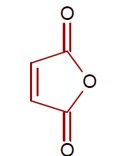
Contributor-Level 10
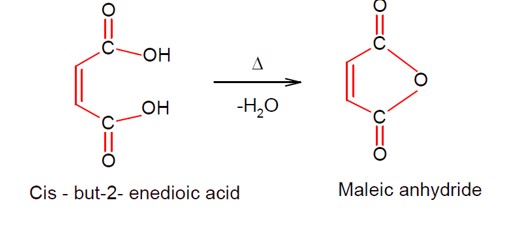
Heating of cis-but-2-enedioic acid gives maleic anhydride as shown.
[Chemical reaction showing conversion of cis-but-2-enedioic acid to maleic anhydride upon heating]
New answer posted
a year agoContributor-Level 10
A = A? (1/2)?
A/A? = 1/8 = (1/2)³ ⇒ n = 3
t = n T½
30 = 3 T½
T½ = 10 years
Taking an Exam? Selecting a College?
Get authentic answers from experts, students and alumni that you won't find anywhere else
Sign Up on ShikshaOn Shiksha, get access to
- 67k Colleges
- 1.2k Exams
- 717k Reviews
- 1850k Answers