

Class 12th
Get insights from 12k questions on Class 12th, answered by students, alumni, and experts. You may also ask and answer any question you like about Class 12th
Follow Ask QuestionQuestions
Discussions
Active Users
Followers
New question posted
a year agoNew answer posted
a year agoContributor-Level 10
Yes, PW Institute of Innovation, Lucknow accepts Class 12 marks for admission. The college offers BTech, BBA, and BVoc programmes at the UG levels. Candidates looking for course admission must complete the basic educational qualification, i.e., Class 12. The application process at the PW Institute of Innovation, Lucknow, is conducted online.
New answer posted
a year agoContributor-Level 10
Resonating structures of phenoxide are-

In structure I and V negative charge is on E.N. Oxygen, in other cases, it is on Less E.N Carbon hence they contribute less towards stability. And the negative charge is localized.
Resonating structures of carboxylic acid-
Both the structures have –ve charge on oxygen and electron are delocalised too hence, the carboxylic acid is more stable and acidic than phenol.


New answer posted
a year agoContributor-Level 10
1. Cyclohexanone forms cyanohydrin in good yield because the ketonic group has very less steric hindrance at both the ortho position but 2,2,6 tri methyl cyclohexanone have high steric hindrance which reduces the attack from CN nucleophile.


New answer posted
a year ago

Contributor-Level 10
1. When 1- phenyl ethane is oxidized with a strong oxidizing agent like KMnO4, it forms a benzoic acid ion.


4. When benzene is mixed with benzoyl chloride in presence of Anhyd.AlCl3 to give benzophenone.

5. When 4-oxocyclohexanecarbeldehyde is treated with tollens reagent it gets oxidized to carboxylate anion as it is aldehyde it reduces tollens reagent.

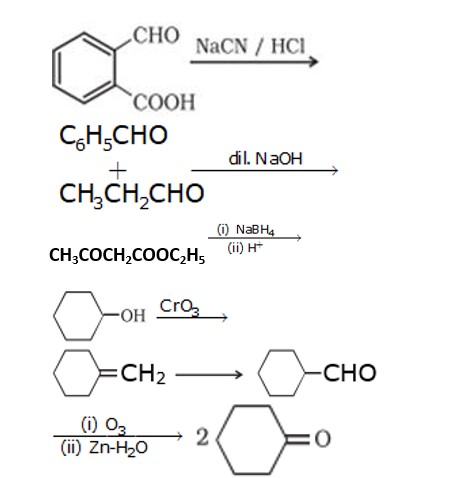
6. When 2-formyl benzoic acid is treated with NaCN it produces 2-[1-hydroxycyanom


New question posted
a year ago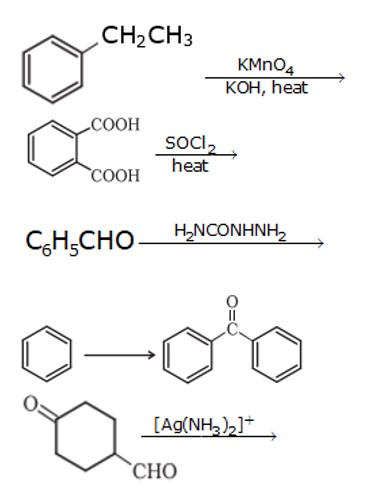
New question posted
a year agoNew answer posted
a year agoContributor-Level 10
1. Acetylation refers to the process of introducing an acetyl group (resulting in an acetoxy group) into a compound, namely the substitution of an acetyl group for an active hydrogen atom. A reaction involving the replacement of the hydrogen atom of a hydroxyl group with an acetyl group (CH3CO) yields a specific ester, the acetate. Acetic anhydride is commonly used as an acetylating agent reacting with free hydroxyl groups., this reaction is usually carried out in the presence of base like pyridine.

2. Aldeydes having no α-H undergo the disproportion reaction in the presence of Strong alkali, it is a chemical reacti


New answer posted
a year agoContributor-Level 10
1. When propanone reacts with NaBH4 it will form propan-2-ol.This alcohol is dehydrated to form propene.
2. When benzoic acid is treated with SOCl2 it chlorinates the acid. After controlled hydrogenation it forms benzaldehyde
3. When ethanol is treated with Cu at 573 k, it will oxidize to ethanal. When ethanal is treated with Dil.NaOH it will form 3-Hydroxy butanal
4. After frieadal craft acylation of benzene it will convert into acyl benzene. And further treating with nitrating mixture it forms m-nitroaceto phenone .

5. When benzaldehyde is oxidized with dichromate and treated with calcium carbonate it forms calcium salt. And after dry di


Taking an Exam? Selecting a College?
Get authentic answers from experts, students and alumni that you won't find anywhere else
Sign Up on ShikshaOn Shiksha, get access to
- 67k Colleges
- 1.2k Exams
- 718k Reviews
- 1850k Answers